 Pryse
PrysePricing Intelligence Software: Complete Buyer's Guide
Compare pricing intelligence platforms for real-time competitor monitoring and market insights. Learn what pricing intelligence software does and when B2B companies need it.
Pricing intelligence software automatically collects and analyzes competitor pricing data across marketplaces, retailer sites, and channels, providing real-time actionable insights to make data-driven pricing decisions while protecting margins.
Research from Shopify shows that 81% of consumers conduct online research before purchasing, often comparing prices across multiple platforms. Retail giants change prices upwards of 50,000 times per month, with Amazon changing prices every 10 minutes at peak times. This price velocity creates pressure for companies to monitor and respond to competitive moves systematically.
For mid-market distribution and manufacturing companies, pricing intelligence delivers value in high-velocity commodity markets where competitive pricing changes daily. Companies selling differentiated products through consultative sales see less benefit from real-time competitor monitoring.
This post explains what pricing intelligence software does, how it differs from pricing optimization, when B2B companies actually need it, and compares leading platforms by features and cost.
What Pricing Intelligence Software Actually Does
Pricing intelligence platforms automate competitor price monitoring that companies previously did manually by visiting competitor websites, downloading price lists, or conducting market surveys.
Core capabilities:
- Automated data collection: Web scraping technology visits competitor websites daily (or multiple times daily) to capture current pricing, promotions, and stock availability
- Product matching: Algorithms match your products to competitor equivalents using text analysis, image recognition, and machine learning
- Price tracking and alerts: Monitors price changes over time and sends alerts when competitors move prices above or below thresholds
- Market positioning analysis: Shows where your prices sit relative to competitors (lowest, average, premium) by product and category
- Reporting and dashboards: Visualizes competitive pricing trends, price gaps, and market share by price band
What pricing intelligence doesn't do:
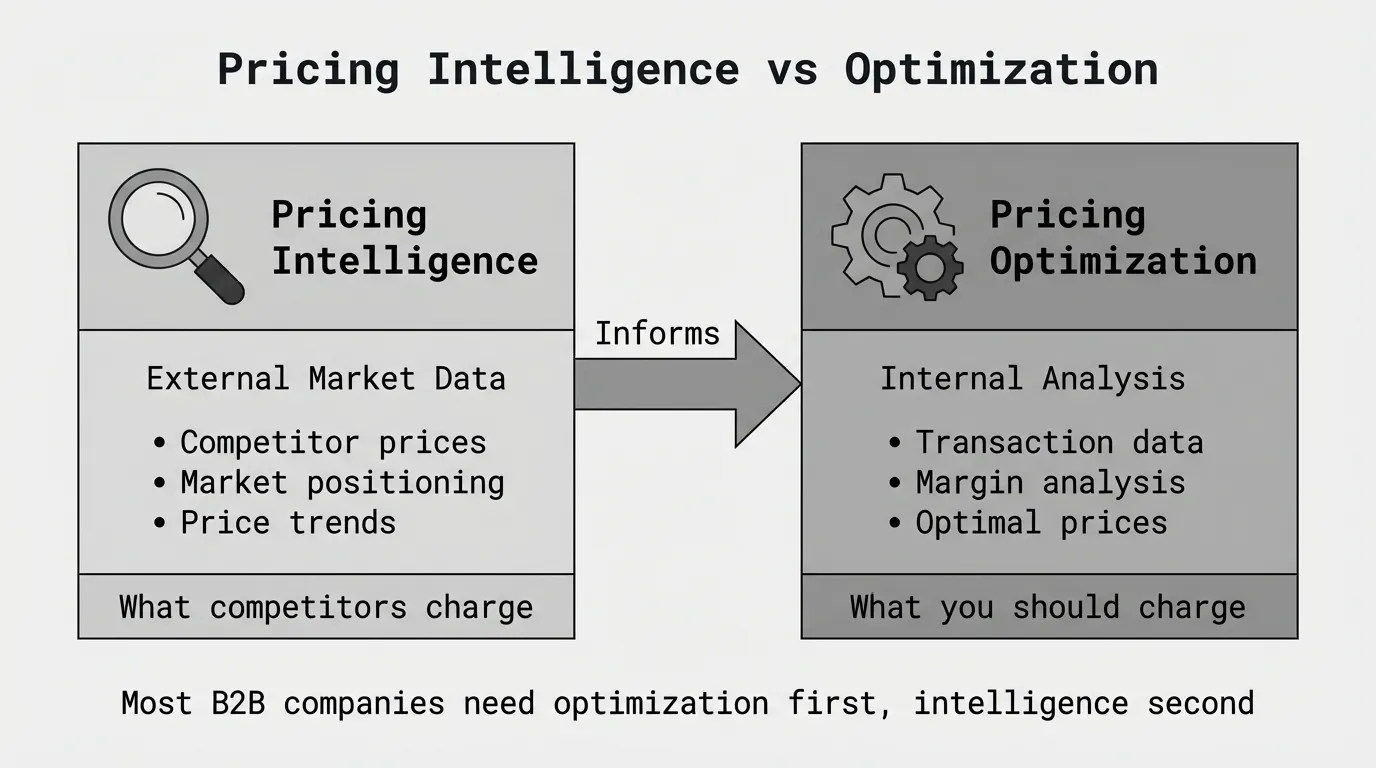
- Set optimal prices for you (that's pricing optimization)
- Access private or negotiated pricing visible only to logged-in customers
- Capture off-invoice costs like rebates, freight, or payment terms
- Tell you whether you should match competitor prices or hold firm
The value of pricing intelligence depends entirely on whether you can act on the data. If market conditions, competitive positioning, or internal constraints prevent you from adjusting prices based on competitor moves, the intelligence has limited value.
Pricing Intelligence vs. Pricing Optimization Software
The terms sound similar but describe different capabilities.
| Aspect | Pricing Intelligence | Pricing Optimization |
|---|---|---|
| Primary function | Collect and analyze competitor pricing | Calculate optimal price points |
| Data sources | External (competitor websites, marketplaces) | Internal (transaction history, costs, margins) |
| Key output | Competitive position reports, price gap analysis | Recommended prices by product and customer |
| Core capability | Market monitoring and benchmarking | Price calculation and recommendation |
| Decision support | "Here's what competitors charge" | "Here's what you should charge" |
| Implementation | Data collection and reporting | Price changes and execution |
According to Pricefx's analysis, pricing intelligence focuses on market monitoring and analysis, while pricing optimization emphasizes decision-making and execution. With price optimization software, price setting, rebate management, quoting contracts, and sales compensation are all part of a built-in package. Pricing intelligence provides the external market context that optimization uses alongside internal data.
In practice, most companies need both:
- Pricing intelligence tells you what the market is doing (competitor A dropped prices 5%, competitor B is out of stock, market average is $47.50)
- Pricing optimization tells you how to respond given your costs, margins, inventory, and strategic objectives (we should price at $46.00 to capture volume while maintaining 22% margin)
The platforms are starting to merge. Enterprise pricing optimization platforms like PROS, Vendavo, and Pricefx now include competitive pricing intelligence modules. Standalone intelligence platforms are adding price recommendation features.
When B2B Companies Actually Need Pricing Intelligence
Not every company benefits from automated competitor monitoring. Here's when pricing intelligence delivers clear ROI.
High-Velocity Commodity Markets (Clear Yes)
Metal distributors, chemical distributors, electronics components, commodity building materials
When supplier prices and competitive prices change daily or weekly, manual monitoring doesn't keep pace. Real-time intelligence prevents margin erosion from price lags.
A metals distributor might track 5,000 SKUs where supplier costs change daily based on commodity markets. Competitors reprice 2-3 times per week. Without automated tracking, the distributor either lags the market (losing volume to lower-priced competitors) or guesses at pricing (risking margin destruction).
E-Commerce and Marketplace Sellers (Clear Yes)
Companies selling through Amazon, eBay, or other online marketplaces where pricing is transparent and customers compare options in real time need automated intelligence.
A manufacturer selling through Amazon Business faces 10-15 competitors on the same listing. Price position determines Buy Box eligibility. Manual checking of competitor prices multiple times daily isn't scalable beyond 100 SKUs.
Multi-Competitor Commodity Products (Maybe)
HVAC distributors, electrical distributors, fasteners, MRO supplies
For products with 3-5 known competitors and quarterly price changes, basic intelligence helps but doesn't require enterprise software.
A regional HVAC distributor competing against 3 national distributors on commodity units can manually check competitor websites quarterly or subscribe to shared pricing services specific to the industry. Full pricing intelligence software is overkill.
Differentiated B2B Products (Probably No)
Specialty manufacturing, custom fabrication, engineered solutions, niche distribution
When customers choose based on technical capability, service, or relationships rather than price, competitor price tracking delivers minimal value. Your pricing should reflect value delivered, not competitor moves.
A custom machine shop quoting engineered solutions has different pricing for every job based on complexity, materials, and capacity. Tracking competitor pricing is irrelevant—each project is unique.
Annual Price List Updates (Probably No)
If you update price lists once or twice per year based on cost changes and competitive positioning, real-time intelligence is unnecessary. Manual competitive analysis during annual reviews is sufficient.
Pricing Intelligence Software Categories
The market splits into three tiers based on target customer size, data volume, and implementation complexity.
Enterprise Platforms ($50K-$150K+ annually)
Best for: Large retailers, e-commerce companies, manufacturers selling 10,000+ SKUs online
Leading vendors: Wiser Solutions, Competera, DataWeave, Intelligence Node
What you get:
- Monitor millions of products across hundreds of competitor websites
- Real-time data collection (hourly or continuous updates)
- Advanced product matching using ML and image recognition
- API integration with pricing engines and ERPs for automated repricing
- Geographic and currency support for global operations
- Dedicated implementation and account management
Typical cost: $50K-$150K annually depending on SKU count, competitor sites, and data collection frequency.
Implementation: 1-3 months for data setup, product matching configuration, and integration.
According to Bright Data's 2026 comparison, leading platforms like Bright Insights combine 150M+ IP proxy networks with AI-driven analytics, delivering 99.9% capture rates across 195 countries. Fortune 500 retailers use them for real-time MAP compliance and cross-retailer price monitoring.
Mid-Market Tools ($10K-$50K annually)
Best for: Mid-market retailers, distributors, manufacturers with 1,000-10,000 SKUs
Examples: Prisync, Skuuudle, Price2Spy, Minderest
What you get:
- Track hundreds to thousands of products across 10-50 competitor sites
- Daily data collection (some offer hourly for premium tiers)
- Rule-based product matching with manual verification
- Email alerts and dashboards for competitive price changes
- CSV export for integration with existing systems
- Email support with limited implementation assistance
Typical cost: $10K-$50K annually ($500-$2,000 monthly subscriptions).
Implementation: Self-service setup with 2-4 weeks for product matching and alert configuration.
Skuuudle has secured the trust of hundreds of retailers, brands, and distributors, helping them deliver revenue and margin growth with competitive pricing intelligence. The platform can gather data on millions of products per day.
Minderest has over 10 years of experience in price monitoring and can monitor websites in any country, language, or currency.
Basic Competitor Tracking (Under $10K annually)
Best for: Small retailers, niche distributors, companies tracking 50-500 SKUs
Examples: Manual services, basic scraping tools, industry-specific pricing services
What you get:
- Track dozens to hundreds of products across key competitors
- Weekly or daily updates depending on service level
- Manual product matching and verification
- Simple reports via email or spreadsheet
- Limited or no integration with internal systems
Typical cost: Under $10K annually ($200-$800 monthly).
These solutions work for companies that need directional competitive intelligence but can't justify enterprise software costs.
Key Features Comparison
Not all pricing intelligence platforms include these capabilities. Here's what to expect at each tier:
| Feature | Enterprise | Mid-Market | Basic |
|---|---|---|---|
| Data collection frequency | Continuous/hourly | Daily | Weekly |
| Competitor sites monitored | 100+ | 10-50 | 3-10 |
| Product matching accuracy | 95-99% | 85-95% | 70-85% |
| AI/ML product matching | ✓ | Limited | × |
| Image recognition | ✓ | Limited | × |
| API integration | ✓ | Limited | × |
| Automated repricing | ✓ | × | × |
| MAP compliance tracking | ✓ | ✓ | × |
| Promotion tracking | ✓ | ✓ | Limited |
| Historical price data | 2+ years | 6-12 months | 3-6 months |
| Geographic coverage | Global | Regional | Local |
| Custom scraping rules | ✓ | Limited | × |
How to Choose Pricing Intelligence Software
Start by confirming you actually need automated intelligence before evaluating vendors.
Decision Framework
Choose enterprise platforms if:
- You sell 10,000+ SKUs with transparent online competition
- Prices change daily or multiple times daily
- You operate in commodity markets with thin margins
- You have e-commerce revenue exceeding $50M annually
- Automated repricing integration is required
- You compete in multiple geographic markets
Choose mid-market platforms if:
- You track 1,000-10,000 SKUs across 10-50 competitor sites
- Price changes happen weekly or daily
- You need competitive intelligence for pricing reviews but not automated repricing
- Budget allows $10K-$50K annually
- Manual review and decision-making is sufficient
Choose basic tracking if:
- You monitor 50-500 key SKUs
- Weekly competitive price updates are sufficient
- Budget is under $10K annually
- You can make pricing decisions from simple reports
Skip pricing intelligence entirely if:
- You sell differentiated products where price isn't the primary buying factor
- Customer-specific negotiated pricing makes competitor tracking irrelevant
- Price changes happen quarterly or annually based on cost, not competition
- You lack authority or process to change prices based on competitive intelligence
- Your market has 1-2 competitors you can track manually
According to research on competitive pricing tools, the ROI of competitive pricing tools typically ranges from 5-20% revenue increase within the first year through improved margins, faster response to market changes, and reduced manual work. But ROI depends entirely on whether you can act on the intelligence.
Leading Pricing Intelligence Platforms
Here's a detailed comparison of market-leading platforms based on 2026 capabilities.
Wiser Solutions (Enterprise)
Best for: Large retailers and brands with complex online distribution
Capabilities:
- Tracks prices across retailer sites, marketplaces, and direct-to-consumer channels
- Updates multiple times daily to catch fleeting changes
- Monitors pricing, promotions, stock levels, and content compliance
- Strong MAP (Minimum Advertised Price) enforcement capabilities
- Deep integration with e-commerce platforms and pricing engines
Pricing: Custom quotes starting at $50K+ annually depending on SKU count and competitor sites.
Typical customers: Fortune 500 retailers, consumer packaged goods brands, electronics manufacturers.
According to Wiser's product overview, the platform facilitates real-time actionable insights that enable data-driven pricing decisions while protecting margins.
Competera (Enterprise)
Best for: Online retailers with dynamic pricing needs
Capabilities:
- AI-powered pricing platform combining intelligence and optimization
- Real-time competitive pricing monitoring
- Demand forecasting and elasticity analysis
- Automated price recommendations based on competitive position and business rules
- Strong for commodity distributors with frequent price changes
Pricing: Custom quotes, typically $50K-$150K annually.
Typical customers: E-commerce retailers, online marketplaces, commodity distributors.
Competera's platform focuses on online price intelligence specifically for retailers looking to maintain competitive pricing while optimizing margins.
DataWeave (Enterprise)
Best for: Brands and retailers needing global price monitoring
Capabilities:
- AI-powered pricing intelligence with advanced product matching
- Monitors prices, promotions, assortment, and content across channels
- Strong image recognition for product matching
- Customizable dashboards and reporting
- Global coverage with multi-currency support
Pricing: Custom quotes starting at $50K+ annually.
Typical customers: Global brands, multi-channel retailers, manufacturers with online distribution.
DataWeave delivers AI-powered advanced pricing intelligence across global markets.
Prisync (Mid-Market)
Best for: Mid-market e-commerce retailers and small distributors
Capabilities:
- Competitor price tracking with daily updates
- Dynamic pricing rules based on competitive position
- Email alerts for price changes
- Historical price data and trend analysis
- API access for integration
Pricing: Plans from $99/month to $499/month based on tracked products and features. Annual contracts available at 20% discount.
Typical customers: E-commerce businesses tracking 500-5,000 products.
Prisync provides competitor price tracking and monitoring with dynamic pricing capabilities for mid-market retailers.
Price2Spy (Mid-Market)
Best for: Companies needing flexible international price monitoring
Capabilities:
- Monitors any website in any country, language, or currency
- Daily price checks with customizable frequency
- Product matching with manual verification
- Historical price tracking
- White-label reporting for agencies
Pricing: Plans from $27.99/month (Professional) to custom enterprise pricing. Scales based on product count.
Typical customers: Retailers, distributors, pricing agencies tracking 100-5,000 products.
Price2Spy offers precise and up-to-date competitive pricing intelligence with price plans for businesses of all sizes.
Skuuudle (Mid-Market)
Best for: Distributors and retailers focused on revenue and margin growth
Capabilities:
- Competitive pricing intelligence at scale
- Can gather data on millions of products per day
- Trusted by hundreds of retailers, brands, and distributors
- Focus on delivering revenue and margin growth
Pricing: Custom quotes based on requirements.
Typical customers: Retailers, brands, distributors needing competitive intelligence.
Skuuudle provides competitive pricing intelligence with a focus on scalable data collection for distributors.
Implementation Considerations
Pricing intelligence software success depends on implementation approach, not just vendor selection.
Data Collection and Accuracy
Product matching complexity
The biggest implementation challenge is accurately matching your products to competitor equivalents. Different part numbers, model variations, and packaging differences make automated matching imperfect.
According to research on competitive pricing tools, competitive pricing tools typically achieve 95-99% accuracy when properly configured, with enterprise tools like Intelligence Node claiming 99% matching accuracy.
Expect to spend 40-60% of implementation time on product matching setup and verification.
Website structure changes
Competitor websites change structure, layout, and data formats regularly. Intelligence platforms must adapt scraping rules to maintain data quality.
Enterprise platforms handle this automatically. Mid-market tools require manual rule updates when websites change.
Data verification
Even with 95%+ matching accuracy, verify a sample of competitive price data against manual checks monthly. Scraping errors, product mismatches, and promotional pricing can create misleading intelligence.
Integration Architecture
API integration for automated repricing
Enterprise platforms offer APIs that push competitive price data into your pricing engine or ERP for automated repricing based on rules you define.
This requires IT resources for integration, testing, and monitoring. Budget 1-3 months for integration projects.
Manual review workflows
Mid-market platforms typically export data via CSV or dashboards for manual review and decision-making.
This requires less technical integration but more operational overhead for regular analysis and price change implementation.
Organizational Readiness
Authority to change prices
Pricing intelligence only delivers value if you can act on it. Confirm that:
- Someone has authority to adjust prices based on competitive intelligence
- Pricing change processes support weekly or daily updates (for real-time intelligence)
- Sales teams understand and support competitive repricing
Competitive pricing strategy
Before implementing intelligence software, define your competitive positioning strategy:
- Which competitors matter most for which products?
- Do you lead pricing (discount to gain share) or follow (match competitors)?
- What price gaps justify repricing vs. holding position?
- How do you balance competitive response with margin targets?
Intelligence without strategy produces noise, not value.
Alternatives to Pricing Intelligence Software
Not every company needs specialized software. Several alternatives deliver competitive insights without software subscriptions.
Manual Competitive Monitoring
For companies tracking 50-500 products across 3-5 competitors, manual monitoring often suffices.
What works manually:
- Monthly visits to key competitor websites
- Quarterly competitive price list comparisons
- Annual competitive market surveys
- Customer feedback on competitive offers
What doesn't scale manually:
- Daily price tracking across 1,000+ SKUs
- Monitoring 10+ competitor websites
- Real-time price change alerts
- Historical price trend analysis
A specialty chemicals distributor with 200 key products and 3 major competitors can assign a pricing analyst to check competitor websites monthly and update a tracking spreadsheet. This costs $5K-$10K in annual labor versus $15K-$30K for software.
Industry Pricing Services
Many industries have third-party services that collect and distribute pricing information among participants.
Examples:
- Metal markets: Platts, Fastmarkets, AMM provide commodity pricing data
- Chemicals: ICIS Pricing, Chemical Market Analytics
- Building materials: Regional distributor groups share pricing surveys
- Electronics: Component distributors subscribe to pricing data services
These services cost $5K-$25K annually and provide market-level intelligence without monitoring individual competitors.
Customer Intelligence
For B2B companies, your customers often know what competitors are quoting. Systematic collection of competitive intelligence from lost deals and customer conversations provides market context.
What to track:
- Lost deal analysis: what competitor won, at what price?
- Win/loss patterns by product and price level
- Customer feedback on price competitiveness
- Sales team intelligence from market conversations
This approach works better for consultative B2B sales where relationships matter more than real-time price matching.
Pricing Intelligence for B2B Distribution and Manufacturing
B2B pricing intelligence has different requirements than B2C retail.
B2B Challenges
Customer-specific pricing complexity
Most B2B distributors and manufacturers use customer-specific pricing, volume discounts, and annual contracts. Intelligence software tracks publicly visible prices but misses negotiated deals that represent 60-80% of B2B volume.
A distributor might see a competitor's website list price of $125, but the competitor's actual deal with a major customer could be $98 after volume discounts and rebates. The intelligence software shows the list price, not the pocket price.
Limited public pricing data
Many B2B competitors don't publish prices online. Custom manufacturers quote everything on request. Specialty distributors require logins to see pricing.
Intelligence software is useless without accessible data to scrape.
Long sales cycles and consultative selling
B2B sales often involve months-long evaluations where price is one factor among technical fit, service capability, and relationships. Real-time price intelligence matters less than understanding customer value perception.
When B2B Companies Benefit from Intelligence
Commodity distribution with online pricing
Electrical, HVAC, MRO, fasteners, and other distributors where competitors publish prices online and customers compare options benefit from basic intelligence.
Manufacturer MAP compliance
Brands selling through distributors use intelligence software to monitor whether channel partners comply with Minimum Advertised Price policies.
E-commerce and marketplace sales
B2B companies selling through Amazon Business, Alibaba, or other online marketplaces face transparent pricing and need intelligence for competitiveness.
According to analysis of B2B pricing software capabilities, specialized B2B platforms like Vendavo and Pricefx handle deal-specific pricing, customer contracts, and multi-tier pricing structures that B2B businesses require, providing margin analysis and deal guidance features needed for B2B sales teams.
Common Pricing Intelligence Mistakes
Companies waste money on pricing intelligence by:
Buying software without pricing authority
Intelligence is useless if you can't adjust prices based on what you learn. Confirm decision-making authority and processes before subscribing.
Expecting perfect accuracy
Product matching is imperfect. Promotional pricing, bundling, and regional variations create noise. Use intelligence for directional guidance, not absolute truth.
Reacting to every competitor move
Just because a competitor dropped prices doesn't mean you should match. Intelligence informs decisions but doesn't dictate strategy.
Tracking too many competitors
Focus on 3-5 competitors that matter most to your customers. Monitoring 20 competitors creates analysis paralysis.
Ignoring why prices changed
A competitor price drop might reflect clearance inventory, cost reduction, market share strategy, or desperation. Context matters more than the price itself.
Over-relying on list prices
In B2B, list prices are fiction. Negotiated deals, volume discounts, and rebates drive actual transaction prices that intelligence software can't see.
Cost-Benefit Analysis
Pricing intelligence ROI comes from margin protection and competitive positioning, not cost savings.
Typical Benefits
Research shows the following outcomes from pricing intelligence implementations:
- 5-20% revenue increase within first year through improved competitive positioning and faster market response
- 1-3% margin improvement from avoiding excessive discounting and maintaining competitive pricing discipline
- 50-80% reduction in manual competitive monitoring time
- Faster price change cycles from weekly/monthly to daily for high-velocity markets
Break-Even Scenarios
Enterprise platform ($100K annually):
Break-even requires $500K-$1M in margin improvement or revenue uplift annually at typical 10-20% ROI. This means $5M-$10M in revenue improvement or protecting 1-2% margin on $50M-$100M in at-risk revenue.
Mid-market platform ($20K annually):
Break-even requires $100K-$200K in benefit annually. Achievable with 0.5-1% margin protection on $20M in revenue or 5% revenue lift on a $2M-$4M product line.
Basic tracking ($5K annually):
Break-even requires $25K-$50K in benefit annually. Any company with $5M+ revenue at risk from competitive pricing should clear this threshold easily.
Hidden Costs
Budget for:
- Implementation time: Product matching setup, integration, testing (20-80 hours depending on complexity)
- Ongoing maintenance: Monthly review of data accuracy, product matching updates (5-10 hours monthly)
- Analysis and decision-making: Interpreting intelligence and making pricing changes (10-20 hours monthly)
- Price change execution: Updating systems, communicating changes to sales and customers
Getting Started
If you've confirmed pricing intelligence makes sense for your business, here's the implementation roadmap.
Step 1: Define Requirements
Which competitors matter most?
List the 3-5 competitors whose pricing impacts your customers' buying decisions. Trying to track 20 competitors dilutes focus.
Which products need monitoring?
Identify 200-2,000 products that are:
- High volume (top 20% by revenue)
- Commodity-like (customers easily compare across competitors)
- Online-priced (data is accessible)
How often do you need data?
Daily updates for commodity markets with high price volatility. Weekly for moderate-velocity markets. Monthly for slow-moving markets.
What will you do with the intelligence?
Define the decision process: who reviews intelligence, how quickly can prices be adjusted, what rules govern competitive response?
Step 2: Evaluate Vendors
Request demos from 2-3 vendors in the appropriate tier (enterprise, mid-market, or basic).
Key questions to ask:
- What's your product matching accuracy for our specific category?
- How do you handle website changes and maintain data quality?
- What integration options exist for our ERP/pricing system?
- What happens when competitors don't publish prices online?
- How many of our competitors do you currently track?
- What's the implementation timeline and resource requirement?
Step 3: Pilot Before Full Deployment
Start with a 200-500 product pilot covering 2-3 key competitors. Run parallel to existing processes for 30-60 days.
Validate:
- Data accuracy (sample check 20-30 products weekly)
- Product matching quality
- Update frequency and reliability
- Value of insights for actual pricing decisions
If the pilot doesn't drive better pricing decisions, the full deployment won't either.
Step 4: Implement and Monitor
Once validated, roll out to full product catalog and competitor set.
Track these KPIs monthly:
- Data capture rate: What % of target products are successfully tracked?
- Matching accuracy: What % of product matches are correct?
- Price change response time: How quickly do you adjust prices after competitor moves?
- Margin impact: Are you protecting margins through better competitive intelligence?
Next Steps
Before investing in pricing intelligence software, confirm two things:
- You have competitive pricing pressure that requires systematic monitoring beyond manual quarterly checks
- You have authority and process to adjust prices based on competitive intelligence
If both are true, start with a mid-market platform pilot on 200-500 key products. If the pilot delivers measurable margin protection or revenue uplift, expand to full deployment.
If either condition is false, you're better off focusing on internal pricing optimization (fixing margin leakage, eliminating underpricing, systematizing customer-specific pricing) before adding external competitive intelligence.
For most mid-market distributors and manufacturers, pricing optimization based on internal transaction data delivers 80% of the value at 20% of the cost compared to competitive intelligence software.
See our complete pricing optimization guide for frameworks on systematic pricing improvement, and our pricing optimization software comparison for tools that analyze internal data alongside competitive intelligence.
Sources
- Bright Data: Best Price Intelligence Tools 2026
- PIMworks: Pricing Intelligence Software Ultimate Guide
- Shopify: What Is Price Intelligence? Definition and Best Practices
- Pricefx: Pricing Analytics Software vs Business Intelligence Software
- Vendavo: What is Pricing Intelligence?
- Skuuudle: Competitive Pricing Intelligence
- Wiser Solutions: Price Intelligence Software
- Competera: Online Price Intelligence Software
- DataWeave: AI-Powered Advanced Pricing Intelligence
- Prisync: Competitor Price Tracking and Monitoring
- Price2Spy: Competitive Pricing Intelligence
- Minderest: Price Intelligence & Competitor Monitor Software
- SYMSON: 10 Best Competitive Pricing Tools for B2B and B2C Companies
Last updated: February 23, 2026
Frequently Asked Questions
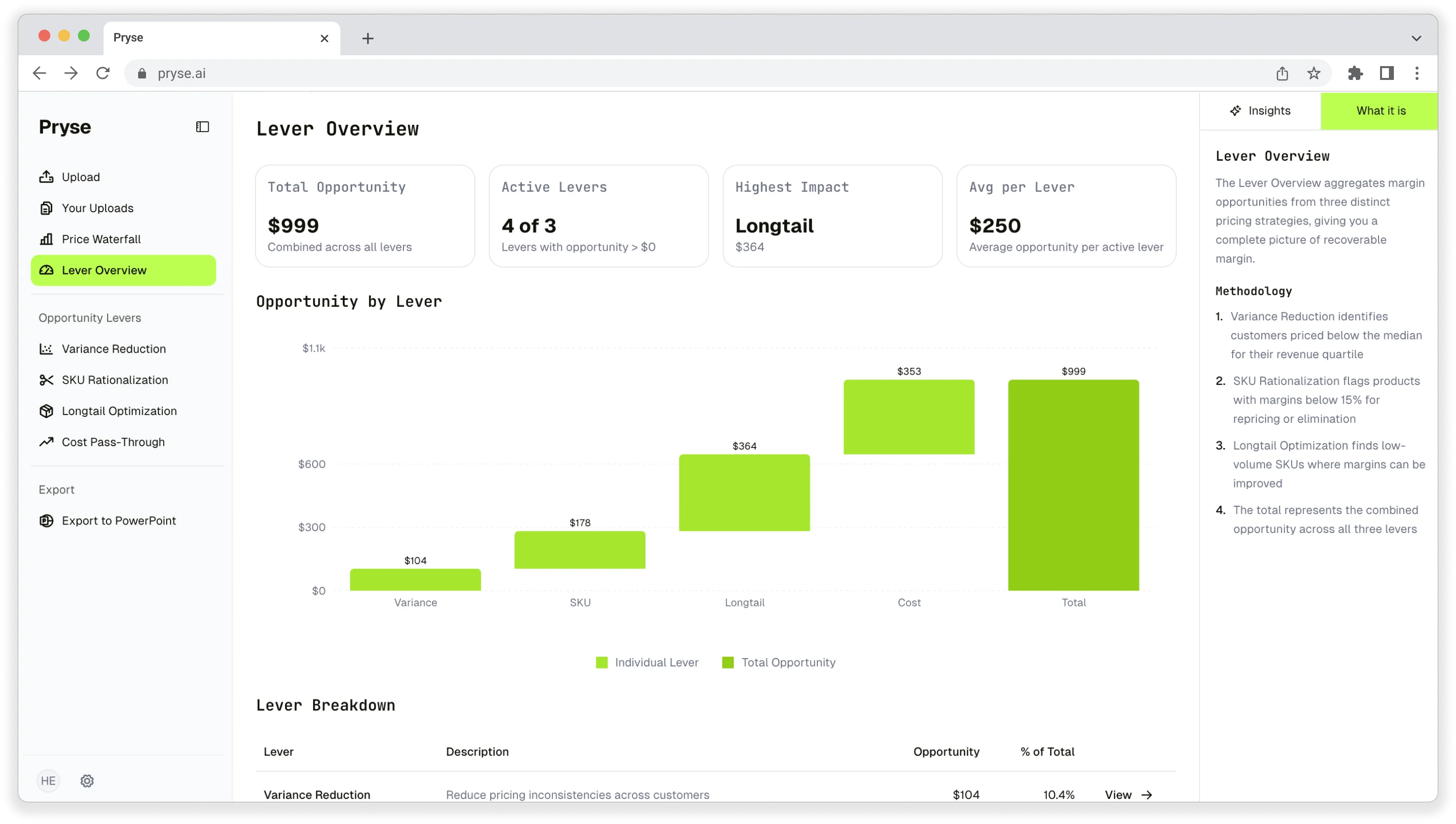
Want to analyze your entire product catalog?
Pryse automatically identifies margin leakage across thousands of SKUs. Upload your data and find hidden profit in 24 hours.
One-time $1,499 diagnostic. No subscription required.