 Pryse
PrysePricing Software for Small Business: When You Need It (And When You Don't)
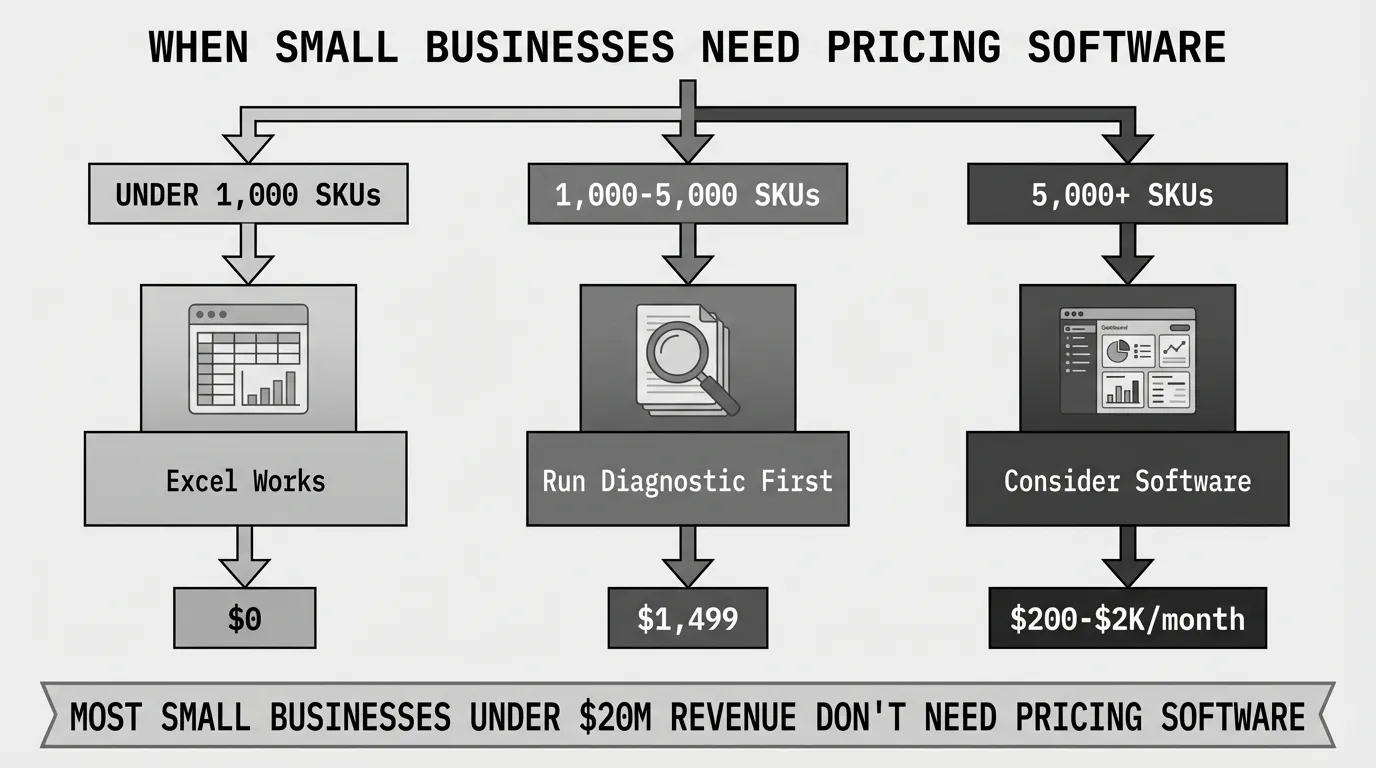
Most small businesses with under $20M revenue don't need pricing software. Here's when Excel, diagnostics, or simple tools deliver better ROI than subscriptions.
Most small businesses with under $20M revenue don't need specialized pricing software. Excel, QuickBooks, or one-time diagnostics deliver better ROI than $200-$2,000/month subscriptions designed for companies managing 20,000+ SKUs with complex customer-specific pricing.
The pricing software market was estimated at $1.2 billion in 2024 and is forecast to grow at 12.5% annually, according to Market Size and Trends research. But that growth is driven by mid-market and enterprise buyers with 10,000+ SKUs and pricing complexity that justifies automation. Small businesses face different economics.
This post explains when small businesses actually need pricing software, which affordable tools make sense, and when simpler alternatives deliver better results.
What Pricing Software Actually Does
Pricing software automates price analysis and recommendations. It ingests transaction data, identifies margin patterns, and suggests price adjustments to improve profitability while maintaining competitive positioning.
Basic capabilities in small business pricing tools:
- Margin analysis: Calculates profit margin by product, customer, or category
- Price list management: Organizes products with costs, markups, and final prices
- Discount control: Tracks discount patterns and enforces approval workflows
- Competitive monitoring: Tracks competitor prices for key products (ecommerce-focused tools)
- Reporting: Visualizes pricing performance and margin trends
What separates small business tools from enterprise platforms:
Enterprise platforms (PROS, Vendavo, Pricefx) cost $100K-$500K annually and use AI to optimize prices across 50,000+ SKUs daily. They integrate live with ERP systems and require 6-18 months to implement.
Small business tools cost $200-$2,000/month and use rule-based logic you define. They typically rely on CSV exports instead of live integrations and take days to weeks to set up.
The key difference: enterprise tools continuously optimize complex pricing across massive catalogs. Small business tools systematize manual pricing workflows you could do in spreadsheets.
When Small Businesses Need Pricing Software
Pricing software makes economic sense when manual pricing becomes unmanageable or margin leakage exceeds software costs.
You Need Pricing Software If:
Product catalog exceeds Excel capacity: You have 5,000+ SKUs and update prices monthly or quarterly. Manual price list management in spreadsheets becomes error-prone at this scale.
Customer-specific pricing is complex: You have 500+ customers with unique pricing arrangements. Tracking who gets which discount or special price across hundreds of customers requires systematic workflows.
Pricing occupies significant time: You or your team spend 10+ hours per week on pricing decisions, price list updates, or discount approvals. Software ROI comes from time savings, not just margin improvement.
Margin leakage is quantified and significant: You've identified $50K+ annually in recoverable margin from pricing inconsistencies, underpriced products, or discount erosion. Software that recovers even 30% of this ($15K+) pays for itself.
Competitor pricing changes frequently: You're in ecommerce or wholesale distribution where competitor prices shift weekly or daily. Manual monitoring becomes impossible.
Regulatory or contract requirements: You need audit trails showing pricing decisions and approval workflows for compliance or customer contracts.
You DON'T Need Pricing Software If:
You haven't done basic margin analysis: If you can't calculate margin by product and customer in Excel, software won't help. Fix data quality and run manual analysis first.
Catalog is under 1,000 SKUs with stable pricing: Excel handles this easily. Export data quarterly, analyze margins, adjust prices. Software adds complexity without clear ROI.
Budget is under $500/month for all software: Most small businesses allocate 2-7% of annual revenue for all IT costs. If your business generates $200K annually, that's $333-$1,167 monthly for everything including accounting, CRM, and operations tools. Pricing software isn't the priority.
Leadership won't implement price increases: Software identifies opportunities, but you still need to act. If your business culture resists pricing adjustments regardless of data, software is wasted investment.
Transaction data is incomplete or unreliable: Pricing software requires clean historical data with SKU, customer, price, volume, and cost. If your data has gaps or inconsistencies, fix that first.
According to reviews on G2, the most common small business pricing software mistake is buying sophisticated tools before establishing data quality and pricing discipline.
Budget-Friendly Pricing Software Options
If you've determined pricing software makes sense, start with affordable options designed for small business constraints.
Accounting Software with Built-In Pricing ($15-$150/month)
QuickBooks Online ($15-$200/month depending on plan)
QuickBooks is one of the most popular accounting tools globally and handles variable pricing scenarios including hourly, unit-based, and fixed pricing, according to reviews of small business pricing tools. It streamlines tax calculations, invoice generation, and payment tracking through a single dashboard.
Best for: Service businesses or simple product catalogs with straightforward cost-plus pricing
Limitations: No margin analysis, price waterfall visualization, or optimization recommendations. You manually set prices; QuickBooks just applies them to invoices.
Zoho Books ($15-$70/month)
Zoho Books stands out for its price-to-capability ratio, supporting configurable billing templates, auto-recurring invoices, and advanced approval workflows. It's ideal for businesses already using Zoho's CRM or inventory management solutions.
Best for: Businesses in the Zoho ecosystem needing basic pricing logic integrated with accounting
Limitations: Like QuickBooks, it handles invoicing with pricing, not pricing optimization.
Standalone Small Business Pricing Tools ($200-$500/month)
ResponsiBid ($195+/month)
ResponsiBid offers simplified pricing workflows at a price point accessible to small businesses, according to small business software reviews.
Features:
- Simple interface designed for non-technical users
- Basic pricing rules and approval workflows
- Lower price point than mid-market platforms
Best for: Small businesses with 1,000-5,000 SKUs needing basic pricing automation
Limitations: Limited analytics and reporting compared to enterprise tools. Most small businesses under 1,000 SKUs recover more margin from Excel analysis than subscription software.
Ecommerce-Specific Tools ($50-$500/month)
Prisync ($50-$350/month)
Prisync is a competitor price tracking software for ecommerce companies of all sizes that lets you track competitor data including product prices, price history, and stock information, according to Monday.com's pricing software guide.
Best for: Ecommerce retailers selling commoditized products where competitor prices drive your pricing decisions
Limitations: Focused on competitive monitoring, not comprehensive margin optimization. Works best for businesses already profitable that want to stay competitive.
Competera (Custom pricing, typically $20K-$100K annually)
Competera uses AI to help businesses anticipate market shifts and adjust prices accordingly. While technically mid-market pricing, their entry-level offerings can work for larger small businesses.
Best for: High-volume ecommerce sellers with 5,000+ SKUs and daily price volatility
Limitations: Still more expensive than most small businesses can justify unless managing significant catalog complexity.
Manufacturing-Focused Tools
CraftyBase ($39-$99/month)
CraftyBase provides pricing software specifically for small manufacturers, makers, and artisans. It calculates true production costs including materials, labor, and overhead to ensure profitable pricing.
Best for: Small manufacturers with under 500 products needing cost-based pricing
Limitations: Focused on cost calculation rather than market-driven pricing optimization.
Comparison: Small Business Pricing Software
| Tool | Monthly Cost | Best For | Key Strength | Main Limitation |
|---|---|---|---|---|
| QuickBooks | $15-$200 | Service businesses, simple invoicing | Integration with accounting | No optimization features |
| Zoho Books | $15-$70 | Zoho ecosystem users | Price-to-capability ratio | Basic pricing logic only |
| ResponsiBid | $195+ | 1K-5K SKUs, simple workflows | Small business pricing | Limited compared to enterprise |
| Prisync | $50-$350 | Ecommerce competitor tracking | Automated price monitoring | Competitive focus only |
| CraftyBase | $39-$99 | Small manufacturers | True cost calculation | Cost-based, not market-driven |
| Excel | Free | Under 1K SKUs | Full flexibility, no costs | Manual, doesn't scale |
| Pryse | $1,499 one-time | First-time analysis, not ready for subscriptions | Professional insights without subscriptions | One-time analysis, not ongoing |
Common Challenges Small Businesses Face with Pricing Software
Small businesses encounter specific obstacles that larger companies with dedicated IT and pricing teams don't face.
Financial Barriers
Many advanced pricing tools can be expensive, which creates a significant obstacle for small enterprises. The initial cost and ongoing expenses are common issues, with many small enterprises hesitating to invest in optimization software due to budget constraints, according to CHRO Strategy's guide to pricing tools for small enterprises.
Reality check: If your business generates $1M annually with 8% profit ($80K), spending $2,400/year ($200/month) on pricing software means it must recover $7,200+ (3x cost) to justify the investment. That's 0.7% margin improvement across your revenue base—achievable, but not guaranteed.
Technical and Implementation Challenges
Lack of in-house technical skills can hinder implementation, and businesses should look for vendors offering comprehensive support and training. A successful deployment relies on accurate and comprehensive data collection, and ensuring that software can handle real-time data and integrate with existing systems is essential, which could involve updates to current IT infrastructure.
What this means: Small businesses rarely have dedicated IT staff. If pricing software requires API configuration, database connections, or technical troubleshooting, you'll need to hire help or rely entirely on vendor support. Choose tools with simple CSV workflows or full white-glove implementation.
Training and Adoption Issues
The learning curve associated with new tools is another aspect that businesses must navigate. Employees need proper training to leverage advanced features effectively, which means allocating time for onboarding and ongoing support. Convincing your team to embrace pricing software can be tough.
The hidden cost: If your team takes 40 hours to learn new software, that's a full work week at $25-$50/hour ($1,000-$2,000) in opportunity cost on top of subscription fees.
Data Quality Problems
Reviewers noted difficulties in the implementation process, complexity in the ecosystem, issues with scaling the solution, and some out-of-the-box functionality that cannot be changed.
Small business context: Your ERP or accounting system has duplicate SKU codes, inconsistent product descriptions, missing cost data, or customer records with wrong information. Pricing software will surface these problems immediately. Budget time to clean data before expecting useful insights.
When Simple Alternatives Beat Pricing Software
Most small businesses should start with simpler, cheaper approaches before committing to software subscriptions.
Excel-Based Pricing Analysis (Free)
For businesses under 2,000 SKUs with quarterly or semi-annual pricing updates, Excel delivers 80% of pricing software value at zero cost.
What works in Excel:
- Export transaction data from QuickBooks, Shopify, or your POS system
- Calculate margin by product and customer using simple formulas
- Identify underpriced products (bottom 20% by margin)
- Build price lists with consistent markup or margin targets
- Visualize pricing patterns with pivot tables and charts
What doesn't scale in Excel:
- 10,000+ SKU price lists updated monthly
- Customer-specific pricing across 500+ customers
- Automated competitor price tracking
- Real-time pricing based on inventory or demand
According to Intuit's pricing strategies guide, many small businesses successfully manage pricing in spreadsheets until product count or pricing complexity crosses the threshold where manual work becomes overwhelming.
See our margin analysis in Excel guide for step-by-step instructions on building pricing spreadsheets.
One-Time Pricing Diagnostic ($1,500)
Before committing to ongoing subscriptions, run a one-time diagnostic to quantify your margin leakage and determine if software is justified.
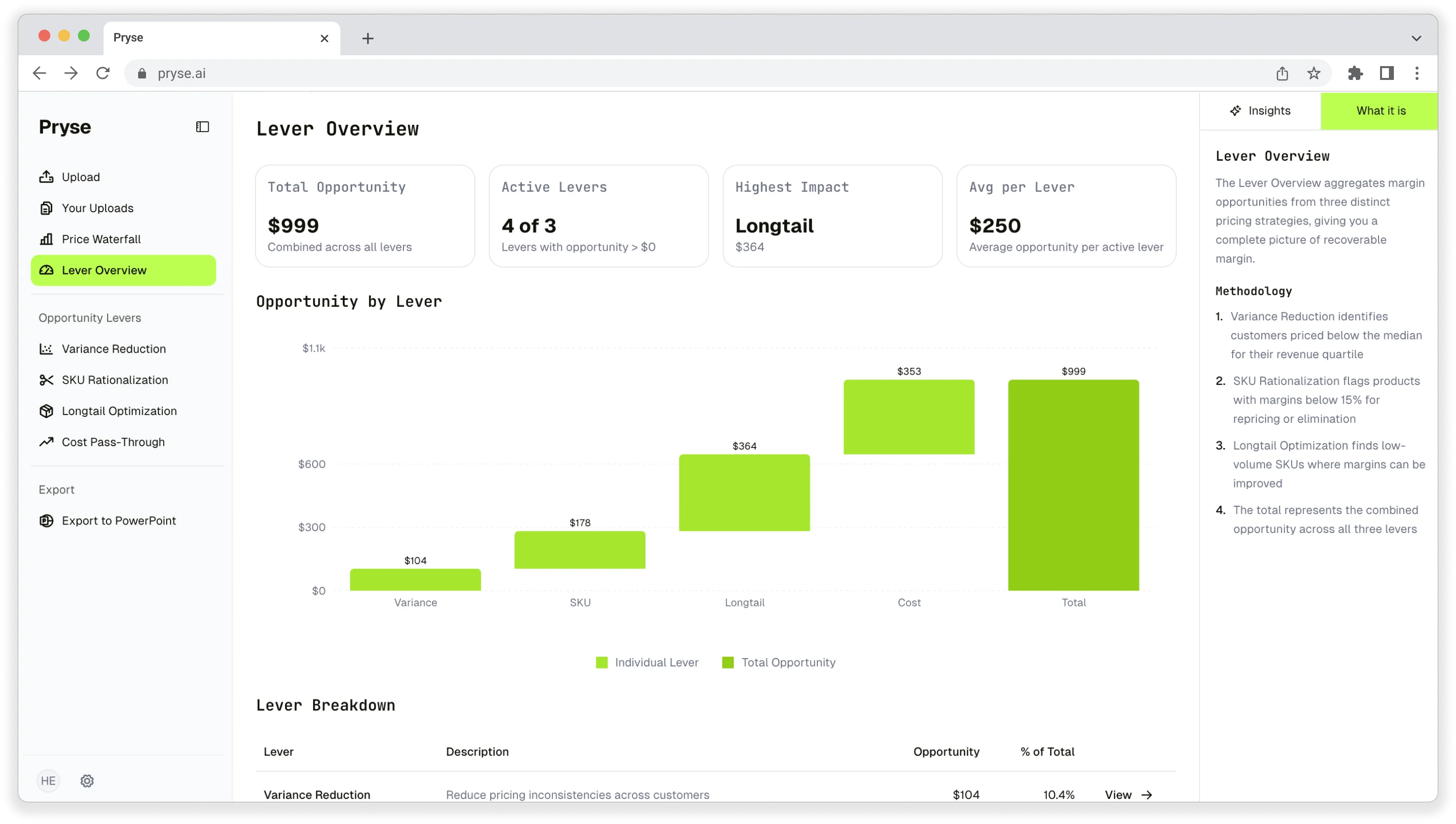
Pryse provides self-serve margin diagnostics for $1,499. You upload a transaction CSV and receive professional analysis within 24 hours showing:
- Your actual margin by product and customer
- Price waterfall visualization showing list-to-pocket erosion
- Top margin leakage sources ranked by dollar opportunity
- Quick-win pricing recommendations
When diagnostics make sense:
You need to justify software investment to leadership, want professional insights without implementation complexity, or suspect margin problems but can't quantify them with Excel alone.
Most small businesses recover 3-10x the diagnostic cost by implementing top recommendations. If your opportunities are small, you've saved thousands by not investing in software you don't need.
Pricing Consultants ($5K-$50K)
For small businesses facing major pricing restructuring, hiring a pricing consultant delivers strategic guidance that software can't provide.
When consultants beat software:
- Your business model is changing and requires pricing redesign
- You lack internal pricing expertise and need strategic direction
- You need to communicate price increases to customers and want proven messaging
- Your pricing challenges are organizational or strategic, not just analytical
Budget $5K-$50K for small business pricing consulting engagements. Specialized pricing consultants combine strategy with analytical tools.
Many small businesses hire consultants for one-time strategy, then use Excel or simple software for ongoing execution.
Decision Framework: When to Invest in Pricing Software
Use this framework to determine whether pricing software makes sense for your business:
Start with Your Numbers
- Annual revenue: ________
- Current net profit margin (%): ________
- Number of active SKUs: ________
- Number of customers with unique pricing: ________
- Hours per week spent on pricing decisions: ________
- Estimated margin leakage ($ annually): ________
Apply the Decision Rules
If revenue is under $5M AND SKUs are under 1,000: → Excel is sufficient. Spend $0 on pricing software.
If revenue is $5M-$20M AND SKUs are 1,000-5,000: → Run a diagnostic ($1,499) to quantify opportunity before investing in subscriptions.
If revenue is over $20M OR SKUs exceed 5,000: → Mid-market pricing platforms ($20K-$100K annually) deliver clear ROI. See our pricing optimization software guide.
If you spend less than 5 hours per week on pricing: → You don't have enough pricing complexity to justify software.
If estimated margin leakage is under $20K annually: → Software won't pay for itself. Fix problems manually first.
Calculate Your Break-Even Point
Required Annual Margin Recovery = (Software Cost × 3) to justify investment
Software Budget = (2-7% of Annual Revenue) allocated across ALL software
Example calculation:
- Annual revenue: $3M
- Total software budget at 3%: $90K
- Existing software costs: $60K (QuickBooks, Shopify, etc.)
- Available for pricing software: $30K annually ($2,500/month)
- Required margin recovery: $90K (3x software cost)
- This is 3% of your $3M revenue base
If you can't recover $90K from better pricing, investing $30K in pricing software destroys value.
Implementation Advice for Small Businesses
If you've determined pricing software makes economic sense, follow these steps to maximize ROI.
Step 1: Clean Your Data First
Export 12 months of transaction data from your accounting or POS system. Verify:
- SKU codes are consistent (no duplicates or typos)
- Product descriptions are standardized
- Cost data exists and is current
- Customer records are accurate
- Transaction history is complete
Budget 10-20 hours for data cleaning before software implementation. Most small business failures with pricing software stem from poor data quality, not tool selection.
Step 2: Define Clear Objectives
What specific pricing problems are you solving?
- Inconsistent markups across product categories?
- Excessive discounting without approval?
- Prices that haven't changed in 2+ years despite cost increases?
- Competitor prices undercutting your pricing?
- Customers asking for discounts because they know others pay less?
Pricing software implementation succeeds when objectives are clear and measurable, not vague aspirations for "better pricing."
Step 3: Start Simple, Add Complexity Later
Choose tools with basic features and low learning curves. Resist the temptation to buy enterprise-grade platforms with AI and advanced analytics you won't use.
Implementation path:
Month 1: Upload data, verify margin calculations are correct Month 2: Identify underpriced products, implement targeted price increases Month 3: Set up discount approval workflows Month 4: Add competitive monitoring (if relevant) Month 6: Evaluate whether ROI justifies ongoing subscription
Step 4: Train Your Team
Schedule 4-8 hours of training for anyone who will use the software. Make sure they understand:
- How to export data from existing systems
- How to interpret margin reports
- When to adjust prices vs when to escalate for review
- How to communicate price changes to customers
The best pricing software is worthless if your team doesn't use it correctly.
Step 5: Measure Results Monthly
Track these metrics before and after software implementation:
- Average gross margin (%) by product category
- Discount % as a percentage of revenue
- Pricing decision time (hours per week)
- Margin recovery ($) from pricing adjustments
If you're not seeing 1-2% margin improvement or 5+ hours saved weekly within 90 days, the software isn't delivering ROI. Cancel and revert to Excel.
What to Avoid
Don't Buy Based on Features Alone
Enterprise platforms have impressive feature lists. Most small businesses use less than 20% of what they pay for.
Match software to your actual complexity, not aspirations. A $50/month tool you fully utilize beats a $500/month platform with unused capabilities.
Don't Skip the Diagnostic Phase
Companies that buy pricing software before quantifying their margin leakage often discover they paid for tools that recover less than they cost.
Run Excel analysis or a professional diagnostic first. If you can't identify $20K+ in recoverable margin, you don't need software yet.
Don't Expect Software to Fix Strategy Problems
Pricing software reveals margin problems. It doesn't decide your positioning, competitive strategy, or value proposition.
If your pricing challenges stem from weak positioning, undifferentiated products, or lack of pricing discipline, fix those first. Software amplifies what you already do well.
Don't Ignore Implementation Costs
$200/month looks affordable. But factor in:
- Initial setup time (10-40 hours at $30-$75/hour)
- Training time (4-8 hours per user)
- Data cleaning (10-20 hours)
- Ongoing maintenance (2-5 hours monthly)
Total first-year cost is often 3-4x the subscription price.
Getting Started: Next Steps for Your Business
For Businesses Under $5M Revenue, Under 1,000 SKUs:
Start with Excel. Export transaction data quarterly, calculate margin by product and customer, identify underpriced items, and implement targeted adjustments.
Don't invest in pricing software until you've recovered low-hanging margin through manual analysis and your catalog or pricing complexity exceeds Excel capacity.
For Businesses $5M-$20M Revenue, 1,000-5,000 SKUs:
Run a diagnostic to quantify your opportunity. Pryse analyzes transaction data for $1,499 and shows exactly where margin is leaking and how much is recoverable.
If the diagnostic reveals $50K+ in recoverable margin and manual optimization is unmanageable, then evaluate small business pricing software.
For Businesses Over $20M Revenue, 5,000+ SKUs:
You're at the threshold where mid-market pricing platforms deliver clear ROI. Budget $20K-$100K annually and focus on vendors with distribution or manufacturing expertise.
Skip small business tools. You need platforms that scale with complexity. See our pricing optimization software comparison for mid-market and enterprise options.
The Reality: Most Small Businesses Don't Need Pricing Software
The pricing software market is growing, but that growth comes from mid-market and enterprise buyers with pricing complexity that justifies automation.
For most small businesses with under $20M revenue, straightforward product catalogs, and quarterly pricing reviews, Excel delivers better ROI than $200-$2,000/month subscriptions.
Invest in pricing software only after:
- You've quantified margin leakage and confirmed it exceeds software costs by 3x or more
- Manual pricing consumes 10+ hours weekly and software saves meaningful time
- Product or customer complexity makes Excel unmanageable
- You've cleaned your data and established basic pricing discipline
Start where you are. Run Excel analysis or a diagnostic. Fix the obvious problems. Only invest in software when you've exhausted simpler, cheaper alternatives.
For small businesses ready to quantify their margin opportunity, Pryse provides self-serve diagnostics for $1,499. Upload your transaction data and receive professional analysis within 24 hours showing exactly where margin is leaking and whether software investment makes sense for your complexity.
For broader guidance on pricing strategy beyond software, see our complete pricing optimization guide.
Sources
- Market Size and Trends: Pricing Software & Tools Market Report
- G2: Best Pricing Software for Small Business in 2026
- Monday.com: Pricing Software Solutions Guide for 2026
- CRO Club: 22 Best Pricing Software For Small Businesses Reviewed In 2026
- CHRO Strategy: Optimizing Pricing Tools for Small Enterprises
- Intuit QuickBooks: 14 Pricing Strategies for Small Businesses in 2026
- Capterra: A Guide to Small Business Software Pricing Models
- Pricefx: Pricing Software - A Guide to Revolutionize Your Business
Last updated: February 24, 2026
Frequently Asked Questions
Want to analyze your entire product catalog?
Pryse automatically identifies margin leakage across thousands of SKUs. Upload your data and find hidden profit in 24 hours.
One-time $1,499 diagnostic. No subscription required.