 Pryse
PrysePricing Engine: What It Is and When You Need One
A pricing engine automates real-time price calculations across channels. Learn how it differs from pricing software and when mid-market companies should invest.
A pricing engine is software that calculates and applies prices in real-time based on predefined rules, product attributes, customer segments, discounts, and market conditions. It acts as the execution layer within pricing systems, delivering accurate prices to quoting tools, ecommerce platforms, and sales channels instantly without manual intervention.
According to Vendavo's research, 54% of manufacturers and distributors now use price optimization strategies, but most still rely on ERP pricing modules rather than dedicated pricing engines. The distinction matters: a pricing engine executes pricing decisions across channels at transaction speed, while pricing optimization software analyzes data to determine what those prices should be.
For mid-market distribution and manufacturing companies, pricing engines sit on a spectrum from "unnecessary complexity we don't need" to "the only way to manage real-time pricing at scale" depending on channel complexity, transaction volume, and how often prices change.
This post explains what pricing engines actually do, how they differ from pricing software, implementation costs, and whether you need one or if your ERP's pricing module handles your needs.
What Is a Pricing Engine (Definition)
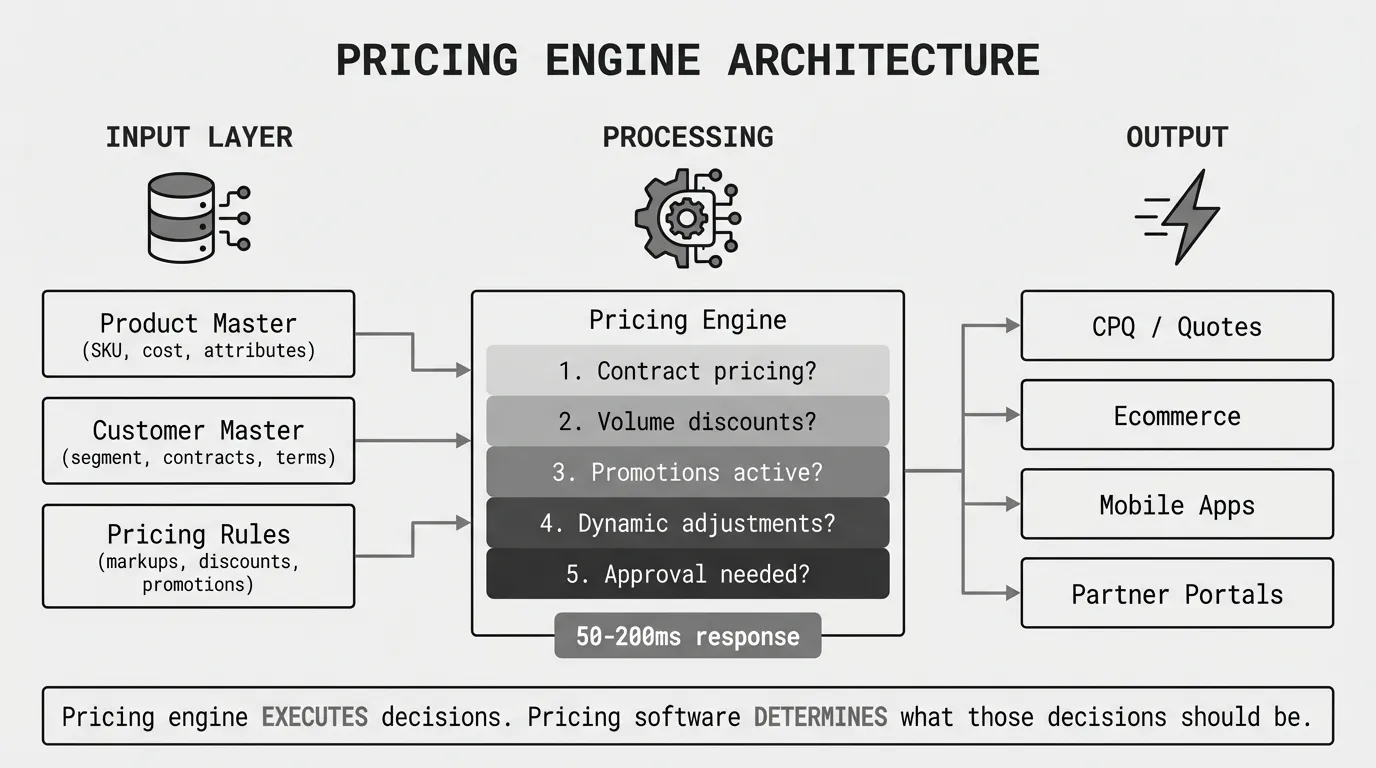
A pricing engine is a system that calculates and applies prices based on predefined inputs such as product attributes, customer segments, contracts, discounts, and market conditions. It acts as the decision layer within pricing software, ensuring that prices are applied consistently and accurately across quoting, billing, and sales workflows.
Think of it as the difference between a calculator and a spreadsheet. Pricing optimization software (the spreadsheet) helps you figure out what prices should be. The pricing engine (the calculator) takes those rules and executes them thousands of times per day across every quote, order, and transaction.
Core function: When a sales rep requests a quote, an ecommerce customer views a product, or an API call asks for pricing, the pricing engine runs through its logic in milliseconds:
- Identifies the customer segment and contract terms
- Retrieves base list price for the SKU
- Applies volume discounts based on quantity
- Factors in promotional pricing if active
- Checks inventory-based pricing rules (clearance, scarcity pricing)
- Applies approval thresholds for exceptions
- Returns the final price to the requesting system
According to Vistaar Technologies, modern pricing engines perform these calculations in milliseconds, allowing businesses to respond to pricing requests from any ERP, CRM, CPQ, ecommerce platform, or mobile app through a web-based API.
What a pricing engine is not:
- A replacement for pricing strategy (you still need to define what prices should be)
- A data analysis tool (it executes rules, doesn't discover insights)
- Necessary for companies with simple pricing that updates monthly
- A standalone solution (it requires pricing rules from somewhere—your pricing team or pricing software)
The difference between having a pricing engine and using your ERP's pricing module comes down to three factors: how many channels need pricing, how fast prices need to update, and how complex your pricing logic is.
Pricing Engine vs Pricing Software: What's the Difference
The market uses "pricing engine" and "pricing software" interchangeably, but they serve distinct functions in your pricing stack.
Pricing optimization software:
- Analyzes historical transaction data to identify margin leakage and pricing opportunities
- Uses AI and machine learning to recommend optimal prices based on elasticity, competitor positioning, and market conditions
- Produces price lists, discount matrices, and strategic pricing recommendations
- Used by pricing managers and finance teams to set strategy
- Examples: PROS, Vendavo, Zilliant, Pryse
Pricing engine:
- Executes pricing decisions in real-time across channels
- Applies predefined rules to calculate prices for quotes, orders, and transactions
- Integrates with CPQ, ecommerce, POS, and mobile apps via API
- Used by sales reps, customers, and automated systems to get accurate prices instantly
- Examples: Zilliant Real-Time Pricing Engine, Vistaar Smart Pricing Engine, custom-built engines
According to a comparison by Wiser, a pricing engine is highly interoperable software that allows you and your customers to request accurate pricing from any external system at lightning speed and in real time, communicating with any external system, including point of sale (POS) systems, mobile applications, and online stores.
How they work together:
- Pricing software analyzes data and recommends that Product A should be priced at $47 for Tier 1 customers with a 12% volume discount at 100+ units
- That rule gets configured in the pricing engine
- When a Tier 1 customer adds 120 units of Product A to their cart, the pricing engine calculates $47 × 120 × 0.88 = $4,968 instantly
- The price appears in the quote or shopping cart within 100ms
Most mid-market companies don't need both. If you update price lists monthly in Excel and load them into your ERP, you're using your ERP as a basic pricing engine. You don't need a separate system.
You need a dedicated pricing engine when:
- You sell through 3+ channels (direct sales, distributors, ecommerce, mobile apps) that need synchronized pricing
- Prices change frequently (daily or hourly) based on market conditions, inventory levels, or competitor moves
- Your pricing logic is too complex for your ERP's pricing module (contract-specific matrices, customer-SKU exceptions, multi-tier channels)
- You need API-based pricing for external systems (partner portals, marketplace integrations, mobile apps)
If none of those apply, your ERP handles pricing execution just fine.
How a Pricing Engine Works: Technical Architecture
Pricing engines sit between your master data (ERP) and your commercial systems (CPQ, ecommerce, POS). Here's the typical data flow:
Input Layer: Master Data Sources
The pricing engine pulls data from multiple systems:
Product master data:
- SKU, description, category
- Standard cost and list price
- Product attributes (size, weight, material) that affect pricing rules
- Inventory levels (for dynamic pricing based on stock)
Customer master data:
- Customer segment (A/B/C classification, industry vertical)
- Contract terms and effective dates
- Negotiated discount matrices
- Payment terms and credit status
Pricing rules:
- Base markup formulas by product category
- Volume discount tiers
- Promotional pricing calendars
- Competitive pricing rules (floor prices, margin thresholds)
Processing Layer: Rules Engine
When a pricing request arrives, the engine processes rules in priority order:
- Contract-specific pricing: Does this customer have negotiated prices for this SKU?
- Volume discounts: What quantity tiers apply?
- Promotional pricing: Are there active promotions?
- Dynamic adjustments: Should inventory levels, time of day, or competitor prices modify the base price?
- Approval thresholds: Does this price require manager approval before being quoted?
According to Zilliant's real-time pricing engine documentation, the system can automate negotiations, counteroffers, and approvals based on predefined parameters, creating a continuous feedback loop between pricing requests and approved exceptions.
Output Layer: API Delivery
The pricing engine exposes an API that commercial systems call:
POST /api/calculate-price
{
  "sku": "PART-12345",
  "customer_id": "CUST-67890",
  "quantity": 150,
  "ship_to_location": "Dallas, TX"
}

Response (in 50-200ms):
{
  "list_price": 52.00,
  "net_price": 44.20,
  "discounts_applied": [
    {"type": "volume", "amount": 6.50},
    {"type": "regional", "amount": 1.30}
  ],
  "approval_required": false
}
PricesAPI, a retail-focused pricing engine, updates prices hourly and delivers them through a simple REST API, demonstrating how modern pricing engines prioritize speed and integration simplicity over complex on-premise installations.
Integration Requirements
Pricing engines typically integrate with:
- ERP systems: NetSuite, SAP Business One, Microsoft Dynamics 365, Oracle, Acumatica for master data sync
- CPQ tools: Salesforce CPQ, DealHub, Experlogix for quote generation
- Ecommerce platforms: Shopify, BigCommerce, Magento for online pricing
- CRM systems: Salesforce, HubSpot for customer-specific pricing rules
According to Pricefx's integration guide, companies implementing proper pricing engine integration with ERP see 40-60% reduction in quote errors and 25-35% faster order processing times.
When Do You Need a Pricing Engine?
Not every company needs a dedicated pricing engine. Your ERP's pricing module handles simple scenarios just fine. Here's when upgrading makes sense.
You Probably Need a Pricing Engine If:
1. You sell through multiple channels with different pricing logic
If you have direct sales, distributor partners, ecommerce, and retail channels that each need different pricing—and those prices need to stay synchronized—a pricing engine becomes the single source of truth.
Example: An electrical distributor sells the same SKU at different prices through their direct sales team (contract pricing), their ecommerce site (list price minus online discount), and through independent reps (wholesale pricing minus channel incentives). Each channel hits the pricing engine API for accurate real-time prices.
2. Pricing changes frequently based on external factors
If you adjust prices daily or hourly based on commodity costs, competitor moves, inventory levels, or market demand, manually updating price lists becomes impossible.
According to Hypersonix's analysis, one manufacturer achieved ROI positive results in less than 3 months after implementing a pricing engine that automated daily price adjustments for 20,000+ SKUs based on raw material costs and regional demand.
3. You have complex customer-specific pricing matrices
If you manage hundreds of negotiated contracts with customer-SKU-specific pricing, volume tiers, and promotional overlays, your ERP's pricing table becomes unmanageable. A pricing engine handles the logic:
Net Price = MIN(
Contract Price,
List Price × (1 - Volume Discount) × (1 - Promotional Discount),
Cost × (1 + Minimum Margin)
)
4. You need API-based pricing for external integrations
If partner portals, mobile apps, or third-party marketplaces need to retrieve pricing without direct ERP access, a pricing engine provides a clean API layer.
5. You operate in industries with time-sensitive or perishable inventory
Airlines, hotels, rental car companies, and fresh food distributors adjust prices constantly based on demand and time to expiration. A pricing engine automates these adjustments in real-time.
You Probably Don't Need a Pricing Engine If:
1. Price lists update monthly or quarterly
If you set prices in Excel, load them into your ERP once a month, and handle exceptions manually, you're not generating enough pricing transactions to justify a dedicated engine.
2. You have under 5,000 SKUs and straightforward pricing logic
Simple cost-plus pricing or list-price-minus-discount strategies work fine in your ERP's pricing module.
3. You sell through a single channel (direct sales or ecommerce only)
If all transactions flow through one system with one pricing logic, the integration overhead of a pricing engine exceeds its value.
4. Sales reps manually negotiate every deal
If pricing is consultative and varies deal-by-deal based on relationship and negotiation, automation doesn't help. Focus on pricing software to set guidelines and thresholds, not a pricing engine to execute rules.
Decision framework:
| Factor | Pricing Engine Justified | ERP Pricing Module Sufficient |
|---|---|---|
| Channels | 3+ channels | 1-2 channels |
| SKU count | 20,000+ SKUs | Under 10,000 SKUs |
| Price update frequency | Daily or real-time | Monthly or quarterly |
| Transaction volume | 10,000+ quotes/orders per month | Under 1,000 per month |
| Customer contracts | 100+ negotiated contracts | Under 50 contracts |
| Integration needs | API access for external systems | Internal ERP access only |
According to Flintfox's pricing software guide, wholesale distributors leverage pricing software to analyze market conditions and adjust prices to maximize revenue while staying competitive, but only a subset need dedicated pricing engines for real-time execution.
Pricing Engine Implementation Costs and Timeline
Pricing engines range from open-source APIs you run yourself to enterprise platforms with six-figure implementations. Here's what to expect.
Software Costs
Enterprise pricing engines ($50K-$200K annually):
- Zilliant Real-Time Pricing Engine
- PROS Real-Time Dynamic Pricing
- Vendavo Pricepoint
- Vistaar Smart Pricing Engine
Pricing varies by SKU count, transaction volume, and number of integrations. Annual subscriptions typically start at $50K for mid-market deployments and exceed $200K for Fortune 500 scale.
Mid-market pricing engines ($20K-$75K annually):
- Pricefx Pricing Engine (module within their platform)
- Competera Pricing Platform
- Regional pricing engine vendors
These solutions target companies with 10,000-50,000 SKUs and moderate complexity.
API-based and open-source options (under $10K annually):
- Custom-built pricing engines using AWS Lambda, Google Cloud Functions, or Azure Functions
- Open-source frameworks like Openpricengine
- Low-code integration platforms with pricing logic
According to ERP Focus implementation cost research, companies should budget 100-200% of the software license fee for implementation costs, meaning a $100K/year pricing engine subscription will cost $100K-$200K additional for setup.
Implementation Timeline
Basic setup (1-3 months):
- Configure pricing rules and discount matrices
- Test API integrations with CPQ or ecommerce platform
- Train pricing team on rule management
- Pilot with a single product category or customer segment
Mid-complexity implementation (3-6 months):
- Integrate with ERP for master data sync
- Migrate existing pricing rules from ERP to engine
- Build custom workflows for approval exceptions
- Roll out across multiple channels sequentially
Enterprise implementation (6-12 months):
- Deep ERP integration with real-time data sync
- Complex discount waterfall logic migration
- Multi-region, multi-currency configuration
- Change management across sales, pricing, and finance teams
According to Itransition's ERP implementation cost analysis, low-code integration platforms reduce implementation timelines by 50-70% while maintaining flexibility for future business needs.
Hidden Costs to Budget For
Ongoing maintenance:
- Rule updates as pricing strategy evolves (ongoing)
- API monitoring and troubleshooting ($10K-$30K annually)
- Data quality management for master data feeds ($20K-$50K annually)
Internal resources:
- Pricing analysts to manage rules (0.5-2 FTEs depending on complexity)
- IT support for integration maintenance
- Training for new sales and pricing team members
Change management:
- Sales team adaptation to automated pricing vs manual negotiation
- Customer communication about pricing changes
- Process documentation and governance
The total cost of ownership for a mid-market pricing engine implementation typically runs $150K-$400K in year one (software + implementation + internal resources), then $80K-$200K annually thereafter.
Pricing Engine Examples and Use Cases
Real-world implementations show where pricing engines deliver measurable ROI and where they add complexity without value.
Use Case 1: Multi-Channel Industrial Distributor
Company profile:
- $85M electrical distributor
- 45,000 SKUs
- Channels: direct sales, ecommerce, 12 independent rep firms
- 800 customers with negotiated contracts
Challenge: Rep firms called inside sales for pricing on every quote. Inside sales looked up contract pricing manually, applied volume discounts, and called back. Average quote took 45 minutes. Pricing errors occurred on 8% of quotes.
Solution: Implemented Vistaar Smart Pricing Engine with API integrations to rep portal and ecommerce platform. Configured contract pricing, volume discount matrices, and cost-floor rules.
Results:
- Quote time dropped to 2 minutes (95% automated)
- Pricing errors reduced to under 1%
- Inside sales team reallocated from quote generation to customer service
- Recovered $800K annually from eliminated pricing errors and better discount discipline
Use Case 2: Custom Manufacturer with Complex BOMs
Company profile:
- $120M custom metal fabricator
- Each quote is unique (no standard SKUs)
- Pricing based on material cost, labor hours, machine time, and margin targets
Challenge: Sales engineers spent 3-4 hours per quote calculating costs, checking material prices, and applying margin targets. Quote accuracy varied by estimator. Win rates on bids dropped when material costs spiked.
Solution: Built custom pricing engine that pulls real-time metal commodity prices, calculates labor and machine costs from ERP data, applies margin targets by customer tier, and generates quotes in under 10 minutes.
Results:
- Quote generation time reduced by 75%
- Quote accuracy improved (standard margin targets applied consistently)
- Win rates increased 12% by responding faster to RFQs
- Avoided $400K in underpriced bids when commodity costs spiked
Use Case 3: Mid-Market Distributor That Didn't Need One
Company profile:
- $35M HVAC distributor
- 8,000 SKUs
- Pricing updates quarterly
- 90% of sales through direct team with manual quoting
Challenge: Sales team complained about slow quoting process. Management considered a pricing engine.
What they actually needed: Better Excel templates and ERP training. They updated price lists quarterly, had straightforward cost-plus-margin pricing, and minimal customer-specific exceptions. A pricing engine would have added integration complexity without reducing quote time meaningfully since most delay came from sales reps gathering customer requirements, not calculating prices.
Solution: Created Excel-based quoting templates that pulled pricing from ERP exports. Trained sales team on ERP pricing lookup. Cost: $15K consulting vs $200K+ pricing engine implementation.
Result: Quote time reduced 60% through process improvement and training, not automation.
Pricing Engine vs Other Pricing Tools
Pricing engines complement other tools in your pricing stack. Here's how they differ from adjacent categories.
Pricing Engine vs CPQ (Configure Price Quote)
CPQ software:
- Guides sales reps through product configuration and quoting
- Enforces bundling rules, upsell logic, and approval workflows
- Generates formatted quotes and proposals
- Examples: Salesforce CPQ, DealHub, Experlogix
Pricing engine:
- Calculates the actual price for each line item
- Sits behind the CPQ as a pricing data source
- Doesn't handle configuration logic or quote formatting
According to Mobileforce's integration guide, integrating CPQ with ERP creates a seamless pricing and quoting ecosystem, with the pricing engine serving as the calculation layer between them.
Relationship: Most CPQ tools have basic pricing capabilities but call an external pricing engine for complex calculations. The CPQ handles workflow, the pricing engine handles math.
Pricing Engine vs Dynamic Pricing Software
Dynamic pricing software:
- Uses AI to adjust prices continuously based on demand, competition, and inventory
- Analyzes market conditions to recommend price changes
- Optimizes for revenue or margin goals
- Examples: Zilliant, Competera, Revionics
Pricing engine:
- Executes the price changes that dynamic pricing software recommends
- Applies rules in real-time without analyzing data
- Doesn't make strategic pricing decisions
Relationship: Dynamic pricing software sets the rules ("raise price by 5% when inventory falls below 10 units"), the pricing engine executes them in every transaction.
See our full guide on dynamic pricing for when demand-based pricing makes sense.
Pricing Engine vs Pricing Optimization Software
Pricing optimization software:
- Analyzes transaction history to find margin leakage and opportunities
- Recommends optimal prices based on price-volume relationships
- Produces price lists and discount guidelines
- Examples: PROS, Vendavo, Pricefx, Pryse
Pricing engine:
- Applies the prices that optimization software determines
- Doesn't analyze data or make recommendations
- Executes predefined logic at transaction speed
Relationship: Pricing optimization software determines what prices should be, pricing engines ensure those prices are applied consistently across all channels and transactions.
For most mid-market companies, pricing optimization software delivers more value than a pricing engine because the biggest opportunity is figuring out what prices should be, not automating their application.
See our pricing optimization software buyer's guide for platform comparisons and cost ranges.
Getting Started Without a Dedicated Pricing Engine
Most mid-market companies can improve pricing execution without buying a dedicated pricing engine by optimizing their existing ERP pricing capabilities.
Maximize Your ERP's Pricing Module First
Modern ERPs have built-in pricing engines that handle:
- Base price lists by customer segment and product category
- Volume discount matrices
- Promotional pricing with date ranges
- Customer-specific pricing overrides
- Multi-currency and multi-location pricing
If you're not using these features fully, start there before buying external tools.
NetSuite pricing example:
- Supports multiple price levels (list, wholesale, retail)
- Customer-specific pricing rules by SKU or category
- Quantity discount schedules
- Promotional pricing with priority rules
D365 Business Central pricing:
- Price lists with date-based activation
- Customer-SKU-specific pricing
- Line discount groups by customer and item category
- Campaign pricing with start/end dates
Build a Lightweight Pricing API (For Companies with Tech Resources)
If you need API-based pricing for an external system (partner portal, mobile app), you can build a lightweight pricing engine using:
Serverless functions:
- AWS Lambda + API Gateway (pricing API that calls your ERP data)
- Google Cloud Functions (similar approach)
- Azure Functions (integrates natively with D365)
Cost: $100-$500/month for hosting, plus 40-80 hours of development time to build the initial API.
This approach works when you need external API access but your pricing logic is straightforward enough to code into a few hundred lines of rules.
When to Stop DIY and Buy a Platform
You've outgrown your ERP's pricing capabilities when:
- Performance degrades: Quote generation takes over 10 seconds because the pricing table has 500K+ rows
- Logic becomes unmaintainable: Your ERP pricing rules span 50+ worksheets and nobody understands how they interact
- Integration requires constant maintenance: You're manually exporting and importing price lists across systems weekly
- Error rates increase: Pricing exceptions and mistakes cost more than the software would
At that point, a dedicated pricing engine becomes infrastructure, not overhead.
Choosing the Right Pricing Engine
If you've determined you need a pricing engine, here's how to evaluate vendors.
Technical Requirements Checklist
Integration capabilities:
- Native connectors for your ERP (NetSuite, SAP, D365, Oracle, Acumatica)
- REST API for custom integrations with CPQ, ecommerce, and mobile apps
- Webhook support for real-time data sync
- Batch import/export for bulk price list updates
Pricing rule complexity:
- Multi-tier discount waterfall (volume + customer + promotional)
- Contract-specific pricing with effective dates
- Conditional logic based on inventory, region, channel, customer attributes
- Cost-floor enforcement and margin threshold rules
- Approval workflows for exceptions
Performance requirements:
- API response time under 200ms for 95th percentile
- Support for your transaction volume (quotes/orders per day)
- Uptime SLA of 99.5%+ for customer-facing applications
Administration and governance:
- No-code rule builder for pricing team (not IT-dependent)
- Audit log of all price changes with user attribution
- Role-based access control for rule management
- Testing environment for rule validation before production
Vendor Evaluation Criteria
Implementation track record:
- How many companies in your industry has the vendor implemented?
- What's the average time to go live?
- Do they have implementation partners in your region?
Total cost of ownership:
- Annual subscription cost
- Implementation fees (fixed price or time-and-materials?)
- Ongoing support and maintenance
- Per-transaction or per-SKU pricing tiers
Support and training:
- Onboarding and training programs
- Availability of support (24/7 or business hours?)
- Documentation quality
- Community forums or user groups
Summary: Do You Need a Pricing Engine?
Pricing engines automate price calculation and delivery across channels at transaction speed. They're necessary infrastructure for companies with complex multi-channel pricing, frequent price updates, and high transaction volumes.
You probably need a pricing engine if:
- You sell through 3+ channels with different pricing logic for each
- Prices change daily or hourly based on market conditions
- You manage 100+ customer contracts with SKU-specific pricing
- External systems (partner portals, mobile apps, marketplaces) need API pricing access
- Quote volume exceeds 10,000 per month
You probably don't need one if:
- Pricing updates monthly or quarterly
- You have under 10,000 SKUs with straightforward markup logic
- You sell through a single channel
- Your ERP's pricing module handles current volume comfortably
For most mid-market distributors and manufacturers, the bigger opportunity is analyzing transaction data to identify margin leakage and determine what prices should be, not automating their application across channels. Start with pricing optimization before investing in real-time execution.
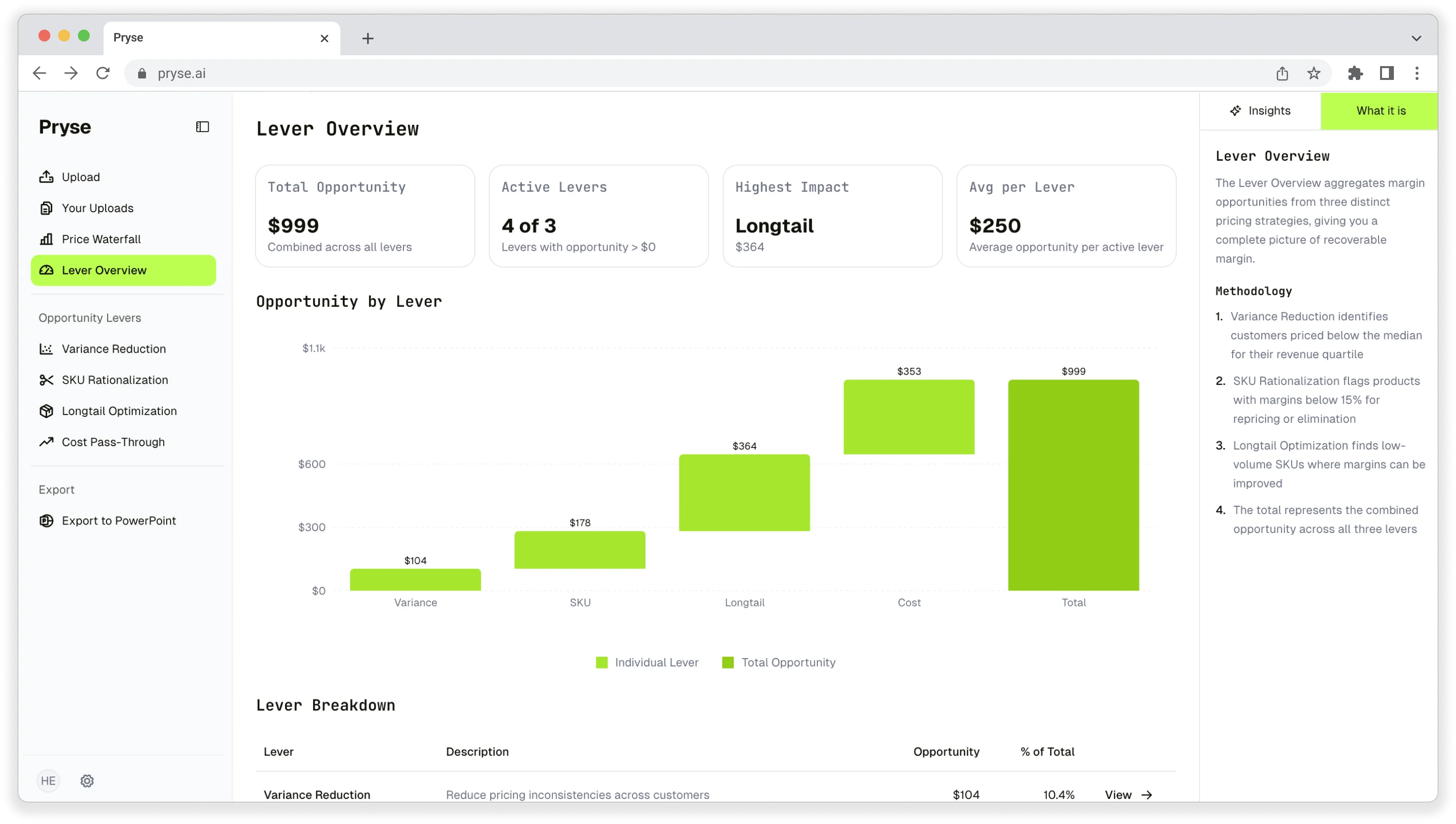
If you're still using Excel for pricing and want to see where you're leaving margin on the table, Pryse delivers a diagnostic analysis of your transaction data in 24 hours for $1,499 one-time. Upload your data and get a price waterfall showing exactly where margin disappears.
Sources:
- Vendavo: What is a Pricing Engine?
- Zilliant: Real-Time Pricing Engine
- Vistaar Technologies: Smart Pricing Engine
- Hypersonix: What Is a Pricing Engine and Why Do You Need One?
- Flintfox: Pricing Software Guide
- Wiser: ERP Software or Pricing Engine?
- Pricefx: 3 Ways to Integrate Your ERP Systems with Pricing Software
- Itransition: ERP Implementation Costs
- ERP Focus: Calculating ERP Implementation Costs
Last updated: February 23, 2026
Frequently Asked Questions
Want to analyze your entire product catalog?
Pryse automatically identifies margin leakage across thousands of SKUs. Upload your data and find hidden profit in 24 hours.
One-time $1,499 diagnostic. No subscription required.