 Pryse
PrysePricing Management Software: Complete Guide to POM Platforms
Compare pricing management platforms for list pricing, discount control, and price governance. Find the right solution for your catalog size and pricing complexity.
Pricing management software centralizes price list creation, discount management, approval workflows, and price governance across products, customers, and channels to manage the operational execution of pricing strategy—who can change prices, when, by how much, and with what approvals.
The global pricing optimization software market is expected to grow from $3.76 billion in 2024 to $11.22 billion by 2032 at a compound annual growth rate of 16.16%, according to MarkWide Research market analysis. This growth is driven by businesses shifting from Excel-based pricing to systematic platforms that reduce errors, improve margin control, and scale pricing across thousands of SKUs.
For mid-market distribution and manufacturing companies, pricing management software sits between basic ERP pricing modules and enterprise optimization platforms. The challenge is understanding which capabilities you actually need and which are expensive overhead.
This post explains what pricing management software does differently from optimization platforms, when it makes sense for your business, what features matter, and how to choose between vendors at different price points.
What Pricing Management Software Actually Does
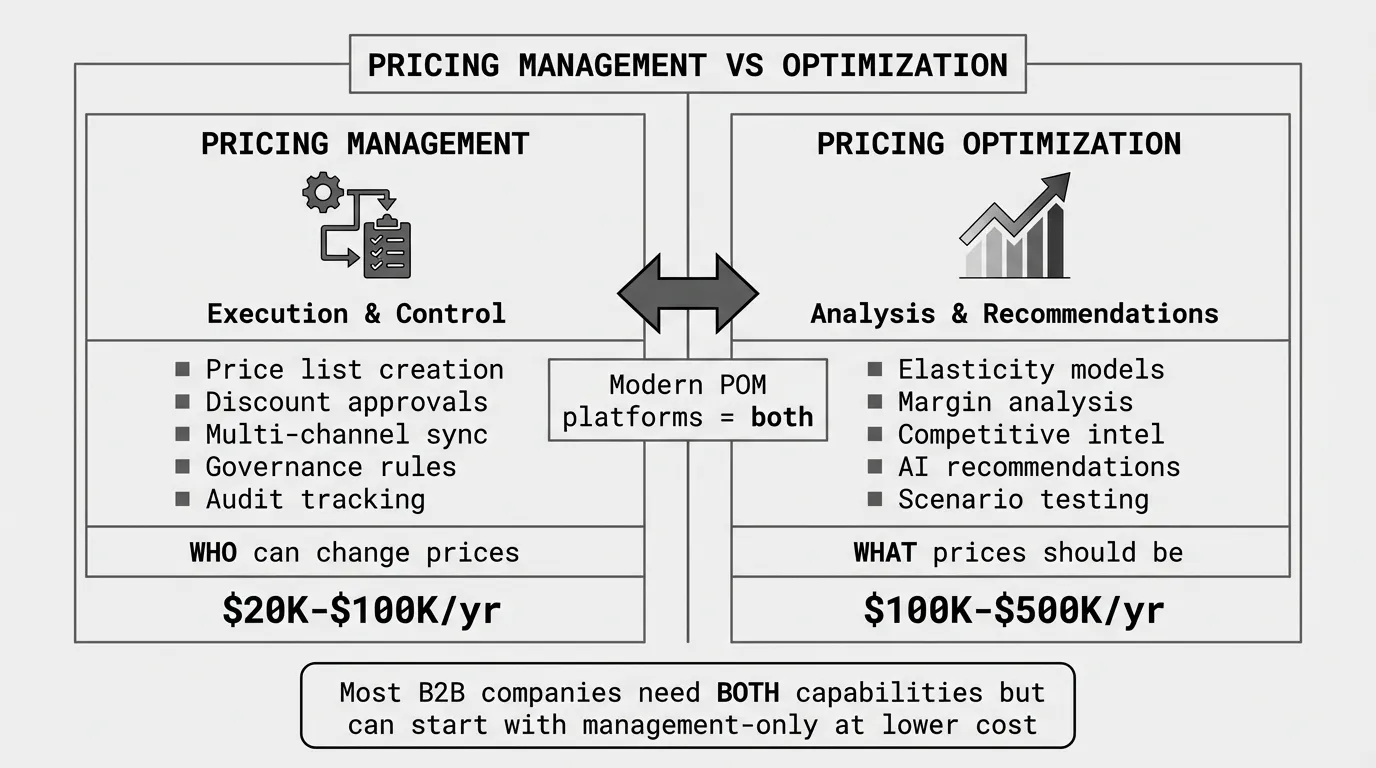
Pricing management software handles the operational side of pricing—creating price lists, controlling discounts, managing approvals, and distributing prices to sales channels. It's the execution layer below pricing strategy.
Core operational capabilities:
- Price list management: Create and maintain master price lists by product, customer segment, region, and channel
- Discount and rebate management: Track discount levels, volume tiers, promotional pricing, and off-invoice rebates
- Approval workflows: Route price change requests through defined approval chains based on margin impact, customer type, or discount depth
- Price governance: Enforce pricing policies through rules like minimum margin thresholds, competitive positioning guardrails, and authorization levels
- Multi-channel distribution: Sync prices to ERP, CPQ, e-commerce, and sales tools automatically
- Audit trails: Track who changed what price, when, and why for compliance and analysis
Where pricing management differs from pricing optimization:
According to Pricefx's analysis of software categories, pricing optimization analyzes data to recommend optimal prices using algorithms, elasticity models, and competitive intelligence. Pricing management implements those recommendations through operational workflows.
Most companies struggle with both. They don't know what prices should be (optimization problem) and they can't control what prices sales actually quotes (management problem).
Modern platforms combine both capabilities under "price optimization and management" (POM). You get analytics to identify optimal prices plus workflows to implement them systematically.
The Five Types of Pricing Software (And Where Management Fits)
The pricing software market breaks into five categories based on primary function. Understanding where each fits helps clarify what "pricing management" actually means.
1. Price Optimization and Management (POM)
Most comprehensive category. Includes analytics, optimization algorithms, workflow management, and governance in one platform.
Best for: B2B companies managing list prices, customer-specific deals, and channel pricing across thousands of SKUs
Leading vendors: Pricefx, PROS, Vendavo, Zilliant
What you get: List price optimization, discount analysis, customer segmentation, approval workflows, price distribution, and reporting
This is what most people mean when they say "pricing management software"—it manages pricing operations but includes optimization capabilities too.
2. Configure-Price-Quote (CPQ)
Generates quotes for complex configurable products based on predefined pricing rules.
Best for: Companies selling products with hundreds of configuration options where sales needs quote generation speed
Leading vendors: Salesforce CPQ, Oracle CPQ, ConnectWise CPQ
What you get: Product configuration, price calculation based on rules, quote generation, approval workflows, CRM integration
CPQ enforces pricing rules at quote time. POM platforms set what those rules should be. Many companies use both.
3. Competitive Intelligence Platforms
Monitor competitor pricing and market positioning to inform your pricing decisions.
Best for: Commodity distributors facing daily competitor price changes who need automated market monitoring
Leading vendors: Competera, Prisync, PROS Intelligence Hub
What you get: Automated competitor price scraping, market positioning dashboards, price change alerts
These feed data into POM platforms but don't handle price list management or approval workflows themselves.
4. Rebate Management Systems
Track and manage complex rebate agreements, volume incentives, and channel partner programs.
Best for: Manufacturers and distributors with multi-tier rebate programs where off-invoice incentives significantly impact realized price
Leading vendors: Enable, Flintfox, Vendavo Rebate Management
What you get: Rebate agreement tracking, accrual calculations, claims processing, reconciliation
Rebate management is a specialized subset of pricing management focused on post-invoice pricing adjustments.
5. Dynamic Pricing Engines
Adjust prices automatically based on real-time signals like demand, inventory, competitor moves, or time of day.
Best for: E-commerce retailers, airlines, hotels, and other high-velocity transactional businesses
Leading vendors: Competera, Perfect Price, Revionics
What you get: Real-time price adjustments, demand sensing, inventory-based pricing, automated repricing
Dynamic pricing rarely fits B2B distribution or manufacturing due to relationship-based selling and long sales cycles.
See Pricefx's guide to pricing software types for detailed capability comparisons.
Pricing Management vs Pricing Optimization: What's the Difference?
The terms overlap, but they emphasize different aspects of pricing operations.
Pricing Optimization: Analysis and Recommendations
Focus: Figuring out what prices should be
Methods:
- Price elasticity modeling to measure demand response
- Competitive benchmarking to understand market positioning
- Margin waterfall analysis to identify leakage
- Customer segmentation to find willingness-to-pay differences
- AI and machine learning for pattern detection
Output: Recommended price lists, suggested discount levels, identified opportunities
Who owns it: Pricing analysts, finance teams, data scientists
Pricing Management: Execution and Governance
Focus: Implementing prices and controlling who can change them
Methods:
- Price list creation and distribution
- Approval workflows with authority levels
- Discount cap enforcement
- Price change tracking and audit
- Multi-channel price synchronization
Output: Controlled price execution, reduced pricing errors, consistent pricing across channels
Who owns it: Sales operations, pricing managers, commercial excellence teams
According to Simon-Kucher's analysis of pricing software needs, most B2B companies need both capabilities. They struggle with "what prices should we charge?" (optimization) and "how do we make sure salespeople actually charge those prices?" (management).
Modern POM platforms combine both. You analyze transaction data to identify optimal prices, then manage implementation through approval workflows and governance rules.
Key Features of Pricing Management Software
Not all platforms include these capabilities. Here's what to expect at different price tiers.
Tier 1: Essential Management Features
Price list creation and maintenance
Build master price lists organized by:
- Product category or SKU
- Customer segment (volume tiers, industries, regions)
- Channel (direct sales, distributor, e-commerce)
- Time period (seasonal pricing, promotional windows)
Most platforms support inheritance logic where customer-specific prices override segment prices which override master list prices.
Discount and margin controls
Set minimum margin thresholds, maximum discount caps, and approval triggers:
- Sales can quote up to 15% off list without approval
- 15-25% discounts require sales manager approval
- 25%+ discounts require VP approval
- Negative margin quotes are blocked
Rules can vary by customer size, product category, or deal value.
Approval workflows
Route price change requests through defined approval chains based on business rules. Track request history, approver comments, and approval time.
Better platforms include mobile approval so managers aren't bottlenecks when traveling.
Basic analytics and reporting
- Margin by product, customer, and salesperson
- Discount frequency and depth analysis
- Price variance tracking (actual vs list price)
- Top underpriced SKUs
Tier 2: Advanced Management Features
Customer-specific pricing rules
Manage negotiated contracts, volume commitments, and special agreements:
- Customer A gets 12% off list on Category X
- Customer B has a floor price of $47.50 on SKU 12345
- Customer C qualifies for volume tier pricing: 1-100 units at list, 101-500 at -8%, 500+ at -15%
Enterprise platforms manage thousands of these agreements automatically instead of relying on sales to remember customer-specific pricing.
Multi-currency and geo-based pricing
Manage price lists across regions with:
- Currency conversion and localization
- Regional cost structures
- Competitive positioning by market
- Regulatory compliance rules
Channel partner pricing
Separate pricing for direct sales, distributors, resellers, and online channels:
- Distributor pricing = COGS × 1.35
- Reseller pricing = Distributor price × 1.15
- Direct e-commerce = List price
- Direct sales = List price with discount authority up to 20%
Tier 3: Optimization Features (POM Platforms)
Price optimization algorithms
Beyond managing prices, platforms analyze data to recommend optimal prices:
- Price elasticity detection across customer segments
- Competitive positioning recommendations
- Margin waterfall analysis showing leakage sources
- Underpriced SKU identification with quantified opportunity
This is where "management" becomes "optimization and management."
Scenario modeling
Test "what if" pricing changes before implementation:
- If we raise Category A prices by 5%, what volume loss and margin gain do we expect?
- If we tighten discount controls from 20% to 15% maximum, what's the margin recovery?
- If we implement cost pass-throughs next quarter, what's customer impact?
Competitive intelligence integration
Platforms ingest competitor pricing data and recommend positioning:
- Price to market (match competitors)
- Price premium (justify with differentiation)
- Price below market (gain share on commodities)
AI-powered recommendations
Machine learning models suggest:
- Customer-specific optimal prices based on buying patterns
- Dynamic discount levels based on deal characteristics
- Price increase timing and magnitude
- Competitive response scenarios
How to Choose Pricing Management Software
Most companies overestimate their need for sophisticated platforms. Start with complexity assessment, not vendor demos.
Decision Framework
Use Excel or ERP pricing if:
- You have under 5,000 active SKUs
- Price lists change quarterly or less frequently
- Discount structures are simple (single markup or standard discount tiers)
- You have under 100 customers with unique pricing
- Sales rarely requests pricing exceptions
Your ERP likely has basic price list management. Excel handles margin analysis. Save $20K-$100K annually until complexity justifies investment.
Choose mid-market POM platforms ($20K-$100K/year) if:
- You have 5,000-50,000 SKUs requiring systematic price list management
- Customer-specific pricing creates manual workload and errors
- Discount control is inconsistent—some reps give away margin while others hold pricing
- You update pricing quarterly and it takes weeks to prepare price lists
- You've identified margin leakage through manual analysis and need execution discipline
Mid-market platforms deliver:
- 1-3 month implementation timelines
- CSV-based ERP integration (export/import workflows)
- Rule-based optimization (you define pricing logic)
- Email support with some implementation help
- 1-2% margin improvement from better discount control
Choose enterprise POM platforms ($100K-$500K/year) if:
- You have 50,000+ SKUs with frequent price changes
- Multi-tier channels (distributors, resellers, direct) require coordinated pricing
- Customer-specific deals number in the hundreds or thousands
- Real-time competitive pricing matters (commodity markets with daily price changes)
- You have a dedicated pricing team managing optimization and execution
- Implementation capacity exists for 6-18 month projects
Enterprise platforms deliver:
- Live ERP integration with real-time data sync
- AI-powered optimization recommendations
- Advanced analytics and scenario modeling
- Dedicated implementation and support teams
- 2-5% margin improvement from optimization plus execution
Red flags—you're not ready for pricing management software if:
- Your transaction data is incomplete or unreliable (missing costs, duplicate SKUs, poor customer records)
- You don't have clear pricing strategy or objectives
- Leadership won't support price increases regardless of data
- Your sales team is completely independent without pricing discipline
- You haven't done basic margin analysis to quantify the opportunity
According to G2 reviews of pricing software, the most common failure mode is buying sophisticated tools before fixing data quality and organizational readiness. Clean data and pricing discipline beat advanced algorithms.
Feature Priorities by Company Size
$10M-$50M revenue (5K-20K SKUs)
Must-have features:
- Price list creation and distribution
- Basic discount controls and approvals
- Margin reporting by product and customer
- CSV export/import for ERP integration
Nice-to-have features:
- Customer-specific pricing rules
- Volume tier automation
- Margin waterfall visualization
Skip for now:
- AI optimization algorithms
- Real-time competitive intelligence
- Multi-currency and geo pricing
$50M-$200M revenue (20K-100K SKUs)
Must-have features:
- Everything from the $10M-$50M list
- Customer contract management
- Channel partner pricing rules
- Approval workflows with mobile access
- Detailed discount pattern analysis
Nice-to-have features:
- Basic elasticity modeling
- Scenario testing
- Competitive positioning dashboards
Skip for now:
- Advanced AI recommendations
- Autonomous dynamic pricing
$200M+ revenue (100K+ SKUs)
Must-have features:
- Everything from previous tiers
- Live ERP integration
- AI-powered optimization
- Multi-channel price synchronization
- Advanced analytics and forecasting
- Dedicated support and training
Nice-to-have features:
- Real-time competitive repricing
- Predictive margin modeling
- Integration with CPQ, CRM, and BI tools
Pricing Management Software Costs
Software subscription is only part of total cost of ownership.
Subscription Pricing Models
Per-user pricing: $100-$500 per user per month
Common for CPQ-embedded pricing. Works if you have 5-20 pricing and sales ops users. Gets expensive at scale.
Flat subscription: $20K-$500K annually
Most POM platforms use tiered flat pricing based on:
- Revenue size
- SKU count
- Transaction volume
- Number of channels
- Modules included (optimization, rebates, CPQ)
Negotiate based on actual usage, not maximum potential usage.
Transaction-based: Variable monthly cost
Some platforms charge per quote generated, price change executed, or transaction processed. Predictable for low-volume businesses, risky for high-volume.
According to Zylo's analysis of AI pricing models, nearly half (49%) of AI-enabled pricing vendors use hybrid models combining subscription fees with usage-based charges. Budget 20-30% above quoted subscription for consumption overages.
Implementation Costs
Budget 0.5-3x annual subscription for implementation depending on complexity:
Mid-market platforms: $10K-$50K implementation
- Data extraction and mapping from ERP
- Price list configuration and rules setup
- User training and change management
- CSV integration testing
- Timeline: 1-3 months
Enterprise platforms: $100K-$1M+ implementation
- Live API integration with ERP systems
- Custom model training on your transaction data
- Advanced workflow configuration
- Multi-team training and rollout
- Timeline: 6-18 months
Hidden Ongoing Costs
Don't forget:
IT support: $10K-$50K annually for integration maintenance, troubleshooting, and security updates
Training: $5K-$20K annually for onboarding new users and refresher training as features evolve
Data quality: 20-40% of implementation time typically goes to cleaning ERP data before it's usable
Change management: Pricing changes affect sales compensation, customer relationships, and margin. Budget for communication, enablement, and handling pushback.
Cost-Benefit Reality Check
Pricing management software ROI comes from margin improvement, not cost savings.
Typical margin improvements:
- Mid-market platforms: 1-3% margin improvement from better discount control and systematic pricing
- Enterprise platforms: 2-5% margin improvement from optimization plus execution discipline
Break-even math:
A $50M distributor with 25% gross margin has $12.5M in gross profit. A 2% margin improvement generates $1M in additional gross profit. If the software costs $50K/year + $25K implementation, it pays back in under one year.
But that assumes:
- Clean transaction data exists
- Sales team adopts new workflows
- Leadership supports recommended price changes
- Implementation stays on schedule and budget
Companies that treat pricing software as a technology project (not a business transformation) often fail to capture projected ROI.
Leading Pricing Management Software Vendors
The market splits between enterprise platforms for complex global businesses and mid-market solutions for growing regional companies.
Enterprise Platforms
Pricefx
Pricefx is a cloud-based AI price management, optimization, and CPQ platform. It holds 26.87% market share with 208 enterprise customers according to Capterra's 2026 analysis.
Strong for:
- B2B manufacturers and distributors
- Modular implementation (start with analytics, add optimization later)
- Price list management across complex channel structures
PROS
PROS Smart Price Optimization and Management is an omnichannel pricing solution defining pricing strategies, managing prices across channels and geographies, governing approval processes, and providing analytics.
According to Gartner Peer Insights, PROS holds 18.48% market share with 143 enterprise customers and strong AI capabilities.
Strong for:
- Industries with high pricing velocity (industrials, chemicals, building materials)
- Advanced machine learning for elasticity modeling
- Real-time pricing recommendations
Vendavo
Enterprise pricing and CPQ solution for complex B2B deal management. Built specifically for manufacturers and distributors managing channel partners and customer-specific agreements.
Strong for:
- Global manufacturers with multi-tier channel pricing
- Price-volume-mix analysis and margin waterfalls
- Large-scale rebate management
Zilliant
Zilliant manages the complete B2B pricing lifecycle from list prices to customer deals with AI-driven recommendations.
Strong for:
- Large B2B SKU catalogs (chemicals, distribution, building materials)
- Sales guidance and deal scoring
- Advanced segmentation and personalization
Mid-Market Platforms
Competera
AI-powered pricing platform for retail and e-commerce with competitive intelligence and optimization.
Strong for:
- Commodity distributors facing frequent competitor price changes
- E-commerce channel pricing
- Real-time repricing based on market signals
Conga
Conga provides CPQ and contract lifecycle management with embedded pricing optimization capabilities.
Strong for:
- Companies needing combined CPQ and pricing management
- Contract-based pricing with approval workflows
- Mid-market businesses wanting unified commercial platform
Vistaar
SaaS platform for pricing, promotion, and rebate management using predictive models.
Strong for:
- Mid-market companies not ready for enterprise complexity or cost
- Faster implementation than enterprise platforms
- Regional deployments
Specialized Solutions
Enable (Rebate Management)
Enable focuses specifically on rebate and incentive management for manufacturers and distributors with complex off-invoice programs.
Omnia (Retail Pricing)
According to G2's Winter 2026 Grid for Retail Pricing Software, Omnia leads in both customer satisfaction and market presence for retail and e-commerce pricing.
Alternatives to Pricing Management Software
Not every company needs specialized software. Several alternatives deliver margin improvement without subscriptions.
ERP Pricing Modules
Your ERP (NetSuite, SAP Business One, Acumatica, Dynamics 365) likely includes:
- Basic price list management by customer and product
- Simple discount rules and approvals
- Margin reporting
When ERP pricing works:
You have under 5,000 SKUs, straightforward pricing logic, and infrequent price changes. Extending your existing ERP is cheaper than adding new software.
When ERP pricing fails:
Complex customer agreements, channel partner pricing, or optimization analytics. ERPs handle transactions well but lack sophisticated pricing capabilities.
See our ERP pricing guide for detailed comparison of ERP pricing modules and when to supplement with dedicated software.
Excel-Based Analysis
For companies with under 10,000 SKUs and straightforward pricing structures, Excel delivers 80% of the insight at 1% of the cost.
What works in Excel:
- Margin analysis by product, customer, and salesperson
- Price waterfall visualization showing list-to-pocket erosion
- Underpriced product identification
- Discount pattern analysis
What doesn't scale in Excel:
- Customer-specific pricing rules across hundreds of customers
- Approval workflows and governance
- Real-time price distribution to sales channels
- Statistical optimization algorithms
See our guide on margin analysis in Excel for step-by-step instructions.
Pricing Diagnostics (One-Time)
Before committing to ongoing software, run a one-time diagnostic to quantify margin leakage and prioritize opportunities.
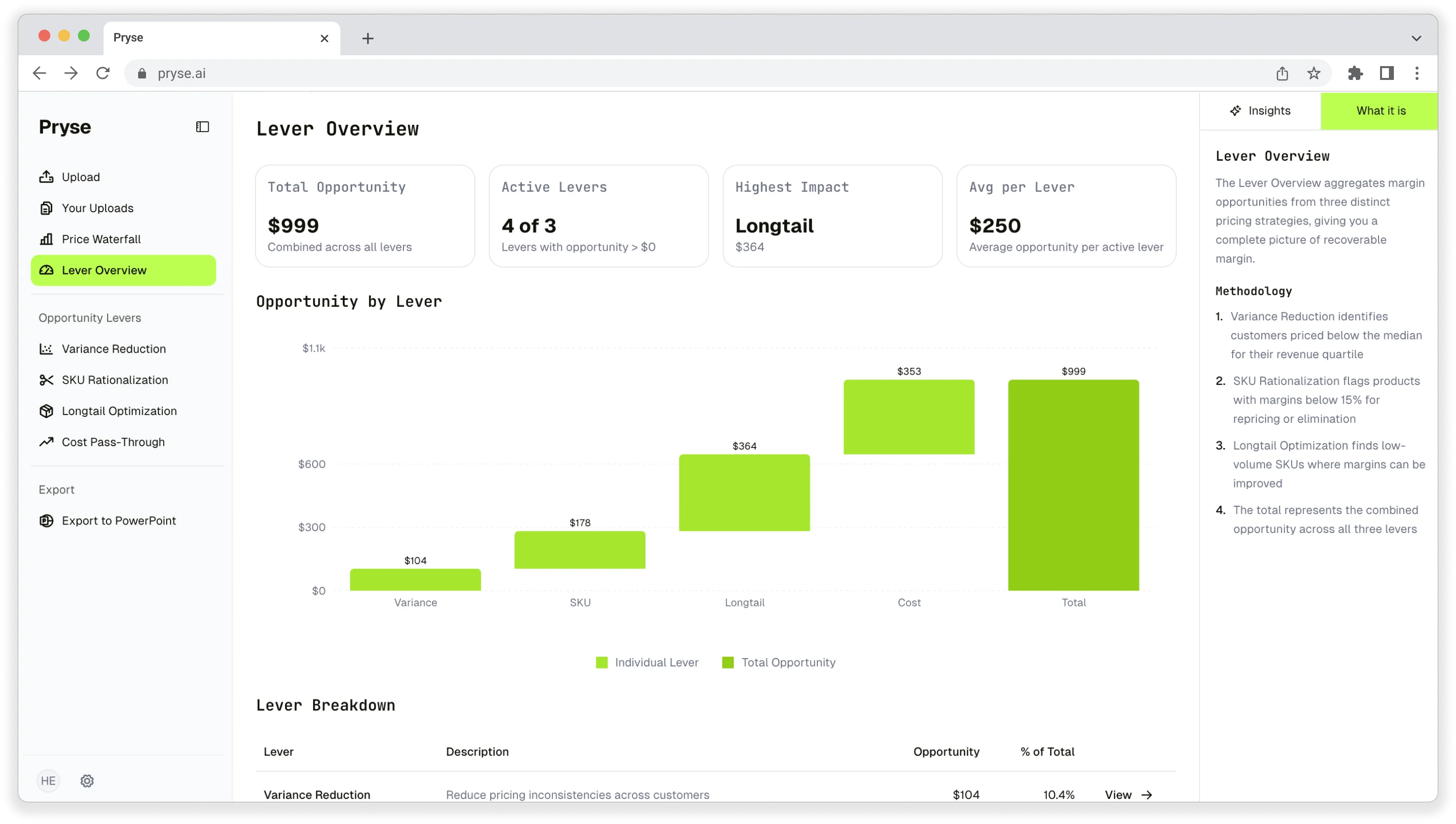
Pryse provides self-serve margin diagnostics for $1,499. Upload your transaction CSV and receive a complete margin analysis within 24 hours showing:
- Price waterfall visualization
- Top margin leakage sources ranked by $ opportunity
- Underpriced products and customers
- Quick-win pricing adjustments
Most companies recover 3-10x the diagnostic cost by implementing the top 5 recommendations. If your opportunities are small, you've saved $20K-$100K annually by not investing in software you don't need.
Implementation: How to Actually Deploy Pricing Management Software
Pricing management software fails when companies treat it as plug-and-play technology. Successful implementations follow a structured approach.
Phase 1: Data Preparation (Months 1-2)
Extract and clean transaction data from your ERP:
Minimum required data:
- 12 months of transaction history (more is better)
- SKU identifier, description, and product category
- Customer identifier, name, and segment
- Invoice price, list price, and quantity
- Cost (COGS)
- Transaction date
Data quality issues to fix before implementation:
- Duplicate SKU codes for the same product
- Missing or zero cost data
- Inactive customers still in pricing systems
- Inconsistent product categorization
- Incorrect customer segment assignments
Most companies discover they're not as data-ready as they thought. Budget 20-40% of implementation time for data cleaning.
Phase 2: Configuration and Setup (Months 2-4)
Work with your vendor to configure the platform:
Price list structure:
- Master list by product category
- Customer segment overrides (volume tiers, industries, regions)
- Individual customer exceptions
- Channel-specific pricing (direct, distributor, e-commerce)
Approval workflows:
- Define authority levels (rep, manager, director, VP)
- Set discount thresholds triggering approvals
- Configure margin floor rules
- Build exception request processes
Integration setup:
- Map ERP fields to platform fields
- Configure data export schedules
- Test price synchronization
- Build error handling for data mismatches
Phase 3: Testing and Validation (Month 4-5)
Test the system with real scenarios before going live:
Test cases:
- Create sample price lists and verify accuracy
- Submit pricing exception requests through approval workflows
- Generate margin reports and compare to manual calculations
- Sync prices to ERP and verify correct distribution
- Test edge cases (multi-tier discounts, promotional pricing, volume commitments)
Involve sales managers and pricing analysts in testing to catch issues before rollout.
Phase 4: Training and Rollout (Months 5-6)
Train users by role:
Pricing analysts: Price list creation, optimization tools, reporting Sales managers: Approval workflows, exception handling, team performance dashboards Sales reps: Quote generation with system pricing, exception requests, deal guidance
Roll out in phases:
- Week 1: Pricing and finance teams only
- Weeks 2-4: Sales management
- Weeks 5-8: Full sales team by region or product line
Monitor adoption, collect feedback, and iterate on workflows.
Phase 5: Continuous Improvement (Month 6+)
Pricing management isn't set-and-forget technology:
Monthly reviews:
- Discount pattern analysis (are controls working?)
- Margin performance by product and customer
- Exception request volume and approval rates
- Pricing errors or system issues
Quarterly optimization:
- Review and update pricing rules based on market changes
- Analyze elasticity and competitive positioning
- Test scenario models for upcoming price changes
- Refresh training for new team members
Annual strategic review:
- Evaluate margin improvement vs baseline
- Assess ROI and justify renewal
- Plan feature expansion (add CPQ, rebate management, etc.)
Common Implementation Mistakes
Companies waste time and money on pricing management software by:
Buying before understanding requirements
Vendors sell comprehensive platforms, but you might only need price list management and discount controls, not AI optimization. Define requirements first, demo second.
Underestimating data cleanup
If your ERP has duplicate SKUs, missing costs, or inconsistent customer records, software won't fix that. Clean data first or budget extra time for data prep.
Skipping change management
Sales teams resist new systems that constrain discount authority. Without communication about why pricing discipline matters and training on new workflows, adoption fails.
Implementing too much at once
Start with core capabilities (price lists, approvals, basic analytics), validate success, then expand to advanced features. Big-bang implementations often stall.
Trusting vendor timelines
Vendors quote 3-month implementations. Reality for mid-market companies is 4-6 months. Enterprise deployments take 12-18 months despite 6-9 month estimates.
Not measuring baseline
If you don't document current margin by product and customer before implementation, you can't prove ROI after. Establish baseline metrics.
Should You Invest in Pricing Management Software?
Here's the decision framework:
Clear yes if:
- You have 10,000+ SKUs with complex customer-specific pricing
- Discount control is inconsistent—margin varies wildly by rep
- Price list preparation takes weeks and contains errors
- You've quantified $500K+ in margin leakage through manual analysis
- You have clean ERP data with 12+ months of transaction history
- Budget exists for $20K-$100K annually and 3-6 month implementation
Clear no if:
- You have under 5,000 SKUs with straightforward pricing
- Price lists change once or twice per year
- Your ERP handles current pricing complexity adequately
- You haven't done basic margin analysis to understand opportunities
- Transaction data is incomplete or unreliable
- Sales team operates independently without pricing discipline
Maybe—start with diagnostics if:
- You're in the 5,000-20,000 SKU range with moderate complexity
- You suspect margin leakage but haven't quantified it
- Budget allows for software but not if ROI is unclear
- You're willing to pilot with limited scope before full rollout
For most mid-market distributors and manufacturers reading this, the right answer is: not yet. Start with margin diagnostics, quantify the opportunity, fix obvious issues with improved processes, and revisit software when you've maxed out manual approaches.
Companies generating real value from pricing management software didn't start there. They built pricing discipline through analysis and process improvement first, then added software to scale what was already working.
Next Steps
Before evaluating vendors, understand your baseline pricing performance. Most companies discover they have $100K-$1M in recoverable margin they didn't know about.
Run a margin diagnostic first. This costs $1,499 with Pryse and takes 24 hours from CSV upload to results. You'll learn:
- Your actual margin by product and customer (most companies are surprised)
- Where margin leakage occurs and how much is recoverable
- Whether Excel, mid-market software, or enterprise platforms make sense for your complexity
- Which capabilities you actually need vs vendor upsells
Start with diagnostics. Invest in software once you've confirmed the opportunity, quantified the ROI, and built organizational readiness.
For companies ready to explore broader pricing optimization strategy beyond software tools, see our complete pricing optimization guide covering frameworks, organizational design, and implementation best practices.
Sources
- G2: Best Pricing Software User Reviews 2026
- Capterra: Best Pricing Optimization Software 2026
- Monday.com: Pricing Software Solutions - The Definitive Guide for 2026
- Gartner Peer Insights: PROS Smart Price Optimization & Management Reviews 2026
- Gartner Peer Insights: Best B2B Profit Optimization Software Reviews 2026
- Pricefx: The 5 Types of Pricing Software
- Pricefx: Pricing Software vs Pricing Solution: What's the Difference?
- Simon-Kucher: What Type of Pricing Software Do I Need?
- Zilliant Blog: Pricing Software - What It Is and How It Works
- Enable: Rebate vs Pricing Optimization
- MarkWide Research: B2B Price Optimization and Management Software Market Analysis 2025-2034
- OpenPR: B2B Price Optimization Software Market Set to Boom
- Zylo: 175+ Unmissable SaaS Statistics for 2026
- Conga: Price Optimization and Management Software
Last updated: February 23, 2026
Frequently Asked Questions
Want to analyze your entire product catalog?
Pryse automatically identifies margin leakage across thousands of SKUs. Upload your data and find hidden profit in 24 hours.
One-time $1,499 diagnostic. No subscription required.