 Pryse
PryseB2B Pricing Software: Buyer's Guide for Distribution and Manufacturing
Compare B2B pricing software for mid-market distributors and manufacturers. Learn what B2B pricing platforms do, key features, costs, and when to invest.
B2B pricing software automates complex pricing calculations for business-to-business transactions, handling customer-specific pricing, volume discounts, contract terms, rebates, and multi-tier channel pricing to prevent discount erosion and deliver real-time insights into buyer behavior and pricing performance.
According to Gitnux's 2026 ranking of B2B pricing software, B2B pricing software includes functions that allow sales staff to set custom prices for individual customers or customer categories based on volume, demand, payment conditions, contract conditions, customer value, and sales targets.
Unlike B2C pricing software that focuses on dynamic retail pricing and promotions, B2B platforms handle the complexity of relationship-based pricing where every customer might have different terms, volume breaks, rebates, and contract pricing. A $50M distributor might manage 10,000 SKUs across 300 customers with dozens of different pricing agreements.
This post explains what B2B pricing software does, how it differs from general pricing tools, when mid-market distributors and manufacturers need dedicated platforms, and compares leading solutions by features and cost.
What B2B Pricing Software Does
B2B pricing platforms solve the complexity of business-to-business pricing that Excel and basic ERP systems can't handle at scale.
Core capabilities across all B2B pricing platforms:
- Customer-specific pricing: Manages individual price lists, contracts, and negotiated terms for hundreds or thousands of customers
- Contract pricing management: Tracks agreement terms, expiration dates, volume commitments, and automatic renewals
- Volume discount tiers: Applies quantity breaks automatically based on order size or annual volume
- Rebate and allowance tracking: Calculates supplier rebates, customer allowances, co-op funds, and other off-invoice deductions
- Approval workflows: Routes discount requests and exceptions through defined approval chains with margin thresholds
- Price waterfall analysis: Shows list-to-pocket price erosion through discounts, rebates, freight, and terms
- Margin reporting: Breaks down profitability by customer, product, region, and transaction
What differentiates enterprise from mid-market platforms:
- AI-powered optimization: Enterprise tools use machine learning to recommend optimal prices. Mid-market platforms use rule-based logic you define.
- Real-time pricing: Advanced platforms update prices continuously based on costs, competitors, and inventory. Basic tools produce quarterly price lists.
- CPQ integration: Enterprise platforms include Configure-Price-Quote for complex product configuration. Mid-market tools focus on price list management.
- Channel complexity: Enterprise platforms handle multi-tier distribution (manufacturer → distributor → dealer → end user). Basic tools handle single-tier pricing.
According to Monday.com's 2026 pricing software guide, pricing software typically falls into four categories: Pricing Analytics (surfaces historical data and deal trends), Price Management (centralizes pricing rules), Price Optimization (uses AI to recommend price changes), and Price Execution (automates quoting and approval flows).
B2B vs. B2C Pricing Software
These represent fundamentally different pricing challenges and require different software capabilities.
| Aspect | B2B Pricing Software | B2C Pricing Software |
|---|---|---|
| Primary use case | Relationship-based pricing with contracts | Transaction-based pricing for consumers |
| Pricing complexity | Customer-specific pricing, contracts, rebates | Uniform pricing with promotions |
| Volume discounts | Multi-tier volume breaks, annual commitments | Bulk discounts, cart-level promotions |
| Quote management | Custom quotes with approval workflows | Self-service checkout with fixed prices |
| Competitive focus | Long-term value, total cost of ownership | Real-time price matching, promotions |
| Price changes | Quarterly updates with customer notification | Daily or hourly dynamic pricing |
| Payment terms | Net 30/60/90, early payment discounts | Credit card, immediate payment |
| Integration focus | ERP, CPQ, contract management | Ecommerce, point-of-sale, inventory |
| Decision complexity | Multiple stakeholders, procurement approval | Individual purchase decisions |
Practical example:
-
B2B pricing: An electrical distributor manages 12,000 SKUs across 400 contractor customers. Each customer has a different price list based on annual volume commitments, negotiated margins, freight terms, and rebate participation. Prices update quarterly based on supplier cost changes, with customer notification 30 days in advance. Custom quotes require approval when margin falls below 15%.
-
B2C pricing: An online retailer adjusts prices hourly based on competitor pricing, inventory levels, and demand patterns. All customers see the same price. Promotions run automatically during peak shopping hours. No quotes or approvals required.
B2C pricing tools like Prisync or Competera focus on dynamic repricing and competitive monitoring. B2B tools like Vendavo or Pricefx focus on relationship management, contract compliance, and margin protection across complex customer hierarchies.
When Mid-Market Companies Need B2B Pricing Software
Not every distributor or manufacturer requires dedicated pricing platforms. Here's when software delivers clear ROI versus Excel or ERP-native pricing.
Clear Yes: Need Dedicated Software
Customer-specific pricing across 100+ accounts
When you maintain different price lists, contract terms, or negotiated pricing for 100+ customers, Excel becomes unmanageable. A $40M distributor with 200 active customers and customer-specific pricing can't track contract expirations, volume commitments, and margin targets manually.
B2B pricing software centralizes customer pricing rules, automates contract renewals, flags margin exceptions, and ensures sales reps quote correct prices consistently.
5,000+ SKUs with frequent price changes
Companies managing 5,000+ SKUs that reprice quarterly or more frequently can't maintain pricing accuracy in Excel. Cost changes, supplier increases, and competitive adjustments create hundreds of price updates monthly.
Pricing software connects to your ERP, applies pricing rules automatically, and identifies which products need attention based on margin thresholds or market movement.
Multi-tier channel pricing (manufacturer → distributor → dealer)
Manufacturers selling through distributors and dealers need software to manage channel pricing, dealer rebates, market development funds, and price protection. Excel can't track channel compliance or prevent margin erosion when dealers undercut pricing guidelines.
According to Gartner Peer Insights reviews of B2B profit optimization software, enterprise buyers report that while platforms deliver 2-5% margin improvement, complexity and cost make them viable only for companies with dedicated pricing teams and millions in recoverable margin.
Complex rebate structures (volume, growth, mix)
Distributors participating in supplier rebate programs with volume tiers, growth incentives, and product mix requirements need software to track accrual, forecast payouts, and ensure targets are met.
Manual rebate tracking in Excel leads to $50K-$500K annual leakage when expected rebates don't materialize or eligibility requirements aren't met.
Probably Yes: Software Helps But Not Urgent
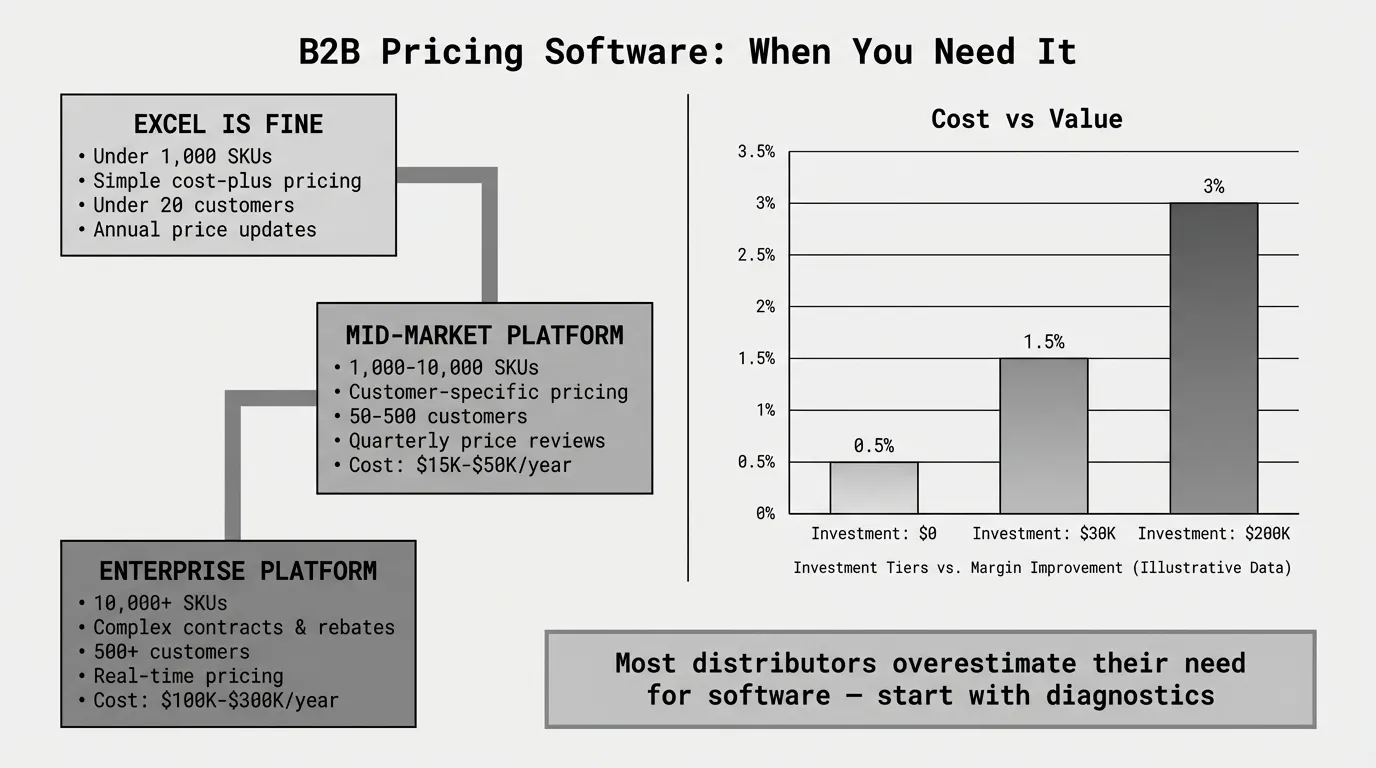
1,000-5,000 SKUs with quarterly pricing reviews
Companies in this range outgrow Excel but can delay software investment if pricing is relatively stable. Start with Excel analysis to quantify margin leakage. Invest in software when Excel limitations block improvement.
50-100 customers with contract pricing
Managing 50-100 customer contracts is painful in Excel but not impossible. Consider software when contract complexity increases (volume commitments, tiered discounts, rebate participation) or when you're missing renewal opportunities.
Growing from regional to multi-region operations
As you expand geographically, pricing complexity grows with regional pricing, freight zones, and local competitors. Software provides consistent pricing governance across regions.
Probably No: Excel or ERP Sufficient
Under 500 SKUs with simple cost-plus pricing
A specialty manufacturer with 300 SKUs, 20 customers, and straightforward cost-plus markup can manage pricing effectively in Excel or ERP-native pricing tables.
Under 20 customers, all on standard price lists
Small distributors serving fewer than 20 customers using published price lists don't need software complexity. Excel handles margin analysis and occasional price list updates.
Annual price changes based solely on supplier costs
If you update prices once or twice annually by passing through supplier cost changes with standard markups, Excel suffices. Software delivers value when you move to value-based or competitive pricing requiring market analysis.
Poor ERP data quality or incomplete transaction records
Pricing software can't fix bad data. If your ERP has inconsistent SKU codes, missing cost records, or unreliable customer master data, clean the foundation first before adding software complexity.
Types of B2B Pricing Software
The market splits into three tiers based on company size, pricing complexity, and implementation approach.
Enterprise B2B Pricing Platforms ($100K-$300K annually)
Best for: $100M+ revenue, 10,000+ SKUs, multi-tier channels, dedicated pricing teams
Leading vendors: Vendavo, Pricefx, PROS, Zilliant
What you get:
- AI-powered price optimization using machine learning to detect elasticity and recommend optimal prices
- CPQ (Configure-Price-Quote) for complex product configurations and quote automation
- Advanced analytics including margin waterfalls, customer profitability, and price-volume-mix analysis
- Multi-tier channel management for manufacturers selling through distributors and dealers
- Rebate management tracking supplier and customer rebates, co-op funds, and market development funds
- Deep ERP integration via APIs for automated data sync with NetSuite, SAP, D365, Oracle
- Dedicated implementation teams and ongoing support
What it costs:
Annual subscriptions range from $100K to $300K depending on SKU count, user count, modules, and data complexity. Implementation adds 1-3x the annual subscription (typically $150K-$500K) for data integration, rule configuration, and sales training.
Implementation timeline: 6-18 months from contract signing to production use.
According to Monday.com, most pricing software starts around $50K-$100K annually, with additional costs for setup, integration, and users, while enterprise features like price optimization or usage modeling drive costs higher, and implementation typically takes 3-6 months.
When it makes sense:
You have a dedicated pricing team (2+ FTEs), complex B2B pricing requiring daily optimization, and can justify $100K+ annually from 2-5% margin improvement on $100M+ revenue (at least $2M-$5M annual benefit).
Mid-Market B2B Pricing Tools ($15K-$50K annually)
Best for: $20M-$100M revenue, 1,000-10,000 SKUs, quarterly price reviews
Examples: Mid-market pricing consultancies with software, specialized B2B platforms, ERP add-ons
What you get:
- Rule-based pricing that applies formulas you define (cost-plus, competitive positioning, margin targets)
- Customer price list management with contract tracking and approval workflows
- Basic margin analysis showing profitability by customer, product, and transaction
- Price waterfall visualization displaying list-to-pocket erosion
- CSV upload/download workflows instead of live ERP integration
- Email support with implementation guidance
What it costs:
Annual subscriptions range from $15K to $50K. Implementation typically costs 0.5-1x the annual subscription ($8K-$25K) for data setup, rule configuration, and user training.
Implementation timeline: 2-4 months.
When it makes sense:
You've outgrown Excel, need systematic price list management across 1,000+ SKUs, and can justify $15K-$50K annually for 1-2% margin improvement on $30M+ revenue.
ERP-Native Pricing (included with ERP subscription)
Best for: Small to mid-market companies using modern ERPs, simple pricing needs
Examples: NetSuite pricing management, SAP pricing, D365 pricing, Acumatica pricing
What you get:
- Customer price lists and volume discount tiers built into ERP
- Basic contract pricing with start/end dates
- Standard margin reports by product and customer
- Approval workflows for discounts below thresholds
- Native integration (no separate platform to manage)
What it costs:
Included with ERP subscription or available as add-on module for $2K-$10K annually depending on ERP platform and user count.
When it makes sense:
Your pricing complexity fits within ERP-native capabilities, you're not ready to invest in dedicated pricing platforms, and your ERP has modern pricing features.
According to Blulink ERP's guide to pricing software for distributors, Acctivate's pricing and inventory management software serves small-to-mid-sized manufacturers, distributors, and online retailers who use QuickBooks, and for pricing, Acctivate tracks historical data on sales, shipping and customs costs, risk, and overhead.
Key Features for B2B Distributors and Manufacturers
B2B pricing software should include these capabilities to address distribution and manufacturing pricing complexity.
Customer-Specific Pricing
What it does: Maintains individual price lists, negotiated terms, and contract pricing for hundreds or thousands of customers without manual spreadsheets.
Why it matters for B2B: Distribution and manufacturing pricing is relationship-based. Two customers buying the same product might pay different prices based on volume commitments, contract terms, competitive situations, or strategic value.
Critical capabilities:
- Customer price list hierarchy (default → product category → individual SKU overrides)
- Contract pricing with start/end dates and automatic expiration notifications
- Price change workflows that notify customers 30-60 days in advance
- Historical price tracking showing what each customer paid over time
Landed Cost Tracking
What it does: Calculates true cost including freight, duties, handling, and other landed cost components to show real margin, not just invoice margin.
Why it matters for B2B: Distributors offering "freight included" pricing or manufacturers importing components need landed cost visibility. Invoice margin might show 25%, but pocket margin after freight and terms could be 18%.
According to Blulink ERP's guide, essential features to look for in pricing software include customer-specific and contract pricing, landed cost tracking to determine the true cost of imported products accurately, automated reporting for timely decision-making, and seamless integration with other systems.
Critical capabilities:
- Freight cost allocation by customer, order, or product
- Import duty tracking for international products
- Handling and warehousing cost allocation
- Payment term cost calculations (cost of extending Net 30/60/90 terms)
Volume Discount Management
What it does: Applies quantity breaks automatically based on order size, monthly volume, or annual commitments without manual calculation.
Why it matters for B2B: Volume discounts drive larger orders and customer loyalty, but manual calculation in quotes is error-prone. Software ensures consistency and tracks whether volume commitments are being met.
Critical capabilities:
- Multi-tier volume breaks (buy 100 = 5% off, buy 500 = 10% off, buy 1000 = 15% off)
- Annual volume tracking showing progress toward tier thresholds
- Alerts when customers approach tier breakpoints
- Volume discount simulation showing margin impact
Rebate and Allowance Tracking
What it does: Tracks supplier rebates, customer allowances, co-op funds, and other off-invoice deductions that impact net cost and realized margin.
Why it matters for B2B: Distributors participating in supplier rebate programs need to track volume toward rebate tiers and ensure payouts materialize. Manufacturers offering dealer rebates need visibility into program costs and compliance.
Critical capabilities:
- Rebate accrual calculations showing expected rebate based on current volume
- Tier tracking with alerts as volume approaches breakpoints
- Rebate realization tracking (accrued vs. paid)
- Customer rebate management for dealer and distributor programs
Price Waterfall Analysis
What it does: Visualizes how list price erodes to pocket price through sequential deductions: invoice discounts, rebates, freight, payment terms, and other allowances.
Why it matters for B2B: Most distributors and manufacturers don't know their true pocket margin. Price waterfalls reveal where margin leaks and quantify $ opportunity in each leakage category.
Critical capabilities:
- Multi-level waterfall (list → invoice → pocket → net)
- Waterfall by customer, product, or transaction
- Leakage categorization and $ quantification
- Historical waterfall trends showing whether leakage is increasing
See our complete price waterfall analysis guide for detailed explanation of waterfall components and interpretation.
Quote and Approval Workflows
What it does: Routes discount requests and pricing exceptions through defined approval chains with margin thresholds to prevent unauthorized discounting.
Why it matters for B2B: When 5-10 sales reps can approve discounts, consistency breaks down and margin erodes. Software ensures discounts follow approval rules and creates accountability.
Critical capabilities:
- Configurable approval chains based on discount depth or margin impact
- Automatic routing to appropriate approvers
- Approval history and audit trail
- Discount pattern reporting by rep showing who approves deepest discounts
ERP Integration
What it does: Connects pricing software to your ERP system for automated data sync, eliminating manual CSV exports and imports.
Why it matters for B2B: Companies processing hundreds of transactions weekly can't manually export transaction data, analyze it, then upload price changes back to the ERP. Automation is required for pricing to scale.
Critical capabilities:
- API integration with major ERPs (NetSuite, SAP, D365, Oracle, Epicor)
- Scheduled data sync (hourly, daily, or weekly depending on needs)
- Bidirectional sync (pull transaction data, push price updates)
- Error handling and validation for failed syncs
Leading B2B Pricing Software Platforms
Here's a detailed comparison of market-leading platforms based on 2026 capabilities and customer feedback.
Vendavo (Enterprise)
Best for: Large distributors and manufacturers with complex B2B pricing and multi-tier channels
Capabilities:
- Enterprise pricing and CPQ solution for complex B2B deal management
- Strong in distribution vertical with channel pricing complexity
- Price-volume-mix analysis and margin waterfall visualization
- Customer-specific pricing and contract management
- Rebate and promotional management
- Deal guidance showing optimal pricing for specific opportunities
Pricing: Custom quotes, typically $100K-$300K annually for mid-market to enterprise deployments.
Typical customers: Large distributors, industrial manufacturers, chemical companies with $100M+ revenue.
According to Blulink ERP's analysis, Vendavo is considered one of the best pricing software solutions for manufacturers and distributors, offering robust analytics and optimization capabilities specifically tailored to the needs of manufacturers and distributors.
Pricefx (Enterprise)
Best for: Mid-market to enterprise B2B companies needing modular approach
Capabilities:
- Cloud-native SaaS platform for B2B pricing management, optimization, and analytics
- Modular architecture allows companies to start with price management and add optimization later
- CPQ, price optimization, analytics, and discount management modules
- Strong in manufacturing and distribution verticals
- AI-driven simulations and price elasticity modeling
Pricing: Custom quotes starting at $50K-$100K annually depending on modules selected.
Typical customers: B2B manufacturers and distributors from $50M to multi-billion revenue.
According to Gitnux, Pricefx is best for retail and distribution, CPG, industrial manufacturing, and aftermarket parts, offering a cloud-native pricing platform that integrates AI/ML-driven analytics and dynamic pricing tools.
PROS (Enterprise)
Best for: Large enterprises with high pricing velocity and sophisticated optimization needs
Capabilities:
- AI-powered pricing, quoting, and revenue management software
- Dynamic pricing decisions based on real-time market conditions
- Advanced machine learning for elasticity modeling and demand forecasting
- Strongest in industries with frequent price changes (airlines, hospitality, industrials)
- Prescriptive recommendations showing optimal prices by customer and product
Pricing: Enterprise subscription with custom pricing typically starting at $75K-$150K annually plus implementation.
Typical customers: Fortune 500 manufacturers, distributors, and service companies with sophisticated pricing requirements.
Note: In 2026, Conga acquired PROS's B2B business unit, consolidating CPQ and pricing capabilities under Conga's platform.
Zilliant (Enterprise)
Best for: B2B companies with large SKU catalogs and complex customer pricing
Capabilities:
- AI-driven B2B pricing guidance and sales optimization platform
- Manages complete pricing lifecycle from list prices to customer-specific deals
- Industry focus on chemicals, building materials, wholesale distribution
- Strong analytics for 10,000+ SKU catalogs
- Price and margin guidance integrated into sales workflows
Pricing: Custom quotes starting at $75K+ annually.
Typical customers: B2B distributors and manufacturers with pricing complexity and high SKU counts.
Mid-Market Alternatives
Acctivate (Mid-Market)
Small-to-mid-sized manufacturers, distributors, and online retailers using QuickBooks can use Acctivate's pricing and inventory management. Tracks historical data on sales, shipping and customs costs for margin analysis and discount performance reporting.
ERP-Native Pricing
NetSuite, SAP Business One, Dynamics 365 Business Central, and Acumatica include customer pricing, volume discounts, and contract management. Sufficient for companies with under 5,000 SKUs and straightforward B2B pricing needs.
Implementation Considerations
B2B pricing software success depends on implementation approach and organizational readiness, not just vendor selection.
Data Requirements
All platforms require clean transaction history and master data. Minimum dataset:
- 12-24 months of transaction history
- SKU master data (description, category, cost)
- Customer master data (segment, terms, contract status)
- Invoice price and quantity per transaction
- Transaction date and order number
Additional data for advanced capabilities:
- Quoted prices and win/loss outcomes
- Competitor pricing or market benchmarks
- Rebate agreements and accrual tracking
- Freight costs and payment terms
Most companies discover data quality issues during implementation. Budget 30-50% of implementation time for data cleaning and normalization.
Organizational Readiness
Critical success factors:
- Executive sponsorship: Leadership commits to acting on pricing insights and enforcing new pricing rules
- Sales alignment: Sales team understands why pricing discipline matters and has tools to defend pricing
- Pricing authority: Clear decision rights exist for approving price changes and discount requests
- Change management: Plans exist for transitioning from Excel or old systems to new platform
- IT resources: Technical capacity exists for integration, data management, and troubleshooting
Companies that treat B2B pricing software as a technology project fail. Companies that treat it as business transformation with technology enablement succeed.
Integration Architecture
Enterprise platforms integrate via APIs with ERP systems, pulling transaction data continuously and pushing price updates back to master data. Requires IT resources for API configuration, data mapping, testing, and ongoing maintenance.
Mid-market tools typically use scheduled CSV exports from ERPs, loading data weekly or monthly for analysis. Price updates are exported as CSV files and uploaded back to the ERP manually or via scripts.
ERP-native pricing runs directly within the ERP without separate platforms. Simplest architecture but limited to ERP-native capabilities.
Cost-Benefit Analysis
B2B pricing software ROI comes from margin improvement and pricing consistency, not cost savings or efficiency gains.
Typical Margin Improvements
Research shows the following margin lift ranges by platform type and company readiness:
- Enterprise platforms: 2-5% margin improvement through systematic optimization and discount control
- Mid-market platforms: 1-3% margin improvement from fixing obvious leakage and enforcing pricing rules
- ERP-native pricing: 0.5-1.5% margin improvement from basic visibility and controls
- Excel (baseline): 0.5-1% margin improvement if analysis is rigorous and changes are implemented
Break-Even Scenarios
Enterprise platform ($100K-$300K annually + implementation):
Break-even requires $500K-$2M in margin improvement annually at 2-5% lift. This means you need $25M-$100M in revenue with significant recoverable margin problems.
Mid-market platform ($20K-$50K annually):
Break-even requires $100K-$250K in margin improvement annually at 1-2% lift. This means $10M-$25M in revenue with identifiable pricing inconsistency.
ERP-native pricing ($2K-$10K annually):
Break-even requires $10K-$50K in benefit annually. Any company with $5M+ revenue and manual pricing should clear this threshold.
Hidden Costs
Software subscription isn't the only cost. Budget for:
- Implementation: Data integration, rule configuration, user training (typically 0.5-2x annual subscription)
- Ongoing maintenance: Data quality management, rule updates, user support (5-15% of annual subscription)
- Change management: Sales training, customer communication, exception handling
- Opportunity cost: Leadership and team time during implementation (often underestimated)
Alternatives to B2B Pricing Software
Not every mid-market company needs dedicated platforms. Several alternatives deliver pricing improvement without software subscriptions.
Excel-Based Pricing Management
For companies with under 1,000 SKUs and straightforward customer pricing, Excel delivers 60-70% of the value at 5% of the cost.
What works in Excel:
- Customer price list management using VLOOKUP or XLOOKUP
- Volume discount calculations with nested IF formulas
- Margin analysis by customer and product using pivot tables
- Contract tracking with expiration alerts using conditional formatting
- Price change workflows with shared workbooks
What doesn't scale in Excel:
- 5,000+ SKU price lists updated quarterly
- 200+ customer-specific price lists
- Complex rebate calculations with multiple tiers
- Real-time margin analysis during quoting
- Approval workflows with audit trails
See our guide on margin analysis in Excel for detailed instructions.
ERP-Native Pricing Capabilities
Most modern ERPs include customer pricing, volume discounts, and contract management that suffice for mid-market companies with straightforward B2B pricing needs.
NetSuite: Customer price lists, volume discounts, contract pricing, basic margin reporting.
D365 Business Central: Customer pricing groups, trade agreements, sales quotes with approval workflows.
SAP Business One: Customer-specific pricing, volume rebates, pricing procedures, discount management.
Acumatica: Customer price lists, contract pricing, volume discounts, margin analysis.
Start with ERP-native capabilities. Invest in dedicated pricing software when ERP limitations block improvement.
Pricing Diagnostics (One-Time)
Before committing to ongoing software subscriptions, run a one-time diagnostic to quantify margin leakage and prioritize opportunities.
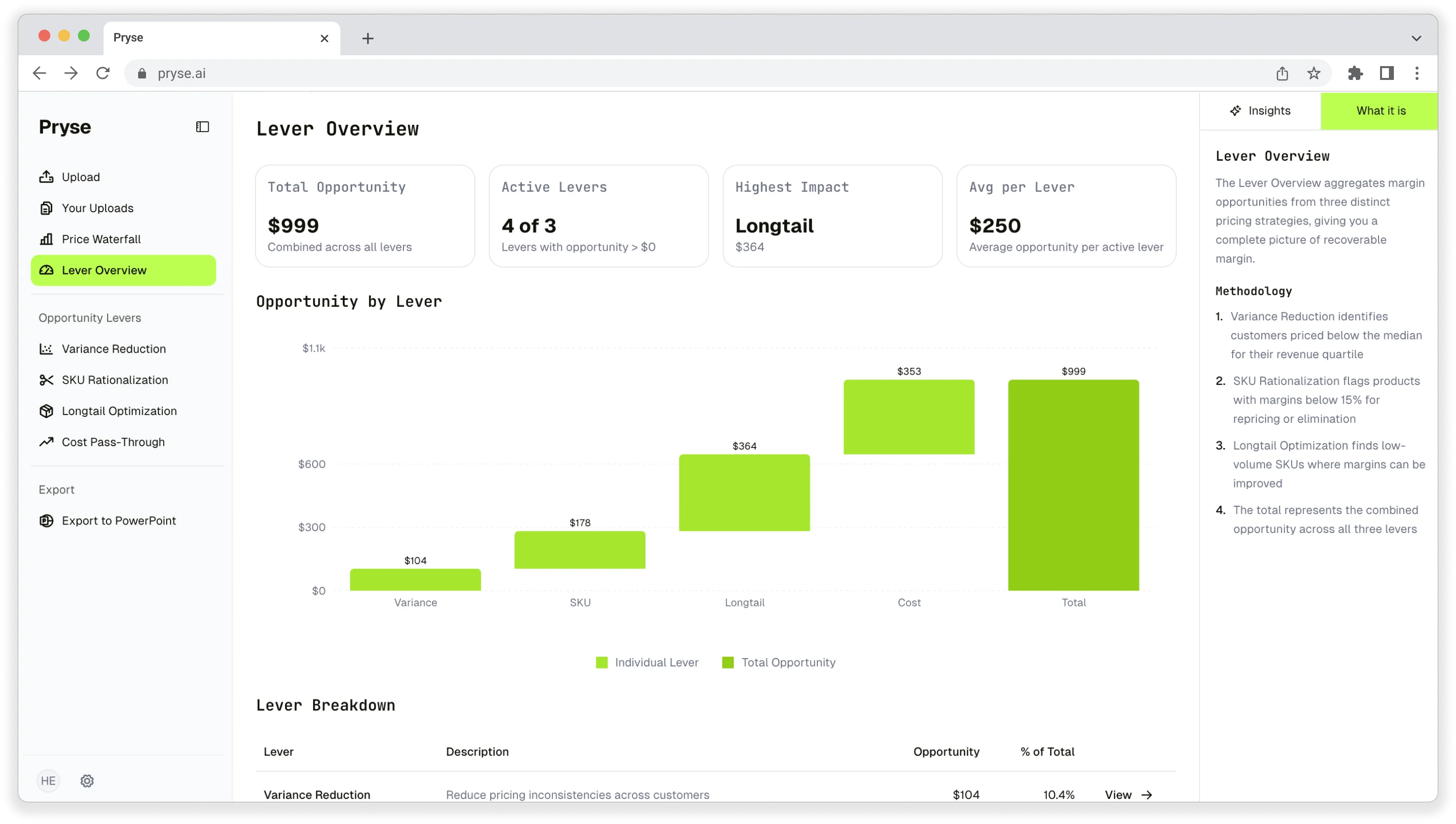
Pryse provides self-serve margin diagnostics for $1,499. Upload your transaction CSV, receive complete analysis within 24 hours showing:
- Price waterfall visualization with leakage quantification
- Top margin improvement opportunities ranked by $ impact
- Customer and product profitability analysis
- Discount pattern analysis showing where controls are needed
Most mid-market companies identify $100K-$1M in recoverable margin through diagnostics. If opportunities are small, you've saved $50K+ by not investing in annual software you don't need yet. If opportunities are large, diagnostics provide the business case for platform investment.
Getting Started
Most mid-market distributors and manufacturers should start with diagnostics before evaluating software vendors.
Step 1: Run a Margin Diagnostic
Export 12 months of transaction data from your ERP (SKU, customer, price, volume, cost). Run it through a diagnostic tool or Excel analysis to identify:
- Your current margin by product and customer
- Where margin leaks (discounts, rebates, freight, terms)
- How much opportunity exists in your top 20 issues
- Whether pricing complexity justifies software investment
If you can't identify $50K+ in recoverable margin, you don't need ongoing software yet. Fix the obvious problems first using Excel or ERP capabilities.
Step 2: Quantify Pricing Complexity
Count your pricing decision points:
- How many active SKUs?
- How many customers with unique pricing terms?
- How many pricing decisions monthly (price updates, quotes, discount approvals)?
- How much time spent monthly on pricing management?
Under 1,000 SKUs with simple pricing: Excel or ERP-native capabilities work fine.
1,000-5,000 SKUs with customer-specific pricing: Mid-market platform or advanced ERP configuration.
5,000+ SKUs with complex customer pricing: Enterprise B2B pricing platform.
Step 3: Assess Organizational Readiness
Before buying software, confirm:
- Leadership will enforce pricing discipline (not just analyze prices)
- Sales team accepts the need for pricing controls and approvals
- Data quality is sufficient (or budget exists to clean it)
- 1-2 people can dedicate 10-20 hours monthly to pricing management
- IT resources exist for integration and technical support
Software doesn't fix organizational problems. It amplifies what you already do well and makes weaknesses more visible.
Step 4: Select and Implement
Once you've confirmed opportunity, complexity justifies investment, and organization is ready:
For enterprise platforms:
- Request demos from Vendavo, Pricefx, PROS, and Zilliant
- Budget 2-3 months for vendor selection including RFP and reference calls
- Plan 6-18 months for implementation
- Expect $100K-$300K annually plus implementation costs
For mid-market solutions:
- Request trials from 2-3 mid-market vendors or ERP add-on providers
- Budget 4-6 weeks for vendor selection
- Plan 2-4 months for implementation
- Expect $15K-$50K annually plus setup costs
For diagnostics:
- Upload transaction CSV to Pryse
- Receive analysis in 24 hours
- Implement top recommendations in 30-60 days
- Cost $1,499 one-time
Next Steps
Before evaluating vendors, understand your baseline pricing performance. Most mid-market distributors and manufacturers discover significant margin leakage they didn't know about through basic analysis.
Start with a pricing diagnostic. For $1,499, Pryse provides comprehensive margin analysis within 24 hours from CSV upload. You'll learn:
- Your actual margin by product and customer (most companies are surprised)
- Where margin leaks across the price waterfall
- Whether Excel, ERP-native pricing, or dedicated software makes sense for your complexity
- The business case for investing in B2B pricing platforms
Start with diagnostics. Invest in software once you've confirmed the opportunity, organizational readiness, and clear ROI path.
For companies ready to explore pricing optimization strategy beyond software selection, see our complete pricing optimization guide covering frameworks, organizational design, and implementation best practices.
Sources
- Gitnux: Top 10 Best B2B Pricing Software of 2026
- Monday.com: Pricing Software Solutions: The Definitive Guide for 2026
- Gartner Peer Insights: Best B2B Profit Optimization Software Reviews 2026
- Blulink ERP: An In-Depth Guide to Pricing Software for Distributors
- Thoma Bravo: Conga Completes Acquisition of PROS B2B Business
- Software Pricing: B2B Pricing Software: A Complete Guide for Revenue Growth
Last updated: February 24, 2026
Frequently Asked Questions
Want to analyze your entire product catalog?
Pryse automatically identifies margin leakage across thousands of SKUs. Upload your data and find hidden profit in 24 hours.
One-time $1,499 diagnostic. No subscription required.