 Pryse
PryseHighest Profit Margin Products: What Sells Best by Industry
Digital products hit 90%+ margins, beauty products 40-80%, pharmaceuticals 60-80%. See which product categories deliver the highest profit margins.
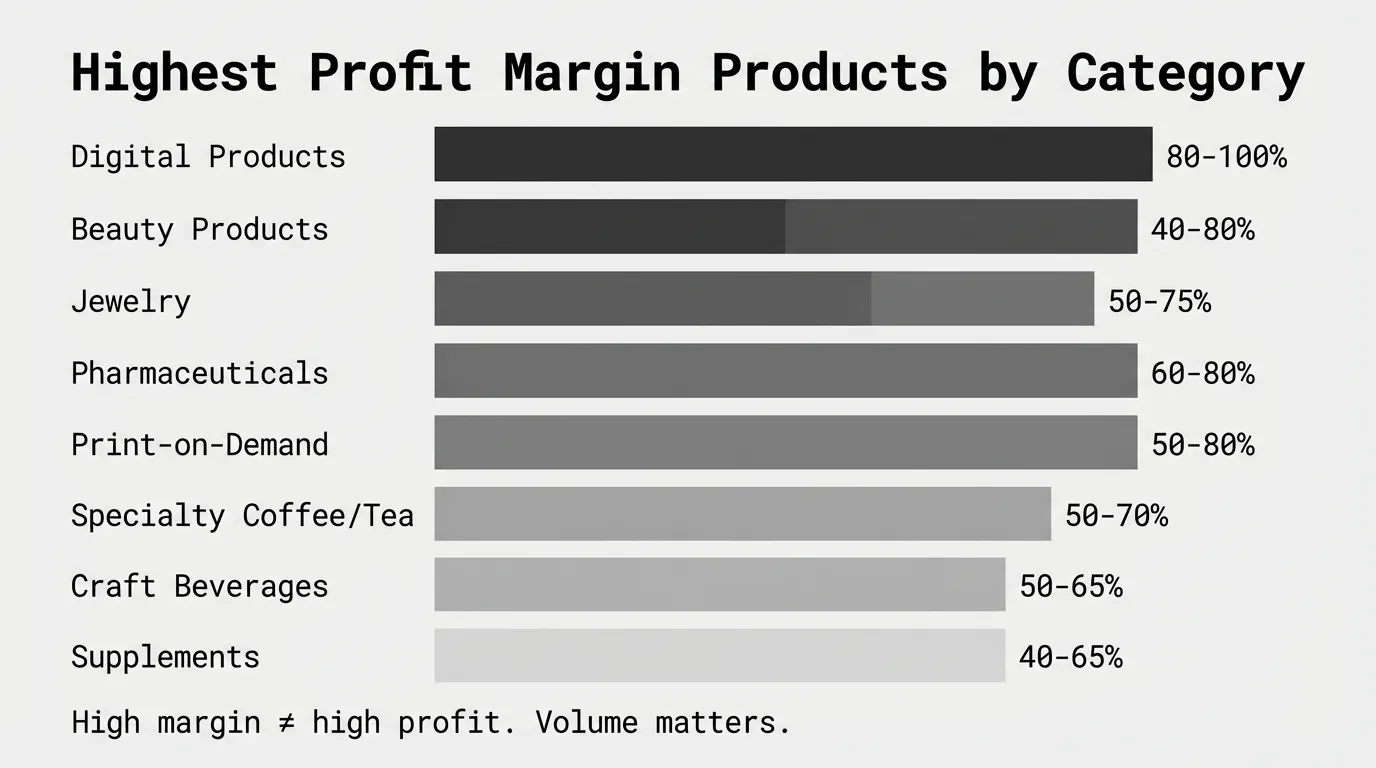
Products with the highest profit margins are digital products (80-100% margins), beauty products (40-80%), jewelry (50-75%), pharmaceuticals (60-80%), and print-on-demand products (50-80%). The highest-margin products share common traits: low production costs relative to selling price, no inventory costs, strong brand value, or specialized knowledge barriers.
High profit margin doesn't always mean high profitability. A digital course with 95% margin selling 10 units at $500 generates $4,750 in profit. An industrial distributor with 18% margin on $5M in sales generates $900K in profit. The question isn't just "what has the highest margin?" It's "what combination of margin and volume works for your business model?"
What Makes a Product High-Margin
A product achieves high profit margin when the gap between production cost and selling price is wide. This happens through several mechanisms:
Low marginal cost after initial investment. Digital products, software, and online courses cost time and money to create once, then cost almost nothing to sell repeatedly. A $500 online course might cost $10K to produce but can be sold 1,000 times with zero additional production cost.
Brand value and perceived differentiation. Luxury goods, branded beauty products, and designer jewelry command premium pricing not because production costs are dramatically higher, but because customers perceive them as worth more. A designer handbag might cost $200 to manufacture but sell for $2,000 based on brand alone.
Specialized knowledge or barriers to entry. Pharmaceutical products with patents, medical devices requiring FDA approval, and specialty chemicals needing technical expertise all command high margins because competitors can't easily enter the market.
Low distribution overhead. Products that ship directly to customers without intermediaries capture more margin. A manufacturer selling direct-to-consumer keeps the 20-40% margin that would otherwise go to distributors and retailers.
According to Vena Solutions' industry margin analysis, the apparel industry achieves 51.93% gross margin through brand value, while auto manufacturing achieves only 12.45% due to commodity-like competition and capital intensity.
Highest Margin Product Categories
Here are the product categories with the highest profit margins, ranked by typical margin percentage:
1. Digital Products (80-100% Margins)
Digital products have the highest profit margins of any category because production cost after the initial creation is near zero. Once you've built the product, selling the 10th copy costs the same as selling the 10,000th copy—almost nothing.
Margin range: 80-100%
Examples:
- Online courses and educational content
- Software and SaaS products
- E-books and digital publications
- Stock photos and digital assets
- Membership sites and subscription content
- Digital templates and tools
According to Shopify's high-margin product analysis, online courses and membership programs achieve 90%+ profit margins because they scale easily and bring recurring revenue with minimal ongoing costs.
A typical digital product P&L:
- Selling price: $197
- Platform fees (3-5%): $10
- Marketing cost per sale (if applicable): $30
- Production cost per unit: $0
- Gross margin: 80% ($157)
The margin compresses if customer acquisition costs are high. A $197 course that costs $150 to acquire each customer through ads delivers only 24% net margin, even though the product itself has 95% gross margin.
Digital products work best when you can sell them repeatedly with low customer acquisition costs—through organic search, email lists, partnerships, or existing audience.
2. Beauty and Personal Care Products (40-80% Margins)
Beauty products achieve high margins through brand perception, consumable nature (customers reorder), and low production costs relative to selling price. A $40 face cream might cost $8 to manufacture and package.
Margin range: 40-80%
Examples:
- Skincare products (serums, creams, cleansers)
- Makeup and cosmetics
- Hair care products
- Fragrances and perfumes
- Premium soaps and body care
- Men's grooming products
According to Printify's 2026 high-margin products report, beauty products average 55% profit margin, with some premium brands reaching almost 80%.
The beauty industry sustains high margins because:
- Consumable products create repeat purchases. Customers need to reorder skincare and makeup regularly, spreading acquisition cost across multiple transactions.
- Perceived value exceeds ingredient cost. A moisturizer with $3 worth of ingredients sells for $45 based on formulation expertise, packaging, and brand trust.
- Strong brand loyalty. Customers stick with products that work for their skin, reducing price sensitivity.
Private label beauty products offer even higher margins. A manufacturer selling branded skincare through distributors might see 30-40% margin. The same manufacturer selling identical products under their own brand direct-to-consumer can achieve 60-75% margin by eliminating distributor and retailer markups.
3. Jewelry (50-75% Margins)
Jewelry achieves high margins through a combination of low production costs, emotional purchasing (customers buy based on feeling rather than utility), and flexible pricing based on materials and design.
Margin range: 50-75%
Examples:
- Fashion jewelry (costume jewelry, accessories)
- Silver and gold jewelry
- Custom and handmade pieces
- Minimalist and modern jewelry
- Niche jewelry (zodiac, birthstone, personalized)
According to SaleHoo's profitable products analysis, jewelry items might use $3 in supplies but sell for $32, with makers averaging 85% margins after payment processing. TangBuy's wholesale product margin guide shows jewelry products like silver earrings and minimalist necklaces have profit margins of 50-75%.
Jewelry margins depend heavily on materials:
| Jewelry Type | Material Cost | Typical Selling Price | Gross Margin |
|---|---|---|---|
| Fashion/costume jewelry | $3-8 | $25-50 | 70-85% |
| Sterling silver | $15-40 | $75-200 | 60-75% |
| Gold-plated | $20-50 | $100-300 | 65-80% |
| Solid gold (low-end) | $150-400 | $500-1,500 | 50-70% |
| Custom/artisan pieces | $30-100 | $200-800 | 60-75% |
When jewelry is sold wholesale through distributors, margins compress. A jewelry manufacturer selling to distributors might see 35-45% margin. Selling direct-to-consumer captures the full 60-75% margin.
4. Pharmaceutical and Medical Products (60-80% Margins)
Pharmaceutical products, especially patented drugs and medical devices, achieve some of the highest margins in any industry due to intellectual property protection, regulatory barriers, and high customer willingness to pay for health outcomes.
Margin range: 60-80% (specialty pharmaceuticals)
Examples:
- Patented prescription drugs
- Specialty medications
- Medical devices and equipment
- Diagnostic tests and kits
- Over-the-counter branded medications
According to FullRatio's industry margin data, pharmaceutical companies benefit from extensive research and development investments, which lead to patented drugs with high profit margins. IBISWorld's 2026 industry profitability trends shows pharmaceutical and medical device companies, especially those involved in COVID-19 testing, dominated the profit-margin metric.
The margin story differs between pharmaceutical segments:
Branded pharmaceuticals with patents: 70-85% gross margin. A drug that costs $5 to manufacture sells for $50-$200 based on therapeutic value and lack of generic competition.
Generic pharmaceuticals: 25-40% gross margin. Once patents expire, generic manufacturers compete on price, compressing margins dramatically.
Medical devices: 55-75% gross margin. Devices require FDA approval and specialized manufacturing, creating barriers to entry that protect margins.
High pharmaceutical margins exist because of:
- Patent protection eliminating competition for 10-20 years
- Regulatory approval requirements creating barriers to entry
- High R&D costs requiring margin recovery
- Inelastic demand (customers need medications regardless of price)
According to Vena Solutions' industry benchmarking, pharmaceutical companies maintain some of the highest profit margins across all industries due to these factors.
5. Print-on-Demand Products (50-80% Margins)
Print-on-demand products combine high margins with low risk because you don't hold inventory. Products are manufactured only after a customer orders, eliminating inventory carrying costs and obsolescence risk.
Margin range: 50-80%
Examples:
- Custom t-shirts and apparel
- Tote bags and accessories
- Canvas prints and wall art
- Stickers and decals
- Mugs and drinkware
- Notebooks and journals
- Phone cases
According to TrueProfit's 2026 POD analysis, top-performing POD products include tote bags, canvas prints, softstyle t-shirts, pet bandanas, mugs, stickers, and spiral notebooks, with gross margins ranging from 50% to 80%. Stickers and decals typically offer the highest margins due to their low production costs and high perceived value.
Typical print-on-demand margins by product:
| Product Type | Production Cost | Typical Selling Price | Gross Margin |
|---|---|---|---|
| Stickers/decals | $1-2 | $8-15 | 70-85% |
| Canvas prints | $8-15 | $40-80 | 65-80% |
| T-shirts | $8-12 | $25-40 | 50-65% |
| Tote bags | $5-10 | $25-45 | 65-75% |
| Mugs | $6-10 | $20-35 | 55-70% |
| Phone cases | $4-8 | $20-35 | 65-75% |
Print-on-demand margins stay high because:
- No inventory investment required
- Design costs are one-time, then applied to unlimited products
- Customers pay for personalization and uniqueness
- No warehouse or fulfillment overhead
The catch: customer acquisition costs can consume margin quickly. If you spend $15 on ads to sell a $30 t-shirt with $12 production cost, your net margin drops from 60% to 10%.
6. Specialty Coffee and Tea (50-70% Margins)
Specialty coffee and tea achieve high margins through brand differentiation, direct trade relationships, small-batch roasting or blending, and customers' willingness to pay premium prices for quality and sourcing story.
Margin range: 50-70%
Examples:
- Single-origin specialty coffee
- Organic and fair-trade coffee
- Artisan tea blends
- Cold brew concentrate
- Subscription coffee/tea boxes
A typical specialty coffee roaster's margins:
- Green coffee beans (wholesale): $3-6 per pound
- Roasting, packaging, labor: $2-4 per pound
- Total cost: $5-10 per pound
- Wholesale price to cafes: $12-18 per pound (40-50% margin)
- Direct-to-consumer price: $18-28 per pound (55-70% margin)
Specialty coffee and tea margins stay high through:
- Direct relationships with farmers eliminating importer markups
- Small-batch production justifying premium pricing
- Subscription models creating recurring revenue
- Brand storytelling around sourcing, sustainability, and craft
Commodity coffee, by contrast, operates at 15-25% margins because it competes purely on price.
7. Craft Beverages (Alcohol) (50-65% Margins)
Craft breweries, wineries, and distilleries achieve high margins through brand differentiation, direct-to-consumer sales, and customers' willingness to pay premium prices for unique flavors and local production.
Margin range: 50-65%
Examples:
- Craft beer
- Small-batch spirits
- Boutique wines
- Hard seltzers and ciders
- Ready-to-drink cocktails
Craft beverage margins by channel:
| Sales Channel | Typical Margin |
|---|---|
| Taproom/tasting room direct sales | 60-70% |
| Direct-to-consumer online | 55-65% |
| Distribution to retailers | 40-50% |
| Distribution to restaurants/bars | 35-45% |
The margin difference between selling a craft beer in your own taproom ($6 pint with $1.50 cost = 75% margin) versus selling through a distributor to a bar ($2.50 wholesale with $1.50 cost = 40% margin) is dramatic.
Craft beverage producers maximize margin by:
- Operating taprooms or tasting rooms for direct sales
- Building subscription or club models (wine clubs, beer CSAs)
- Creating limited releases that command premium pricing
- Eliminating distributor middlemen where legally allowed
8. Handmade and Artisan Products (40-70% Margins)
Handmade products sell for premium prices due to their unique designs, high perceived value, and the story behind their creation. Customers pay for craftsmanship, not just materials.
Margin range: 40-70%
Examples:
- Handmade candles
- Artisan soaps and bath products
- Handcrafted home decor
- Custom pottery and ceramics
- Woodworking products
- Handmade children's products
According to FluentCart's high-margin product analysis, custom products like jewelry, candles, and baby apparel often have the highest profit margins, as they cost little to produce but can sell at a premium, especially when personalized.
A handmade candle business example:
- Materials (wax, wick, fragrance, jar): $4-6
- Labor (30 min at $20/hour): $10
- Total cost: $14-16
- Selling price: $28-45
- Gross margin: 45-65%
Handmade products sustain high margins through:
- Customers valuing uniqueness and craftsmanship
- Limited production creating scarcity perception
- Personal brand storytelling
- Avoidance of mass-market price comparison
The downside: handmade products don't scale easily. Your margin might be 60%, but your output is limited by production time.
9. Supplements and Nutraceuticals (40-65% Margins)
Supplements, vitamins, and health products achieve high margins through low production costs, subscription models, and customers' willingness to invest in health and wellness.
Margin range: 40-65%
Examples:
- Vitamins and minerals
- Protein powders and fitness supplements
- Herbal supplements
- Probiotic products
- Weight loss supplements
- Nootropics and cognitive enhancers
A typical supplement margin structure:
- Ingredient costs: $3-8 per bottle
- Packaging and bottling: $2-4 per bottle
- Total cost: $5-12 per bottle
- Selling price: $25-50 per bottle
- Gross margin: 50-75%
Supplement margins stay high because:
- Perceived value exceeds ingredient cost
- Subscription models create recurring revenue
- Health claims justify premium pricing
- Brand trust drives customer loyalty
The margin compresses if you sell through retailers. A supplement brand selling through Amazon or GNC pays 30-50% in commissions and fees, reducing gross margin from 65% to 35-40%.
Product Categories with the Lowest Margins
Understanding high-margin products is useful. Understanding what has low margins helps you avoid unprofitable categories:
Groceries and Food Retail (1-3% Net Margin)
Grocery stores operate on razor-thin margins. According to NYU Stern's margin database, food wholesalers achieve 13-18% gross margin but only 0.5-2% net margin after operating expenses.
Grocery margins are compressed by:
- Intense price competition
- Limited product differentiation (milk is milk)
- High operating costs (real estate, labor, refrigeration)
- Spoilage and shrinkage
Grocers make money through volume, not margin. A 2% net margin on $50M in sales generates $1M profit.
Auto Parts (8-15% Gross Margin)
Auto parts distribution operates at low margins due to commodity-like products, intense competition, and manufacturer pricing control. According to Vena Solutions' industry benchmarking, auto parts distribution achieves 14-18% gross margin and 1-3% net margin.
Commodity Manufacturing (10-20% Gross Margin)
Manufacturing businesses producing undifferentiated products (basic chemicals, commodity plastics, standard fasteners) operate at low margins. According to FullRatio's industry margin data, auto manufacturing achieves only 12.45% gross margin, and farming/agriculture achieves 16.49%.
Commodity manufacturers compete on price and scale, not margin.
High Margin Doesn't Always Mean High Profit
A critical mistake: assuming high-margin products automatically generate more profit. Margin percentage and total profit are different things.
Example 1: Digital course business
- Margin: 95%
- Average sale: $500
- Units sold per year: 100
- Total profit: $47,500
Example 2: Industrial distribution business
- Margin: 18%
- Average sale: $12,000
- Transactions per year: 350
- Total profit: $756,000
The distributor with 18% margin generates 16x more profit than the digital course business with 95% margin because of volume.
The right question isn't "what has the highest margin?" The right questions are:
-
What margin do you need to cover fixed costs? If your overhead is $200K annually and you generate $1M in revenue, you need at least 20% margin to break even.
-
What volume can you realistically achieve? High-margin products in niche markets might generate 100 sales per year. Lower-margin products in large markets might generate 10,000 sales per year.
-
What's your customer acquisition cost? A 90% margin product that costs $80 to acquire each $100 customer generates less profit than a 30% margin product that costs $5 to acquire each $100 customer.
-
Can you scale it? Handmade products with 65% margin don't scale past your personal production capacity. Digital products with 95% margin scale infinitely.
According to McKinsey's 2003 study "The Power of Pricing" published in McKinsey Quarterly, a 1% price improvement drives an 8% increase in operating profit for B2B companies. This means margin improvements compound dramatically, but only if you maintain or grow volume.
How Distributors and Manufacturers Can Find High-Margin Products
If you're in distribution or manufacturing, you're probably not selling digital courses or handmade jewelry. But you can still identify and prioritize higher-margin products within your existing portfolio.
1. Segment Your Product Catalog by Margin
Calculate gross margin for every SKU or product category. You'll find massive variation. A distributor might have:
- Commodity products at 12% margin
- Standard products at 22% margin
- Specialty products at 35% margin
- Private label products at 45% margin
According to Phocas Software's distribution margin analysis, distributors can increase profit margins by analyzing product profitability by segment and focusing sales efforts on higher-margin categories.
2. Push Sales Toward Higher-Margin Items
Your sales team will naturally push what's easy to sell, not what's most profitable. Create incentives around margin dollars, not just revenue.
A sales rep closing a $50K deal at 15% margin generates $7,500 gross profit. The same rep closing a $30K deal at 35% margin generates $10,500 gross profit. Compensate accordingly.
3. Add Value to Commodity Products
Turn low-margin products into higher-margin solutions by bundling, kitting, technical support, or custom services.
Example: An electrical distributor selling commodity wire at 14% margin bundles it with custom cutting, labeling, and delivery scheduling. They now charge 28% margin for the same product plus $200 in value-add services.
4. Develop Private Label or Proprietary Products
The fastest way to high margins in distribution or manufacturing is proprietary products. According to PROS' distributor pricing analysis, distributor markup on third-party brands ranges from 20-40%, but private label products can achieve 45-60% margins.
A manufacturer selling someone else's branded product captures 25-35% margin. The same manufacturer selling identical products under their own brand captures 50-65% margin.
5. Review Your Pricing Regularly
Most distributors and manufacturers have pricing that hasn't been systematically reviewed in years. Customer-specific deals from 2019 are still active. Supplier cost increases from 2022 haven't been fully passed through.
According to Vendavo's distributor markup research, markups typically range from 15-20% when manufacturers sell to distributors, while distributors add another 20-40%, depending on the industry and market conditions. But these are averages—individual accounts often deviate significantly.
Finding 3-5 percentage points of recoverable margin across your product portfolio can add hundreds of thousands of dollars to profitability without selling a single additional unit.
Where Is Your Margin Actually Going?
Knowing which products have the highest margins in theory is useful. Knowing which products are actually delivering margin in your business is more actionable.
Most distribution and manufacturing companies discover significant margin variation when they analyze transaction-level data:
- The same product sells at 35% margin to one customer and 12% margin to another
- High-volume customers often have the lowest margins due to negotiated discounts
- Freight absorption, rebates, and payment terms erode 5-10 points of list margin
- Product mix shifts over time toward lower-margin categories
Finding this margin leakage requires analyzing thousands of transactions across products, customers, and time periods. For companies with 5,000+ SKUs and hundreds of customers, Excel becomes impractical.
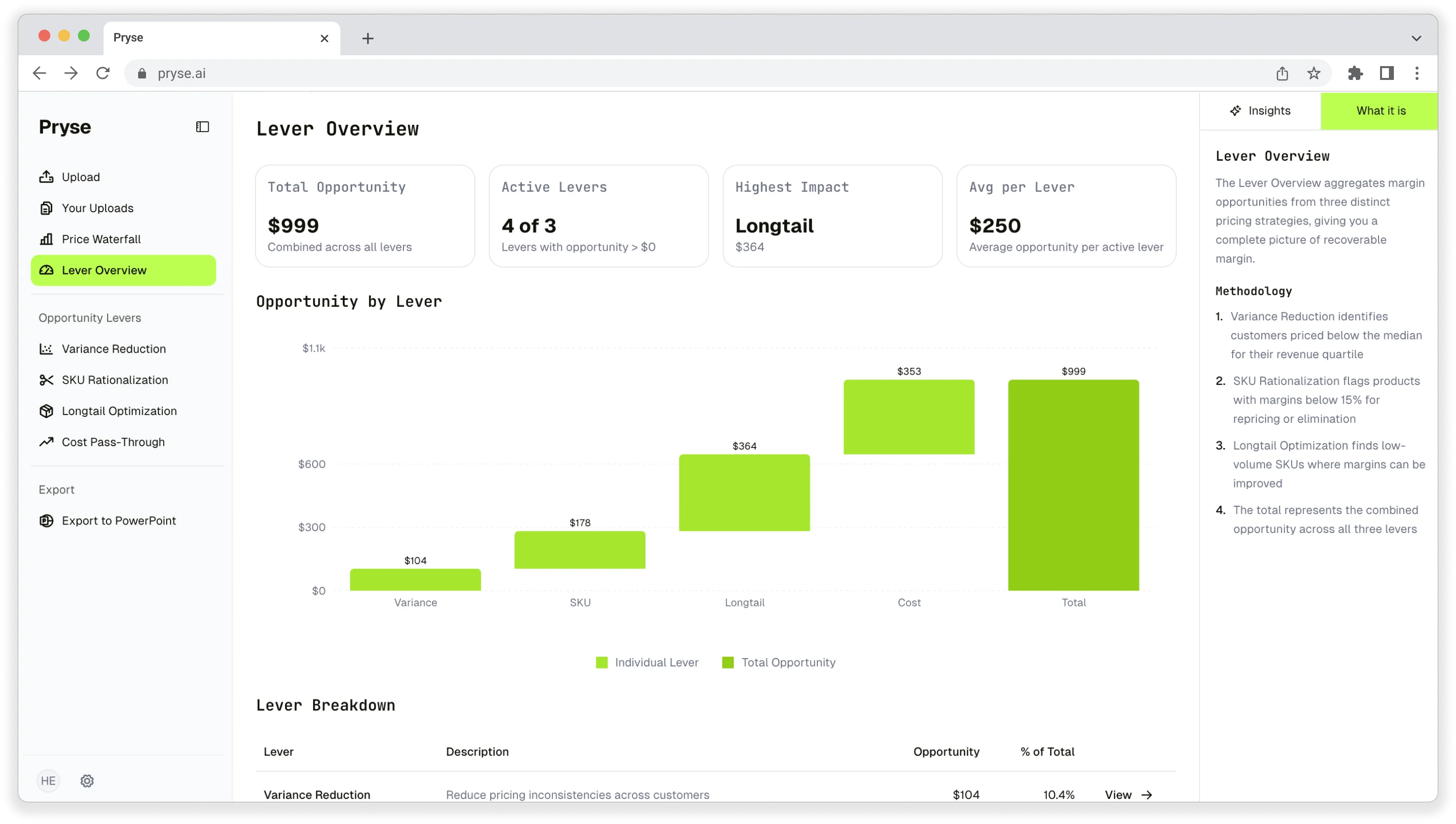
That's what Pryse is built for. Upload your transaction data and see exactly where margin is strong, where it's weak, and where it's leaking in 24 hours.
For a deeper look at margin benchmarks across industries, see our complete guide to profit margins by industry.
Sources
- Vena Solutions: Industry Benchmarks of Gross, Net and Operating Profit Margins
- Shopify: 5 Types of High Profit Margin Products for 2026
- Printify: Boost Your Sales: 12 High-Profit Margin Products for 2026
- SaleHoo: 30 Most Profitable Products to Sell Online
- TrueProfit: 10+ Low Cost, High Profit Margin Products to Sell Online in 2026
- TrueProfit: 7 High Margin Print on Demand Products to Skyrocket Sales in 2026
- FluentCart: 9 Types of High Profit Margins Products in 2025
- FullRatio: Profit margin by industry, gross and net profit margins
- TangBuy: How to Identify High-Profit Margin Wholesale Products for Your Business
- IBISWorld: Industries with the Highest Profit Margin in United States in 2026
- NYU Stern: Operating and Net Margins
- PROS: Distributor Markup and Profit Margins in the Supply Chain
- Vendavo: Distributor Markup Insights: Boost Profits Strategically
- Phocas Software: How distributors and retailers can increase profit margins
- McKinsey: The Power of Pricing (2003)
Last updated: February 24, 2026
Frequently Asked Questions
Want to analyze your entire product catalog?
Pryse automatically identifies margin leakage across thousands of SKUs. Upload your data and find hidden profit in 24 hours.
One-time $1,499 diagnostic. No subscription required.