 Pryse
PryseWhat Is a Reasonable Profit Margin for a Small Business? Benchmarks by Industry
A reasonable profit margin for small businesses ranges from 7-10% on average, but varies widely by industry. See benchmarks and how to evaluate yours.
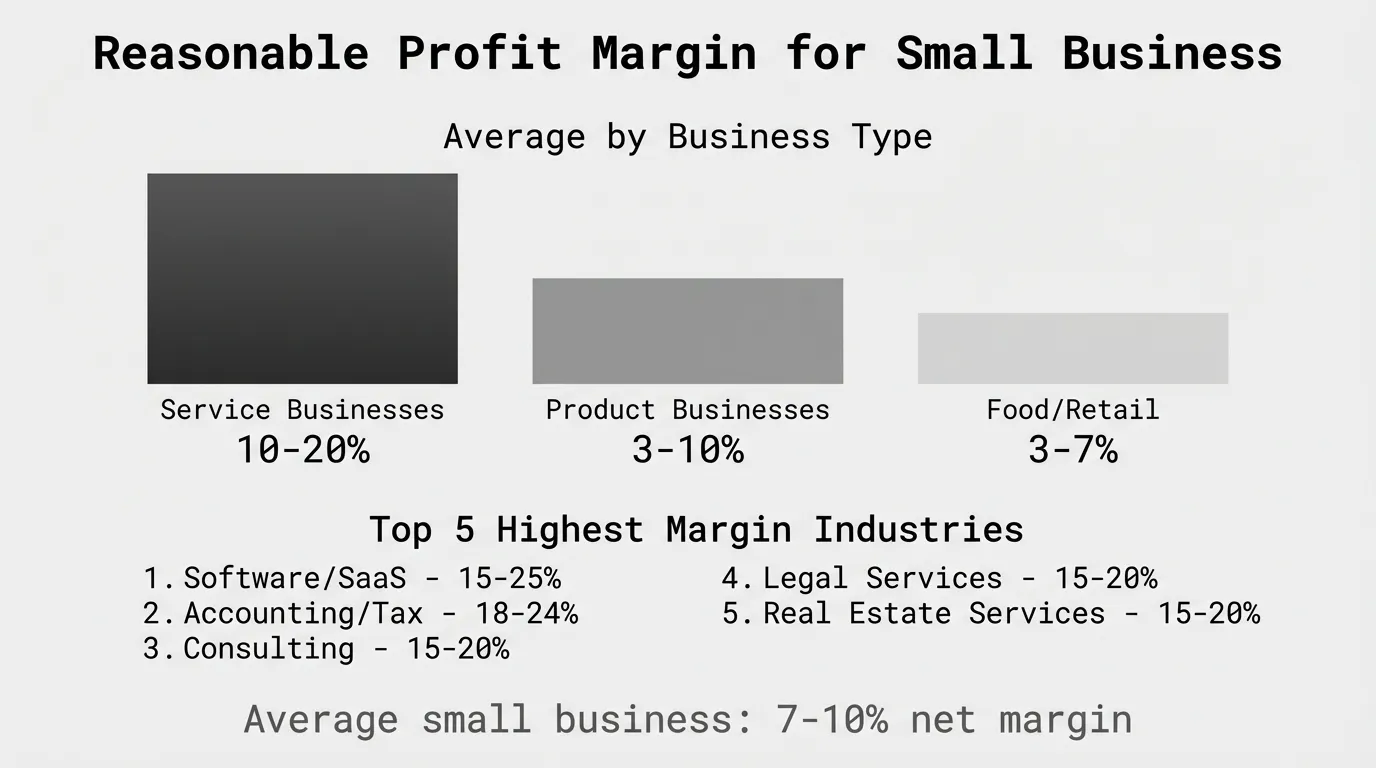
A reasonable profit margin for a small business depends on which margin you're measuring and what industry you operate in. For net profit margin, 7% to 10% is the average across small businesses. Service businesses typically achieve 10% to 20%, while retail and food service average 3% to 7%.
The question isn't whether your margin is "reasonable" in absolute terms. The question is whether it's reasonable for your industry, your size, and your business model.
The Margins That Matter for Small Businesses
Before comparing your margin to benchmarks, clarify which margin you're measuring. Each margin type answers a different question:
Gross Profit Margin
Gross Margin = (Revenue - COGS) / Revenue × 100This measures product or service profitability before operating expenses. It tells you whether your pricing and direct costs are healthy. Small service businesses average 40-60% gross margin. Small retailers average 25-35%.
Net Profit Margin
Net Profit Margin = Net Income / Revenue × 100This measures bottom-line profitability after all expenses, interest, and taxes. It's what most people mean when they ask about "profit margin." Average net margin for small businesses ranges from 7% to 10%.
When someone asks "what's your profit margin?" they usually mean net profit margin. That's the ultimate test of whether your business creates value after paying for everything.
Average Profit Margin for Small Businesses
According to Vena Solutions' 2026 small business revenue research, the average net profit margin for small businesses ranges between 7% and 10%. However, this masks significant variation across industries and business models.
TrueProfit's 2026 analysis shows that while 7-10% is average, a healthy net profit margin falls anywhere from 5% to 20% depending on the industry. The pattern is clear: service-based businesses with lower overhead achieve higher margins, while product-based businesses with inventory and distribution costs run tighter margins.
Here's the general framework:
| Net Profit Margin | What It Means for Small Businesses |
|---|---|
| Below 3% | Risky—no buffer for downturns or unexpected costs |
| 3-5% | Low but acceptable for commodity businesses |
| 5-7% | Below average for most industries |
| 7-10% | Average and healthy for most small businesses |
| 10-15% | Above average—indicates efficiency or differentiation |
| Above 15% | Excellent—typically requires high-value services or products |
According to industry benchmarking data, 20% is considered good, 10% is standard, and 5% is considered low or poor for most businesses. But these thresholds shift dramatically based on what you sell and how you sell it.
Reasonable Profit Margin by Industry
Profit margins vary dramatically across industries. A 5% net margin that's risky for a consulting firm is strong for a grocery store. Here's what the data shows for small businesses:
| Industry | Gross Margin | Net Margin | Source |
|---|---|---|---|
| Software/SaaS | 60-85% | 15-25% | Industry reports |
| Consulting/Professional Services | 50-70% | 12-20% | Vena Solutions |
| Accounting/Tax Services | 60-75% | 18-24% | Industry average |
| Legal Services | 55-70% | 15-20% | Industry average |
| Medical/Healthcare Services | 45-60% | 12-18% | Industry average |
| Real Estate Services | 50-70% | 15-20% | Industry average |
| General Services | 40-60% | 10-15% | Industry average |
| Specialty Retail | 35-45% | 5-10% | Industry average |
| General Retail | 30-35% | 3-7% | NYU Stern |
| E-commerce | 40-50% | 5-12% | Industry average |
| Restaurants/Food Service | 25-35% | 3-6% | Industry average |
| Manufacturing (small-scale) | 25-40% | 7-12% | Industry average |
| Wholesale Distribution | 15-25% | 2-5% | Industry average |
| Construction/Contracting | 20-30% | 5-10% | Industry average |
Data compiled from NYU Stern's margin database, Vena Solutions benchmarking, and TrueProfit's 2026 analysis.
The pattern is clear: service businesses operate at higher margins than product businesses. Software and consulting companies can achieve 15-25% net margins because their COGS is mostly labor. Retailers and food businesses run at 3-7% because of inventory costs, shrinkage, and thin pricing power.
What's Reasonable for Service-Based Small Businesses
Service businesses typically achieve the highest profit margins among small businesses. You're selling expertise, time, or access rather than physical products. Your margin comes from specialized knowledge, not from buying low and selling high.
Reasonable profit margins for small service businesses:
- Gross margin: 40-70%
- Net profit margin: 10-20%
More specifically by service type:
| Service Type | Gross Margin | Net Margin |
|---|---|---|
| Software/SaaS | 70-85% | 15-25% |
| Consulting/advisory | 60-75% | 15-20% |
| Accounting/bookkeeping | 60-75% | 18-24% |
| Legal services | 55-70% | 15-20% |
| Design/creative services | 50-65% | 12-18% |
| Marketing/advertising | 45-60% | 10-15% |
| Cleaning services | 40-55% | 15-30% |
| Landscaping/lawn care | 35-50% | 10-14% |
According to industry research on high-margin small businesses, the most profitable service businesses share common traits: low COGS, recurring revenue, minimal inventory, and scalability without proportional cost increases.
A small accounting firm at 18% net margin is performing well. A software company at 18% might be below average, since software margins often exceed 20% once the product is built.
What's Reasonable for Product-Based Small Businesses
Product-based small businesses operate at tighter margins than service businesses. You're buying or making products and reselling them. Your margin depends on supplier costs, inventory management, and pricing power.
Reasonable profit margins for small product businesses:
- Gross margin: 25-45%
- Net profit margin: 3-10%
More specifically by business type:
| Business Type | Gross Margin | Net Margin |
|---|---|---|
| E-commerce (high-ticket) | 45-55% | 8-15% |
| E-commerce (general) | 35-45% | 5-10% |
| Specialty retail | 35-45% | 5-10% |
| General retail | 25-35% | 3-7% |
| Restaurants/cafes | 25-35% | 3-6% |
| Food retail/grocery | 18-25% | 1-3% |
| Wholesale distribution | 15-25% | 2-5% |
For retail specifically, industry benchmarks show that general retail achieves a 32% gross profit margin and 4.6% net profit margin on average. Electronics retail shows a 25% gross margin and 5.6% net margin.
A small specialty retailer at 7% net margin is performing well. A grocery store at 2% net margin is typical—food retail operates on volume, not margin.
What's Reasonable for Small Manufacturers
Small-scale manufacturers fall between services and retail. You create products, which provides margin control, but you also have material costs, equipment, and inventory.
Reasonable profit margins for small manufacturers:
- Gross margin: 25-40%
- Net profit margin: 7-12%
More specifically by manufacturing type:
| Manufacturing Type | Gross Margin | Net Margin |
|---|---|---|
| Custom/specialty manufacturing | 35-50% | 10-18% |
| Job shop/contract manufacturing | 28-38% | 8-12% |
| Light manufacturing | 25-35% | 7-10% |
| Food/beverage manufacturing | 20-30% | 5-8% |
A $2M custom furniture maker at 12% net margin is performing well. A small food manufacturer at 6% is typical—food manufacturing competes on price, not premium positioning.
Factors That Change What's "Reasonable" for Your Business
Industry benchmarks are starting points, not targets. Several factors shift your reasonable margin up or down:
Business Size and Scale
Larger small businesses typically operate at better margins than smaller ones. A $5M company has better supplier pricing, more operational efficiency, and better cost absorption than a $500K company.
According to research on small business economies of scale, businesses under $1M in revenue often sacrifice margin for growth. Businesses at $5M+ can optimize for profitability.
Business Model Differences
Recurring revenue pushes margins up. A service business with monthly retainers or subscriptions operates at higher margins than one selling one-time projects. Predictable revenue reduces customer acquisition costs and allows operational efficiency.
Value-added services raise your margin ceiling. A retailer providing installation, customization, or ongoing support should command higher margins than one just selling products. If you're at 4% net margin while offering significant value-adds, you're likely underpriced.
Private label or proprietary products push margins up. Reselling someone else's branded product means competing on price. Creating your own means capturing more value. Businesses with proprietary products typically achieve 3-7 percentage points higher net margins.
Geographic and Market Position
Location affects overhead. A service business in a low-cost area can be profitable at 8% net margin. The same business in a high-rent urban market needs 12%+ to cover costs.
Competition intensity matters. Limited local competition allows margin expansion beyond industry benchmarks. But this advantage erodes when new competitors enter or customers shift online.
Customer base affects margin. Serving price-sensitive customers in commodity markets means tighter margins. Serving specialized customers with unique needs allows premium margins.
Growth Stage
Early-stage businesses sacrifice margin for growth. A 3-year-old company investing in marketing, hiring, and infrastructure might accept 4% net margin temporarily. A mature 15-year-old company in a stable market should target 10%+.
Reinvestment strategy matters. Some profitable businesses deliberately reduce reported margin by reinvesting heavily in growth. Others optimize for cash flow and show higher margins.
Warning Signs Your Profit Margin Is Too Low
A below-benchmark profit margin points to specific problems:
1. Pricing below market value. You're competing on price instead of value. Customers choose you because you're cheapest, not because you're best. That's not a sustainable position.
2. Uncontrolled discounting. You give away margin to close deals. Those discounts feel small individually (10% here, 5% there) but compound to destroy profitability.
3. Cost structure bloat. Your gross margin looks fine, but operating expenses eat it. Too many employees for the revenue level, expensive tools you don't fully use, or inefficient processes.
4. Product or service mix drift. You're selling more low-margin offerings over time. Maybe customers demand them, or sales pushes them because they're easier to sell. Overall margin declines while no individual transaction looks bad.
5. Supplier cost increases not passed through. Your costs went up 6% last year. Customer prices went up 2%. That's 4 points of margin erosion. Do that for three years and profitability collapses.
6. Customer concentration at low prices. One or two big customers negotiated hard early on. They represent 40% of revenue at 2% margin. Your overall margin doesn't reflect your pricing capability on normal accounts.
According to McKinsey's 2003 study "The Power of Pricing" published in McKinsey Quarterly, a 1% price improvement drives an 8% increase in operating profit for B2B companies. For small businesses operating at 7-10% net margin, a 1-2% margin leak represents a 10-20% reduction in profitability.
That means fixing a margin problem isn't about getting incrementally better. It's about survival.
Is Your Margin "Reasonable" or Just Average?
Knowing whether your profit margin is reasonable provides useful context. But average performance doesn't mean healthy performance.
The better question is: where is your margin leaking?
Most small businesses with product sales, distributed operations, or complex pricing have 2-5 percentage points of recoverable margin hiding in their numbers. It's in:
- Discounts that were supposed to be temporary but became permanent
- Shipping and handling charges that should be billed but aren't
- Customer-specific pricing that hasn't been reviewed in years
- Cost increases that weren't fully passed through
- Product mix shifts toward lower-margin items
- Time spent on low-margin customers that should go to high-margin ones
Finding this margin requires analyzing your transactions, customers, and products systematically. For small businesses with limited time and resources, margin analysis often gets deferred—until profitability becomes a crisis.
How Small Businesses Can Improve Profit Margins
If your margin is below industry benchmarks, here are the highest-impact fixes:
1. Raise prices selectively. Don't blanket-raise prices across the board. Increase prices on your best customers (they won't leave over 5%), your specialty products (they have no alternatives), and your value-added services (they're undervalued).
2. Stop discounting. Track every discount you give. Require approval for discounts above 10%. Make sales justify discounts with volume commitments or contract length.
3. Fix your product mix. Stop pushing low-margin products just because they're easy to sell. Shift sales focus to high-margin offerings through incentives, training, and marketing.
4. Cut low-performing customers or products. The Pareto principle applies: 20% of your customers or products generate 80% of your profit. Identify the bottom 20% and either reprice them or stop serving them.
5. Pass through cost increases immediately. When supplier costs rise, raise customer prices within 30 days. Announce it clearly and early. Most customers accept it if communicated properly.
6. Reduce operating expense waste. Cancel subscriptions you don't use. Renegotiate contracts for services like insurance, shipping, and software. Eliminate redundant processes.
What to Do Next
If you run a small business with $500K+ in revenue and you're not sure whether your profit margin is reasonable, here's what to do:
- Calculate your margins consistently. Make sure you're measuring gross margin, operating margin, and net margin the same way industry benchmarks do.
- Compare to direct competitors, not just industry averages. Find 3-5 businesses in your specific niche and analyze their margins if publicly available.
- Segment your analysis. Calculate margin by product category, customer type, or sales channel. Your overall margin hides what's working and what's not.
- Track the trend. A margin declining from 9% to 5% over two years is more concerning than a stable 4%. Trend direction matters as much as absolute level.
- Find your margin leakage. Where is margin going? Discounts? Cost increases? Product mix? Customer concentration? Operational inefficiency?
For small businesses managing dozens of products and customers across months of transactions, Excel becomes unwieldy. Margin analysis that should take a day takes weeks—so it doesn't happen.
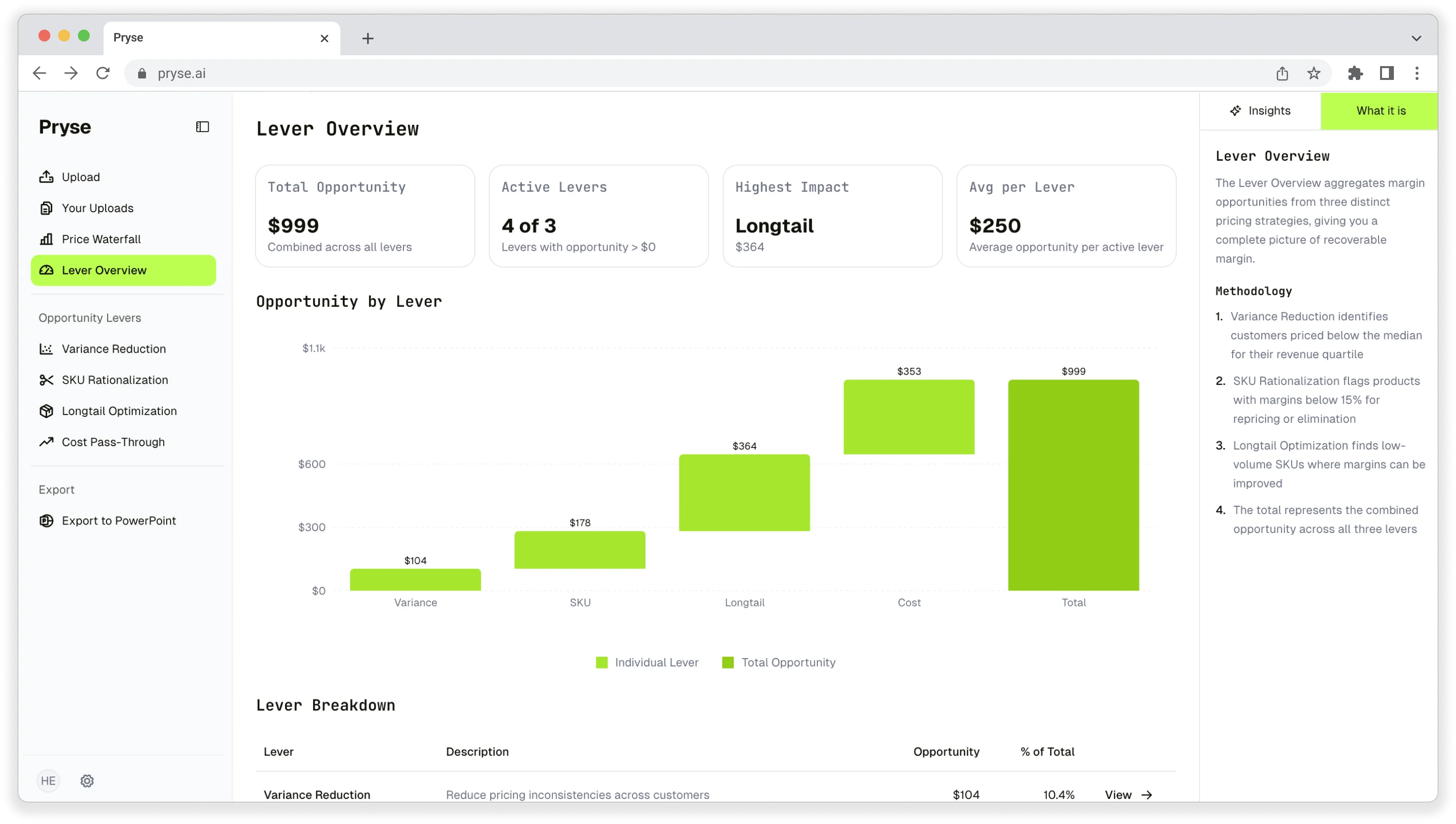
That's where Pryse comes in. Upload your transaction data and see where your margin actually goes in 24 hours, not 6 months. Built for small and mid-market businesses who need insights fast.
For industry-specific benchmarks beyond small business averages, see our complete guide to profit margins by industry.
Last updated: February 24, 2026
Frequently Asked Questions
Want to analyze your entire product catalog?
Pryse automatically identifies margin leakage across thousands of SKUs. Upload your data and find hidden profit in 24 hours.
One-time $1,499 diagnostic. No subscription required.