 Pryse
PryseMargin Analysis Example: 4 Real-World Scenarios From Distribution and Manufacturing
See margin analysis in action with four detailed examples: product-level SKU analysis, customer profitability, deal margin review, and year-over-year comparison.
A margin analysis example is a documented calculation showing how a company measures profitability by comparing revenue to costs at the product, customer, or transaction level. The analysis identifies where profits come from and where margin leaks.
Theory explains what margin analysis is. Examples show how to actually do it. This post walks through four detailed scenarios from distribution and manufacturing companies, with the actual numbers, calculations, and findings that led to pricing decisions.
For a complete framework on margin types and methodology, see our margin analysis guide. The examples below put those concepts into practice.
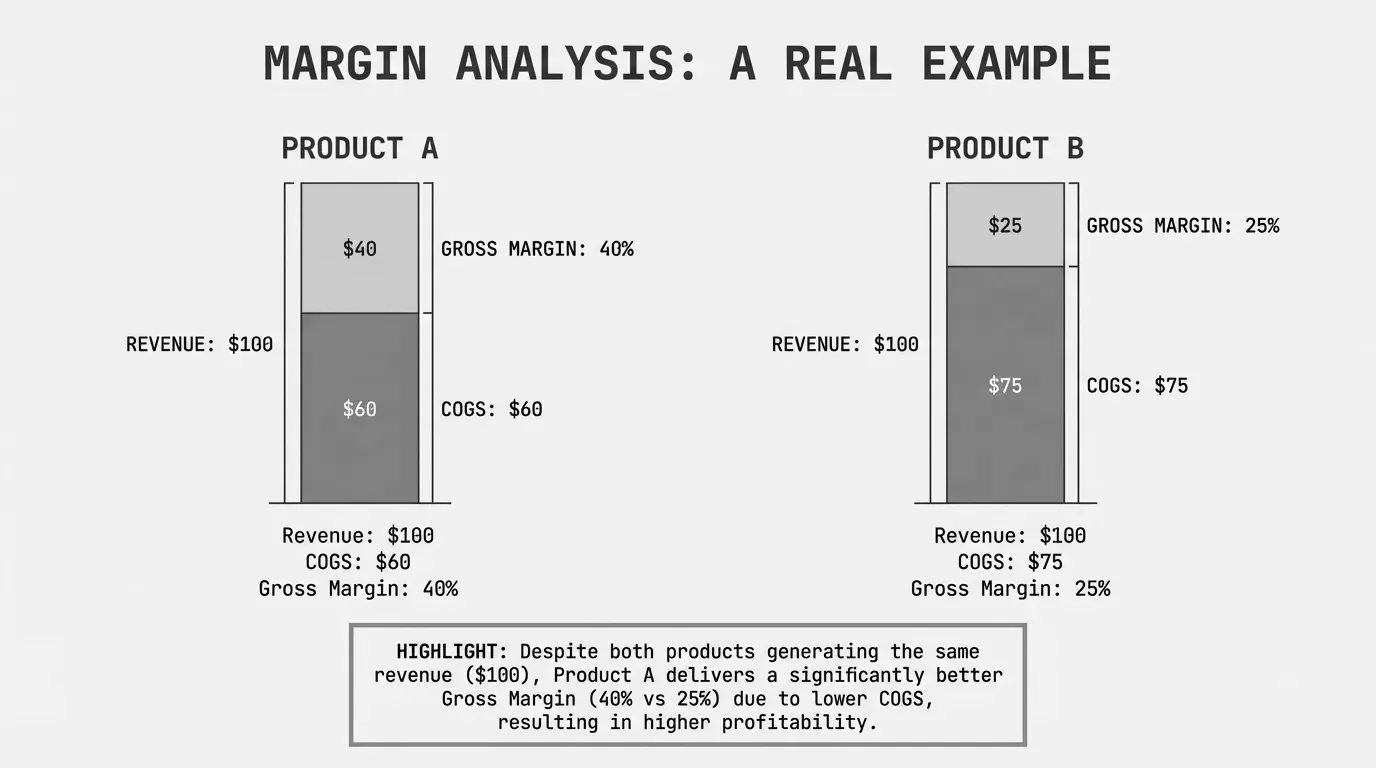
Example 1: Product-Level Margin Analysis
Scenario: Regional industrial distributor, $38M annual revenue, 4,200 SKUs
A regional industrial supply distributor noticed overall gross margin declining from 26.2% to 24.8% over 18 months. Management suspected competitive pressure but lacked specifics. They exported 12 months of transaction data from their ERP and ran margin analysis by SKU.
The Data
Here is a sample of their findings across five product categories:
| SKU | Product | Units Sold | Avg Selling Price | Unit Cost | Gross Profit | Gross Margin |
|---|---|---|---|---|---|---|
| MH-4521 | Safety Gloves 12pk | 2,840 | $84.50 | $67.60 | $16.90 | 20.0% |
| MH-4522 | Safety Goggles | 1,650 | $24.75 | $16.85 | $7.90 | 31.9% |
| PT-8891 | Cutting Fluid 5gal | 890 | $142.00 | $118.45 | $23.55 | 16.6% |
| PT-8892 | Degreaser 5gal | 720 | $89.00 | $58.75 | $30.25 | 34.0% |
| FT-2210 | Abrasive Wheel 10pk | 3,100 | $67.25 | $48.20 | $19.05 | 28.3% |
The Calculation
For each SKU, gross margin is calculated using:
Gross Margin = (Selling Price - Unit Cost) / Selling Price x 100For the Safety Gloves (MH-4521):
Gross Margin = ($84.50 - $67.60) / $84.50 x 100 = 20.0%The distributor's target gross margin was 25%. SKUs below this threshold were flagged for review.
What the Analysis Revealed
Out of 4,200 SKUs, 1,340 (32%) fell below the 25% margin threshold. However, 180 of those low-margin SKUs accounted for 41% of total revenue. These were not random underperformers. They were high-velocity products that customers bought regularly.
Three patterns emerged:
Pattern 1: Cost creep without price adjustment. The cutting fluid (PT-8891) had a cost increase of 12% over two years. Selling price increased only 4%. The margin compression happened gradually, one supplier invoice at a time.
Pattern 2: Competitive price matching. Safety gloves (MH-4521) were priced to match a competitor's promotional pricing from 14 months earlier. That promotion ended. The distributor's price never recovered.
Pattern 3: Volume discount stacking. Certain SKUs had multiple discount layers applied: a promotional discount, a customer-specific discount, and a volume break. Each discount was within policy. Combined, they pushed margin below target.
The Action Taken
The distributor implemented three changes:
-
Price adjustment on 45 high-impact SKUs where cost increases had not been passed through. Average price increase: 6.2%.
-
Quarterly competitive price review instead of reactive price matching. Promotional pricing from competitors no longer triggered permanent price changes.
-
Discount ceiling alerts in their quoting system. When combined discounts exceeded 18% on any line item, the system flagged the quote for approval.
The Result
Six months after implementation, gross margin improved from 24.8% to 26.4%. On $38M revenue, that 1.6-point improvement represented approximately $608,000 in additional gross profit annually. Volume impact was minimal: unit sales declined 2.1%, concentrated in price-sensitive accounts that were margin-negative anyway.
Example 2: Customer-Level Margin Analysis
Scenario: Specialty fastener manufacturer, $52M annual revenue, 340 active accounts
A fastener manufacturer selling to OEMs and distributors wanted to understand which customers were actually profitable. Their sales team prioritized accounts by revenue. The finance team suspected that several large accounts were underwater when factoring in true cost-to-serve.
The Data
They analyzed their top 15 accounts by revenue, adding cost-to-serve data beyond standard COGS:
| Customer | Annual Revenue | COGS | Gross Profit | Order Count | Avg Order Size | Returns % | Days to Pay |
|---|---|---|---|---|---|---|---|
| Midwest Assemblies | $3,420,000 | $2,394,000 | $1,026,000 | 48 | $71,250 | 1.2% | 32 |
| Pacific Industrial | $2,180,000 | $1,635,000 | $545,000 | 186 | $11,720 | 4.8% | 58 |
| Great Lakes MFG | $1,890,000 | $1,360,800 | $529,200 | 62 | $30,484 | 2.1% | 41 |
| Southern Components | $1,650,000 | $1,287,000 | $363,000 | 94 | $17,553 | 3.4% | 67 |
| Northeast Precision | $1,420,000 | $994,000 | $426,000 | 156 | $9,103 | 6.2% | 45 |
The Calculation
Basic gross margin analysis showed Pacific Industrial at 25% margin, which appeared acceptable. But the manufacturer calculated contribution margin after allocating variable costs per customer:
Customer Contribution Margin = Gross Profit - (Order Processing Cost x Orders) - (Return Handling Cost x Returns) - (AR Carrying Cost x Days Outstanding)Using their cost allocations:
- Order processing cost: $85 per order
- Return handling cost: $340 per return incident
- AR carrying cost: 0.8% per month on outstanding balance
For Pacific Industrial:
Gross Profit: $545,000
Order Processing: $85 x 186 = $15,810
Return Handling: $340 x 18 incidents = $6,120
AR Carrying Cost: $2,180,000 x (58/30) x 0.008 = $33,725
Customer Contribution: $545,000 - $15,810 - $6,120 - $33,725 = $489,345
Adjusted Margin: $489,345 / $2,180,000 = 22.4%
For Midwest Assemblies:
Gross Profit: $1,026,000
Order Processing: $85 x 48 = $4,080
Return Handling: $340 x 3 incidents = $1,020
AR Carrying Cost: $3,420,000 x (32/30) x 0.008 = $29,184
Customer Contribution: $1,026,000 - $4,080 - $1,020 - $29,184 = $991,716
Adjusted Margin: $991,716 / $3,420,000 = 29.0%
What the Analysis Revealed
The analysis reordered customer profitability. Pacific Industrial, the second-largest account by revenue, dropped to eighth in contribution margin ranking. Northeast Precision, ranked fifth by revenue, became the least profitable of the top 15 after cost-to-serve adjustments.
Two customers that looked similar on revenue had dramatically different economics:
| Metric | Midwest Assemblies | Pacific Industrial |
|---|---|---|
| Revenue | $3,420,000 | $2,180,000 |
| Standard Gross Margin | 30.0% | 25.0% |
| Adjusted Contribution Margin | 29.0% | 22.4% |
| Orders per Year | 48 | 186 |
| Revenue per Order | $71,250 | $11,720 |
| Returns Rate | 1.2% | 4.8% |
Pacific Industrial placed nearly four times as many orders for a third less revenue. Their return rate was four times higher. They paid nearly a month later. Each of these factors added cost.
The Action Taken
The manufacturer took different approaches for different customer segments:
High-volume, low-margin accounts: Implemented minimum order quantities and small order fees. Pacific Industrial's minimum moved from $5,000 to $15,000. Orders below minimum incurred a $150 handling charge.
High-return accounts: Added inspection documentation requirements for warranty claims. Return authorization process became more rigorous, not to deny legitimate claims but to reduce frivolous returns.
Slow-paying accounts: Offered 2% discount for payment within 15 days. Enforced late payment fees for accounts exceeding 60 days.
The Result
Pacific Industrial's order count dropped from 186 to 71 over the following year. Revenue declined 18% to $1,788,000. However, contribution margin improved to 27.3% ($487,924). The account became more profitable despite lower revenue. Order processing and return handling costs dropped by $12,000. AR carrying costs dropped by $19,000.
Across all accounts, average contribution margin improved 2.1 points. Two accounts left entirely, representing $380,000 in revenue at sub-15% margin. The manufacturer did not pursue replacement.
Example 3: Transaction-Level Deal Margin Analysis
Scenario: Electrical components distributor, $28M annual revenue, request from sales team for pricing approval on a large deal
A sales rep requested approval for a $187,000 order from a new prospect. The proposed pricing represented a 22% discount from list. The rep argued the deal was strategic because the customer could become a $600,000 annual account.
The Data
Finance ran a deal margin analysis on the specific order:
| Line Item | Qty | List Price | Proposed Price | Unit Cost | Line Revenue | Line Margin |
|---|---|---|---|---|---|---|
| Circuit breakers 20A | 400 | $34.50 | $26.91 | $22.80 | $10,764 | 15.3% |
| Panel boards 100A | 85 | $425.00 | $331.50 | $298.00 | $28,178 | 10.1% |
| Conduit fittings assorted | 2,200 | $8.25 | $6.44 | $4.95 | $14,168 | 23.1% |
| Wire 12AWG 1000ft | 60 | $185.00 | $144.30 | $124.00 | $8,658 | 14.1% |
| Disconnect switches 60A | 45 | $289.00 | $225.42 | $187.00 | $10,144 | 17.0% |
Total proposed deal: $187,412 at 16.8% blended gross margin.
The Calculation
The distributor's target margin on this product mix was 26%. The analysis calculated the margin gap:
Target Gross Profit = $187,412 x 0.26 = $48,727Proposed Gross Profit = $187,412 x 0.168 = $31,485Margin Shortfall = $48,727 - $31,485 = $17,242The deal left $17,242 in gross profit on the table compared to target pricing. But the analysis went further, calculating the required annual volume to justify the discount:
Breakeven Volume = Margin Shortfall / Annual Margin RateIf the customer became a $600,000 annual account at 16.8% margin:
Annual Gross Profit at Proposed Pricing = $600,000 x 0.168 = $100,800Annual Gross Profit at Target Pricing = $600,000 x 0.26 = $156,000Annual Margin Sacrifice = $156,000 - $100,800 = $55,200What the Analysis Revealed
The proposed pricing would sacrifice $55,200 annually in gross profit if the customer reached $600,000 in volume. The sales rep's assumption was that deep discounting was necessary to win the business. But the analysis showed the actual cost of that assumption.
Additionally, the deal included panel boards at 10.1% margin, well below the category floor of 18%. A competitor was offering aggressive pricing on this specific product, but not across the entire order.
The Action Taken
Rather than approve or reject the deal outright, the pricing manager restructured the proposal:
-
Panel boards (the competitive line item) stayed at the proposed 10.1% margin as a loss leader.
-
Circuit breakers and wire moved from 15% margin to 21% margin. These were commodity items where price sensitivity was lower once the competitive panel board pricing was matched.
-
Conduit fittings and disconnects stayed at proposed pricing since margins were already acceptable.
Revised deal: $192,847 at 21.3% blended gross margin.
The sales rep pushed back, concerned about losing the deal. The pricing manager provided talking points: "We matched your panel board pricing and kept you competitive. The small increases on commodity items are within normal variance."
The Result
The customer accepted the revised pricing. The deal closed at $192,847. Over the following 12 months, the account grew to $485,000 in annual revenue at 22.8% average margin. The customer never questioned pricing on commodity items after the initial order.
Gross profit on the account: $110,580 versus $81,480 if original pricing had been approved. The $29,100 difference came from restructuring one initial deal and applying the same principles to subsequent orders.
Example 4: Year-Over-Year Margin Comparison
Scenario: Building materials distributor, $67M annual revenue, annual review
A building materials distributor ran annual margin analysis comparing current year to prior year. Overall gross margin had declined from 27.4% to 25.9%. The CEO wanted to understand why.
The Data
The finance team built a year-over-year comparison by product category:
| Category | PY Revenue | PY Margin | CY Revenue | CY Margin | Margin Change | Revenue Mix PY | Revenue Mix CY |
|---|---|---|---|---|---|---|---|
| Lumber | $18,200,000 | 22.5% | $21,400,000 | 21.8% | -0.7 pts | 28.4% | 31.9% |
| Roofing | $12,600,000 | 31.2% | $11,800,000 | 30.4% | -0.8 pts | 19.7% | 17.6% |
| Insulation | $9,400,000 | 28.8% | $10,200,000 | 27.1% | -1.7 pts | 14.7% | 15.2% |
| Drywall | $8,100,000 | 26.4% | $8,900,000 | 24.8% | -1.6 pts | 12.6% | 13.3% |
| Doors/Windows | $7,800,000 | 33.5% | $6,400,000 | 32.9% | -0.6 pts | 12.2% | 9.5% |
| Hardware/Fasteners | $7,900,000 | 29.6% | $8,400,000 | 28.2% | -1.4 pts | 12.4% | 12.5% |
Total: $64,000,000 at 27.4% (PY) versus $67,100,000 at 25.9% (CY)
The Calculation
The finance team decomposed margin change into two components: rate change (margin percentage moving within categories) and mix change (revenue shifting between categories).
Total Margin Change = Rate Effect + Mix Effect
Rate Effect = Sum of (CY Margin - PY Margin) x CY Revenue Mix
Mix Effect = Sum of (CY Mix - PY Mix) x PY Margin
Rate Effect Calculation:
| Category | Margin Change | CY Mix | Rate Effect |
|---|---|---|---|
| Lumber | -0.7% | 31.9% | -0.22% |
| Roofing | -0.8% | 17.6% | -0.14% |
| Insulation | -1.7% | 15.2% | -0.26% |
| Drywall | -1.6% | 13.3% | -0.21% |
| Doors/Windows | -0.6% | 9.5% | -0.06% |
| Hardware | -1.4% | 12.5% | -0.18% |
| Total Rate Effect | -1.07% |
Mix Effect Calculation:
| Category | Mix Change | PY Margin | Mix Effect |
|---|---|---|---|
| Lumber | +3.5% | 22.5% | -0.16%* |
| Roofing | -2.1% | 31.2% | -0.66% |
| Insulation | +0.5% | 28.8% | +0.01% |
| Drywall | +0.7% | 26.4% | -0.01% |
| Doors/Windows | -2.7% | 33.5% | -0.90% |
| Hardware | +0.1% | 29.6% | +0.00% |
| Total Mix Effect | -0.43% |
*Lumber mix effect is negative because the category has below-average margin; growing its share reduces total margin.
Total Change = -1.07% (Rate) + -0.43% (Mix) = -1.50%This reconciles closely to the observed 1.5-point margin decline (27.4% to 25.9%).
What the Analysis Revealed
Two-thirds of the margin decline came from rate compression (margins declining within categories). One-third came from mix shift (customers buying more low-margin lumber and less high-margin doors/windows and roofing).
Rate problems: Insulation and drywall showed the largest margin compression. Both categories had significant supplier cost increases (6-8%) that were only partially passed through to customers (3-4% price increases).
Mix problems: High-margin categories (doors/windows, roofing) lost share. New construction projects that drove lumber demand in the current year did not carry the same attachment rate for these accessory categories as renovation projects in the prior year.
The Action Taken
Addressing rate compression:
- Implemented quarterly price reviews tied to supplier cost changes
- Reduced the lag between cost increase notification and price list updates from 60 days to 21 days
- Added cost escalation clauses to project quotes exceeding $50,000
Addressing mix shift:
- Restructured sales incentives to include margin contribution, not just revenue
- Created attachment rate targets for high-margin categories on lumber orders
- Developed project bundles that included higher-margin products at slight discounts
The Result
The following year, overall margin improved to 26.8%, recovering 0.9 points of the 1.5-point decline. Rate compression largely stopped as cost increases were passed through more quickly. Mix remained challenging as new construction continued to dominate the customer base, but attachment rates improved from 23% to 31% on qualifying orders.
Gross profit increased $940,000 year-over-year despite only 4% revenue growth. The margin analysis directly informed the operational changes that produced this result.
Key Takeaways From These Examples
Each margin analysis example followed the same pattern:
- Gather accurate data at the right level of detail (SKU, customer, transaction, category)
- Calculate margins using appropriate formulas and cost allocations
- Compare against targets to identify variances
- Diagnose the cause by looking for patterns in the data
- Take specific action tied directly to findings
- Measure the result to confirm the analysis drove improvement
The companies in these examples did not use sophisticated pricing software. They used ERP exports, Excel, and basic margin formulas. The value came from asking the right questions and following the data to specific answers.
Most mid-market distributors and manufacturers have 2-5% in margin recovery opportunities hiding in their transaction data. The examples above recovered between 1.5 and 3 percentage points of margin, representing hundreds of thousands of dollars annually in additional profit.
If you are running margin analysis infrequently or only at the company level, you are missing the specific insights that drive pricing decisions. Start with product-level and customer-level margin analysis. The problems will become visible. The fixes will follow.
For a complete methodology on margin analysis, including gross, operating, net, and contribution margin frameworks, see our margin analysis guide.
Last updated: January 8, 2026
Frequently Asked Questions
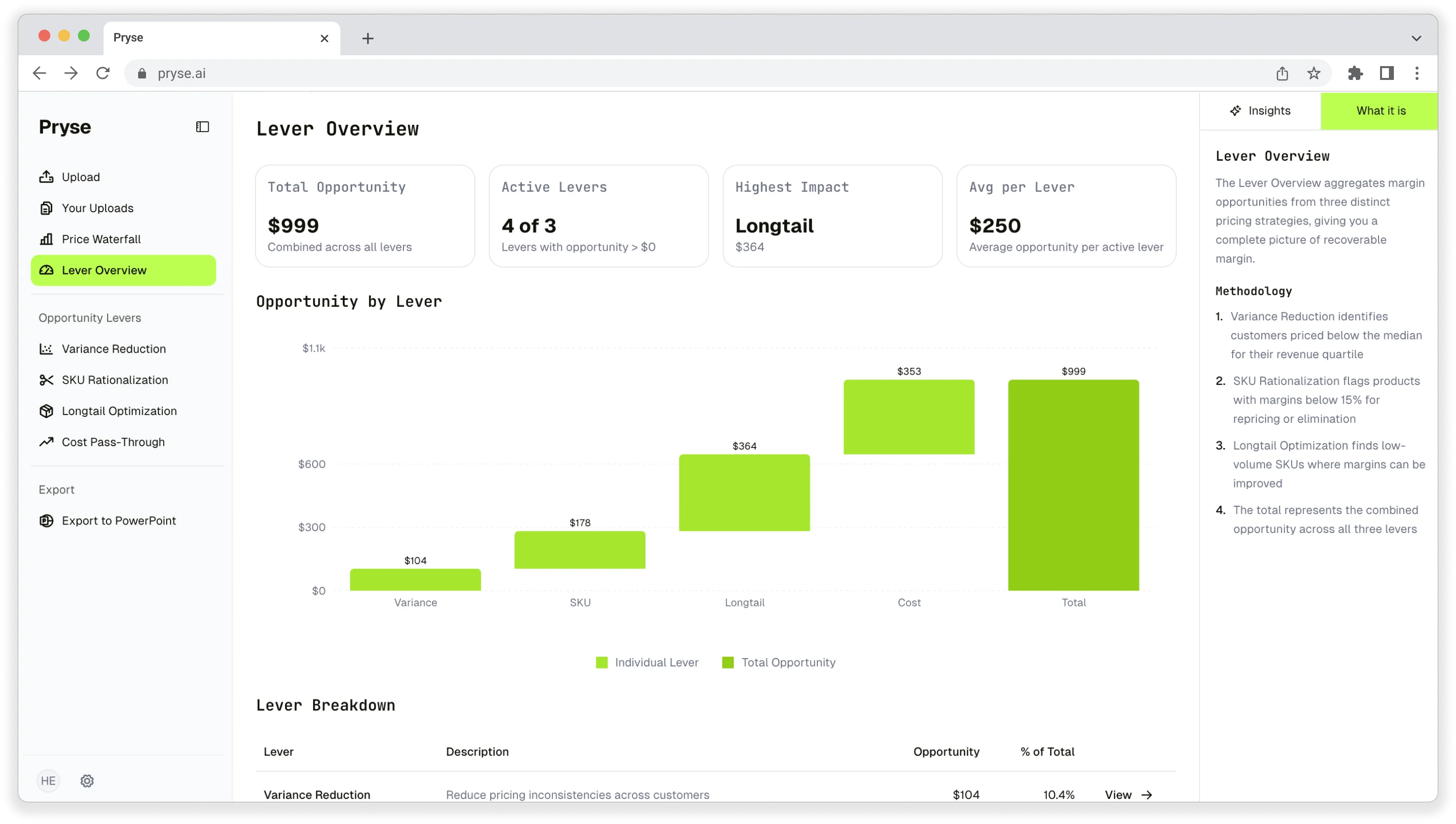
Want to analyze your entire product catalog?
Pryse automatically identifies margin leakage across thousands of SKUs. Upload your data and find hidden profit in 24 hours.
One-time $1,499 diagnostic. No subscription required.