 Pryse
PryseContract Pricing: The Distribution & Manufacturing Guide to Protecting Margins
Contract pricing locks in rates between buyers and sellers for a set period. Learn the types, formulas, escalation clauses, and margin leakage traps distributors face.
Contract pricing is a pre-agreed rate between a buyer and seller that holds for a defined period, typically 12 to 36 months. It's the backbone of B2B distribution and manufacturing transactions. And it's one of the most common places mid-market companies bleed margin without realizing it.
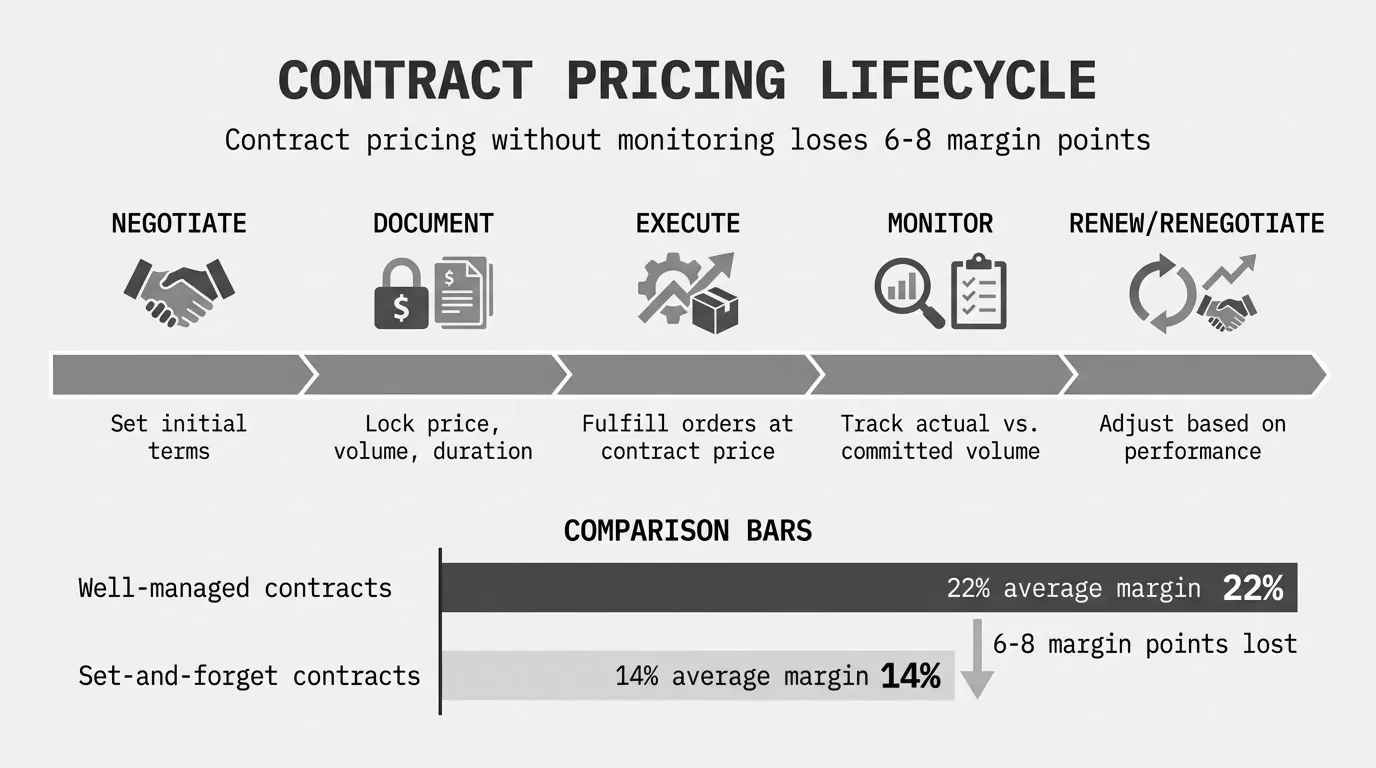
Here's the problem: most distributors set contract prices once, file the agreement, and don't revisit until renewal. Meanwhile, input costs shift, freight rates change, volume commitments go unmet, and the original pricing logic becomes fiction. World Commerce & Contracting's 2014 report "The 10 Pitfalls" estimated that poor contract management costs companies 9.2% of annual revenue on average, a finding later validated in their 2022 follow-up study with Deloitte. For a $75M distributor, that's nearly $7M in value leakage, and contract pricing is a major contributor.
This guide covers the contract pricing structures that actually work for distribution and manufacturing, how to build in protection against margin erosion, and the specific traps that catch mid-market companies running pricing through Excel and basic ERP systems.
For the broader pricing strategy framework, see our pricing strategy guide.
What Contract Pricing Actually Does (and Doesn't Do)
Contract pricing establishes a committed rate structure between buyer and seller. It removes day-to-day price negotiation from the transaction and replaces it with a pre-defined set of rules about what each product costs, under what conditions, and for how long.
What it does well:
- Reduces transaction friction. Orders process faster when prices don't need approval every time. For distributors handling 500-2,000 orders per day, this matters.
- Creates revenue predictability. Both sides can forecast. Buyers budget against known costs. Sellers project margin on committed volume.
- Strengthens relationships. A signed contract signals commitment. It's harder for a competitor to poach a customer who's locked in at a good rate.
What it doesn't do:
- Protect your margin automatically. A contract only protects margin if the pricing reflects current costs and includes adjustment mechanisms. Without those, you're locking in today's margin at best, and yesterday's margin at worst.
- Guarantee volume. Unless your contract includes minimum purchase commitments with teeth (clawback provisions, tiered pricing resets), the volume that justified your discount might never materialize.
- Adapt to market changes. Fixed contracts in volatile markets are a bet. Sometimes you win. During 2021-2023, manufacturers who'd locked in pre-inflation pricing shipped at a loss for months because their contracts had no escalation provisions.
The Three Core Contract Pricing Structures
Every contract pricing agreement in distribution and manufacturing falls into one of three categories, or blends elements from multiple ones.
1. Fixed-Price Contracts
The buyer pays a locked rate per unit for the contract term. Period.
Contract Price = Agreed Unit Rate × QuantityBest for: Stable commodities, standard catalog items, terms under 12 months, situations where you have strong confidence in your cost basis.
Risk profile: The seller absorbs all cost increases. If your steel cost goes up 15% mid-contract, that comes straight out of your margin. The buyer carries zero price risk.
A fixed-price contract for a 6-month run of standard fasteners? Straightforward. A fixed-price contract for a 3-year supply of specialty chemicals? That's a bet on commodity markets you probably shouldn't be making.
The mid-market trap: Smaller distributors default to fixed-price contracts because they're simple. No escalation formulas, no index tracking, no quarterly reviews. That simplicity costs money. SPARXiQ's pricing maturity model for distributors, published via the National Association of Wholesaler-Distributors (NAW), found that pricing overrides and manual adjustments account for 50% or more of transactions at many distributors, often because the underlying contract price is stale and reps have to work around it.
2. Cost-Plus Contracts
The buyer pays the seller's actual cost plus an agreed margin, either as a percentage or a flat fee per unit.
Contract Price = Actual Material Cost + Agreed Margin (% or $)Best for: Custom fabrication, volatile raw materials, long-term agreements (24+ months), project-based work where scope isn't fully defined upfront.
Risk profile: The buyer absorbs cost fluctuations. The seller's margin percentage (or flat fee) stays constant regardless of input cost changes. The seller's risk is limited to managing costs accurately and documenting them transparently.
Subtypes that matter for distribution:
| Structure | How It Works | When to Use |
|---|---|---|
| Cost + Fixed % | Margin scales with cost | Standard approach for commodity-linked products |
| Cost + Flat Fee | Margin stays constant in $ terms | When you want predictable per-unit profit regardless of material cost swings |
| Cost + Fee with GMP | Cost-plus with a price ceiling | When the buyer needs budget certainty but the seller needs cost protection |
The transparency requirement: Cost-plus contracts only work when both parties trust the cost reporting. You'll need to share actual invoices, POs, or indexed cost data. For manufacturers running custom jobs, this is standard practice. For distributors, it can feel uncomfortable, especially if your cost structure isn't well-organized.
3. Index-Linked Contracts
The base price adjusts according to a published external index, on a defined schedule.
Adjusted Price = Base Price × (Current Index Value ÷ Base Index Value)Best for: Multi-year agreements on products tied to commodity inputs, any situation where both parties want fair cost-sharing but don't want to haggle every quarter.
Common indices used in distribution and manufacturing:
- Producer Price Index (PPI): The Bureau of Labor Statistics publishes PPI data for specific commodity groups. BLS estimates that agreements worth trillions of dollars are currently adjusted using PPI-family indices.
- Consumer Price Index (CPI): Broader inflation measure, typically used for general escalation rather than commodity-specific adjustments.
- Industry-specific indices: Steel Service Center Institute pricing, ICIS chemical indices, lumber futures, etc.
The practical version: Your contract says the price for aluminum extrusions resets quarterly based on the PPI for Aluminum Mill Shapes (WPU10250201). If the index is up 4%, the price goes up 4%. If it drops 2%, the price drops. Both sides share the volatility.
Escalation Clauses: The Margin Protection Most Mid-Market Companies Skip
A price escalation clause allows the contract price to adjust when specific cost triggers are hit. It's probably the single most important protective mechanism in contract pricing, and mid-market distributors skip it more often than they should.
Why Escalation Clauses Matter Now
Between 2021 and 2025, distributors and manufacturers faced tariff shocks, inflation spikes, and freight cost swings that made static annual pricing dangerous. Some manufacturers changed prices nine times in a single year instead of the traditional once. Tariffs hit even harder than inflation because they're large, sudden increases rather than gradual shifts.
Without escalation clauses, you're making a 12-month (or longer) bet on cost stability. In the current environment, that's not a bet most $50M-$150M distributors should be taking.
Anatomy of a Working Escalation Clause
A strong escalation clause covers five elements:
1. The trigger. What activates the adjustment? Options include:
- Published index movement (PPI, CPI, commodity-specific)
- Raw material cost increase exceeding a threshold (e.g., steel up more than 5%)
- Tariff or regulatory cost changes
- Freight rate index movement
2. The formula. How is the new price calculated? Be specific. "Prices may be adjusted to reflect market conditions" is unenforceable. "Prices adjust by the percentage change in PPI-WPU10170502 measured quarterly" is enforceable.
3. The frequency. When do adjustments happen? Quarterly is common for volatile categories. Annual adjustments work for more stable product lines. The BLS notes that tying adjustments to annual contract renewal is the most common approach, but quarterly review windows are increasingly standard.
4. Caps and floors. Put boundaries on the adjustment range. A typical structure: annual increases capped at 7-10%, with no single quarterly adjustment exceeding 3-4%. Floors prevent your price from dropping below a minimum margin threshold even if the index falls.
5. Notice requirements. How much lead time before a price change takes effect? Industry standard runs 30-60 days. One common contract structure requires at least 60 days' written notice before any price increase, even if the index trigger has been met.
Escalation Clause Example for Distribution
Here's a simplified version of what this looks like in practice for an industrial distributor:
"Unit prices shall be adjusted quarterly based on the Bureau of Labor Statistics Producer Price Index for [specific commodity group]. Adjustments shall be calculated as the percentage change in the index from the base period. No single quarterly adjustment shall exceed 4%. Total annual adjustments shall not exceed 10% upward or 5% downward. Seller shall provide 45 days written notice of any adjustment. Base price and base index values are set at contract execution."
This gives both sides fair cost-sharing with defined limits. The buyer isn't exposed to unlimited price increases. The seller isn't locked into rates that lose money when costs spike.
Where Contract Pricing Leaks Margin (The Specific Traps)
Contract pricing creates margin leakage through five predictable mechanisms. If you're running contracts through Excel or your ERP's basic pricing module, you're probably exposed to at least three of them.
1. Stale Customer-Specific Pricing
Typical impact: 0.5-1.5% of revenue
This is the most common source. You gave Customer X a 12% discount two years ago when they committed to $500K annually. They're now buying $200K per year. The discount never changed.
Most ERP systems store customer-specific prices as static records. Unless someone manually reviews them, they persist indefinitely. For a distributor with 2,000 active customers and 30,000 SKUs, the number of customer-price combinations is staggering. Nobody is reviewing all of them.
The fix isn't complicated, just time-consuming. Export your customer-specific pricing, compare it against actual volume, and flag any account where the discount tier no longer matches the purchase level. If you're doing this in Excel, budget a full week. With a tool like Pryse, you can run this analysis in 24 hours from a CSV export.
2. Cost Pass-Through Lag
Typical impact: 0.3-1.2% of revenue
Your supplier raises prices on March 1. Your system gets updated on March 15. Your contracts don't reset until April 1. That 30-day window where you're selling at old prices with new costs? That's margin leakage.
The lag compounds when you have multiple suppliers feeding into the same product category, each with different effective dates. For manufacturers, the problem is worse because many industrial companies lack precise bill-of-materials data showing exactly how much steel, rubber, or petroleum-based material goes into each finished product. If you can't trace cost increases to specific SKUs, you can't pass them through accurately.
3. Discount Stacking
Typical impact: 0.5-1.5% of revenue
Customer gets a contract discount. Then a volume tier discount. Then a promotional discount. Then a project bid discount. Each one is justified individually. Together, they crush your margin.
Here's what stacking looks like on a $100 list price item:
| Discount Layer | Rate | Running Price |
|---|---|---|
| List price | — | $100.00 |
| Contract discount | -12% | $88.00 |
| Volume tier (monthly) | -5% | $83.60 |
| Q1 promotion | -3% | $81.09 |
| Project bid | -7% | $75.41 |
| Total effective discount | -24.6% | $75.41 |
Nobody approved a 24.6% discount. But four separate, reasonable discounts stacked to produce one. This is especially common in distribution because different people control different discount layers. The contract price lives in the ERP. The volume tier is automated. The promotion was set by marketing. The project bid came from the sales rep.
For more on detecting stacking through waterfall analysis, see our guide on price waterfall analysis.
4. Expired Contract Pricing That Persists
Typical impact: 0.3-0.8% of revenue
The contract expired six months ago. The pricing didn't. The customer keeps ordering at contract rates because nobody in your system flagged the expiration.
World Commerce & Contracting's research found that poor contract management erodes an average of 9.2% of contract value, with losses reaching up to 15% at larger organizations, through poorly executed contract terms, missed amendments, or auto-renew issues. For mid-market companies without automated contract lifecycle management, this is a constant drain.
The particularly painful version: a promotional contract pricing tier that was meant to run for 90 days but never had an expiration set in the ERP. It just keeps applying, silently, for years.
5. Volume Commitments Without Enforcement
Typical impact: 0.2-0.8% of revenue
You offered a 15% discount based on a commitment to purchase $300K annually. The customer bought $180K. The discount stayed at 15%.
Without clawback provisions or automatic tier resets, volume-based contract pricing is really just unconditional discounting with extra paperwork. And the paperwork creates a false sense of security, because someone signed an agreement, you assume the volume will come.
How to Audit Your Contract Pricing (Step by Step)
You don't need enterprise software to find the biggest leaks. Here's the process that works for mid-market distributors running on standard ERP systems.
Step 1: Export Your Active Contracts
Pull every active customer-specific pricing record from your ERP. You need: customer name, SKU or product group, contract price, effective date, expiration date (if any), volume commitment (if any), and the discount basis (what list or cost it was calculated from).
If your ERP doesn't track expiration dates on pricing records, that's your first red flag. It means every contract price you've ever set is still active unless someone manually removed it.
Step 2: Map Actual Volume Against Commitments
For every contract with a volume commitment, pull the customer's actual purchase history for the contract period. Calculate the gap:
Volume Gap = Committed Volume - Actual VolumeAny customer buying less than 80% of their committed volume needs a pricing review. They're getting a discount sized for a purchase level they aren't hitting.
Step 3: Run a Cost Comparison
Compare the contracted selling price against your current landed cost for each SKU. Calculate the actual margin you're earning today, not the margin when the contract was signed.
Current Contract Margin = (Contract Price - Current Landed Cost) ÷ Contract Price × 100If any product lines show margin below your floor (typically 15-20% gross for distribution, 25-35% for manufacturing), you've found a cost pass-through problem. The contract price hasn't kept up with cost increases.
Step 4: Check for Stacking
Pull a sample of 200-500 invoices. For each, compare the list price to the invoiced price and then to the pocket price (after all off-invoice deductions). If the gap between list and pocket is more than 5 percentage points wider than your intended contract discount, stacking is happening.
Step 5: Flag Expired Agreements
Compare contract expiration dates against current pricing records. Any price that's still active past its contract end date is either an intentional holdover (fine, if someone approved it) or a leak (not fine, if it just slipped through).
Building Better Contract Pricing Structures
Once you've audited your existing contracts, here's how to structure new ones to minimize leakage from the start.
Tiered Pricing with Automatic Resets
Instead of a flat discount, tie the discount to rolling 12-month purchase volume. If volume drops below the tier threshold, the price automatically resets to the next tier up at the quarterly review.
| Annual Volume | Discount from List |
|---|---|
| $500K+ | 18% |
| $300K-$499K | 14% |
| $150K-$299K | 10% |
| Under $150K | 6% |
The key word is "automatic." If tier changes require manual intervention, they won't happen.
Blended Contract Structures
Don't force every product line into the same pricing model. Use fixed-price for your high-volume, stable-cost A items where you have strong cost visibility. Use index-linked pricing for commodity-sensitive products. Use cost-plus for custom or specialty items where costs are genuinely unpredictable.
This sounds more complicated than a flat contract, but it actually reduces the manual work over time because you're not constantly issuing exceptions and overrides when costs move on specific product lines.
Hard Expiration Dates
Every contract price should have an end date in your ERP. No exceptions. When the contract expires, the system should revert to standard pricing, not continue at the contracted rate. The customer calls to reorder, sees a higher price, and that triggers the renewal conversation you should be having.
Margin Floors, Not Just Price Points
Define your minimum acceptable margin for each product category and build it into the contract as a floor. If costs rise to the point where the contracted price would produce margin below the floor, the escalation clause activates automatically.
Margin Floor Trigger: If (Contract Price - Current Cost) ÷ Contract Price < Minimum Margin %, then escalation clause activatesThis is more protective than a simple price cap because it responds to your actual cost position, not just an external index.
Contract Pricing in Your ERP: What Actually Works
Most mid-market distributors run contract pricing through their ERP's customer-specific pricing or price list functionality. Here's what to get right.
Use pricing effective dates and end dates. If your ERP supports them (most modern systems do), use them on every record. This is the single highest-value configuration change you can make.
Separate contract pricing from ad-hoc discounts. Your ERP should distinguish between a contracted rate (reviewed and approved) and a one-time override (a rep giving a discount to close a deal). If they live in the same pricing table, you can't tell which is which.
Set up pricing approval workflows. Any discount beyond your defined threshold should require approval. This doesn't slow down orders if you set the threshold correctly. A 10% discount on a catalog item? Auto-approved. A 25% discount on a specialty product? That needs a second pair of eyes.
Run monthly exception reports. Your ERP can likely report on transactions that fell below a margin threshold, pricing records past their expiration date, and customers whose volume is trending below their commitment. If you're not running these reports, you're flying blind.
For more on the relationship between contract pricing and your broader pricing strategy, see our pricing strategy guide.
The Bottom Line
Contract pricing isn't complicated in theory. You agree on a price, you put it in the system, you honor it for the term. The complexity comes from managing thousands of those agreements across years, market shifts, and personnel changes.
The companies that protect their margins aren't the ones with the most sophisticated pricing software. They're the ones that review their contracts regularly, build in adjustment mechanisms, and actually enforce the terms they negotiated. That takes process more than technology.
But it starts with visibility. If you can't see what your contracts are actually earning you today, at the transaction level, against current costs, you can't know where to fix them.
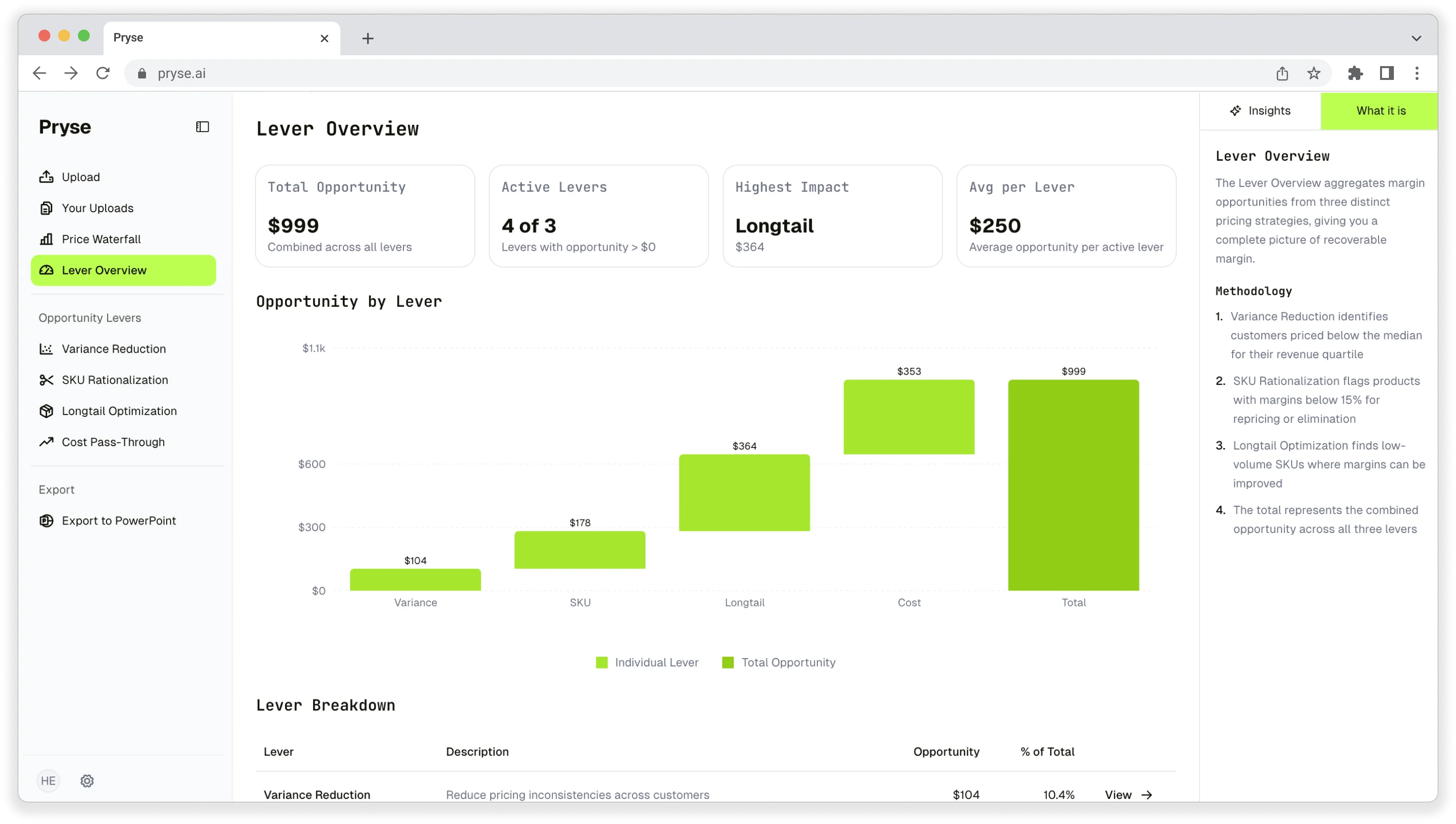
That's what Pryse does: take your transaction data, run the waterfall analysis, and show you exactly where contract pricing is leaking margin. In 24 hours, not 6 months. Start your diagnostic today.
Last updated: Invalid Date
Frequently Asked Questions
Want to analyze your entire product catalog?
Pryse automatically identifies margin leakage across thousands of SKUs. Upload your data and find hidden profit in 24 hours.
One-time $1,499 diagnostic. No subscription required.