 Pryse
PryseReseller Pricing: How to Structure Margins, MAP Policies, and Channel Pricing That Actually Hold
Build a reseller pricing structure that protects margins across your channel. Covers MAP vs MSRP, margin stacking, and fixing the leakage most distributors miss.
Reseller pricing is the price structure a manufacturer or distributor sets for channel partners who purchase products to resell to end customers. It covers everything from list prices and discount schedules to MAP floors and margin allocations at each level of the supply chain.
Get it wrong, and you'll watch margins erode across your entire channel. Get it right, and every partner in the chain makes money without cannibalizing each other.
I spent two years at McKinsey working with industrial distributors who had 30,000+ SKUs and no consistent reseller pricing structure. The pattern was always the same: a pricing spreadsheet built 8 years ago, a handful of reps making ad-hoc discount decisions, and 3-7% of gross margin disappearing into off-invoice leakage that nobody could trace.
This guide covers how to build a reseller pricing structure that holds up across channels, what MAP and MSRP actually mean in practice, and where most mid-market distributors and manufacturers are leaving money on the table.
How Reseller Pricing Works in Distribution
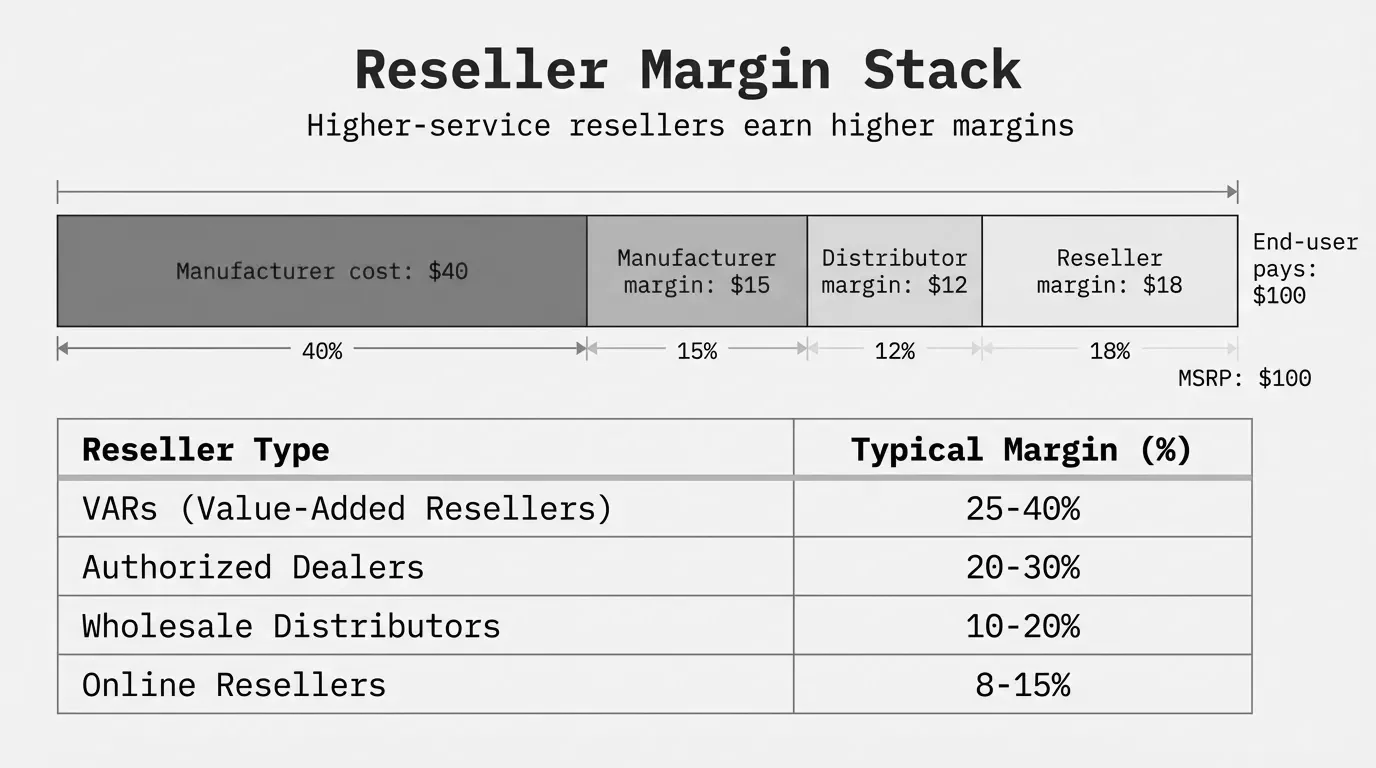
The reseller pricing chain has three to four layers, and margins stack at each level. Understanding this stack is the foundation for any pricing strategy that involves channel partners.
Here's the typical flow:
Manufacturer Cost → Manufacturer Markup (15-20%) → Distributor Markup (20-40%) → Retailer/Reseller Markup (35-50%) → End Customer Price (MSRP)
Each layer takes its cut. A product with an $8 MSRP might look like this:
| Level | Price | Margin |
|---|---|---|
| Manufacturer ex-factory | $3.84 | — |
| Distributor buys at | $3.84 | — |
| Distributor sells at | $4.80 | 20% |
| Retailer buys at | $4.80 | — |
| Retailer sells at | $8.00 | 40% |
That $4.16 gap between your manufacturing cost and the shelf price? It's all margin stack. And when you're running 50,000 SKUs through this chain, the difference between a well-structured stack and a sloppy one can be millions in annual margin.
The mistake most manufacturers make: they set reseller pricing based on a single margin target without modeling how the stack affects each partner's economics. If a distributor can't make 20% on your product, they'll push a competitor's instead. If a retailer can't make 35%+, your product sits on the shelf.
Reseller Margin Benchmarks by Channel Type
Not every reseller needs the same margin. The right allocation depends on what they do and what it costs them to do it.
| Partner Type | Typical Margin | Why |
|---|---|---|
| Master distributor | 10-15% | High volume, low touch, logistics-focused |
| Regional distributor | 20-30% | Warehousing, delivery, local relationships |
| Value-Added Reseller (VAR) | 25-35% | Technical expertise, installation, support |
| Independent retailer | 35-50% | Showroom, sales staff, customer service |
| Online reseller | 15-25% | Lower overhead, higher price transparency |
| Managed Service Provider | 30-40% | Ongoing service, recurring revenue model |
According to the 2023 PartnerPath SaaS Channel Survey, 67% of partners rank competitive margins as a top-three criterion when selecting vendor partnerships. Partners who can't achieve at least 15% gross margin will deprioritize your products. That's not a threat — it's just math. They'll shift shelf space, sales effort, and marketing dollars to whoever gives them better economics.
A distribution company I worked with in building materials had two tiers of resellers getting the same discount: 22%. One tier was a group of VARs doing installation and technical support. The other was a set of online resellers doing nothing but listing products. The VARs were furious. They were spending $40-60 per transaction on pre-sale support, while online resellers undercut them by 8-12% and captured the sale. Within 18 months, three of the five VARs had dropped the product line.
The fix wasn't complicated. They restructured into three discount tiers based on value-added services and enforced a MAP policy. But it cost them two years of channel damage.
MAP vs MSRP: What Each Actually Controls
These two acronyms get thrown around interchangeably, but they do different things.
MSRP (Manufacturer's Suggested Retail Price) is the price you recommend the end customer pays. It's a suggestion. Retailers can sell above or below it. Apple products regularly sell at MSRP because Apple controls supply tightly. Most industrial products don't have that luxury.
MAP (Minimum Advertised Price) is the lowest price a reseller can show in public-facing advertising — on a website, in a catalog, in an email blast. MAP doesn't control what happens at the point of sale. A reseller can sell below MAP in a private negotiation; they just can't advertise it.
The distinction matters legally. Under U.S. antitrust law, MAP policies must be structured as unilateral policies — a manufacturer's independent decision — not bilateral agreements. If you frame MAP as a contract between you and the reseller, you're walking into price-fixing territory.
MAP = Wholesale Cost x (1 + Desired Margin %)
Most manufacturers set MAP using a fixed markup method, typically 30-50% above wholesale cost. Some use tiered MAPs where higher-margin product categories get larger buffers between MAP and MSRP.
How MAP Enforcement Actually Works
Here's where things get uncomfortable. A 2016 study by Harvard Business School professor Ayelet Israeli, published in Marketing Science ("Minimum Advertised Pricing: Patterns of Violation in Competitive Retail Markets"), found that 53% of unauthorized retailers violated MAP policies. Authorized retailers? A 15% violation rate.
That's not a rounding error. If you have 200 authorized resellers and half your unauthorized seller base is undercutting your MAP, your price integrity is shot.
Enforcement follows a predictable escalation:
- Automated monitoring — Track advertised prices across channels daily
- First violation notice — Written warning, documented
- Second violation — Suspension of promotional funding or co-op dollars
- Third violation — Shipment suspension (this is what Hasbro does)
- Persistent violation — Termination of reseller agreement
The companies that make MAP work aren't the ones with the best policy documents. They're the ones that enforce consistently. When you let one reseller slide "just this once," you've signaled to the entire channel that MAP is optional.
The Five Reseller Pricing Models
There's no single right way to structure reseller pricing. The model you choose depends on your product category, channel complexity, and how much control you want over the end price.
1. Cost-Plus Pricing
You set a wholesale price based on your cost plus a fixed margin, and resellers add their own markup.
Wholesale Price = Manufacturing Cost x (1 + Manufacturer Margin %)
Reseller Price = Wholesale Price x (1 + Reseller Markup %)
Best for: Commodity products, simple supply chains, price-sensitive markets.
The problem: No price consistency across channels. Each reseller sets their own retail price, which leads to channel conflict when an online reseller undercuts a brick-and-mortar partner by 15%.
2. MSRP-Based Pricing
You set the end price and work backward to determine wholesale and distributor pricing.
Best for: Branded products, consumer electronics, anything where price consistency matters.
The problem: You can't legally enforce MSRP in the U.S. It's a suggestion, not a mandate. You need MAP as the enforcement mechanism.
3. Tiered Discount Pricing
Resellers get different discount levels off list price based on volume, partner type, or value-added services.
| Tier | Discount Off List | Requirement |
|---|---|---|
| Platinum | 45% | $500K+ annual purchases, technical certification |
| Gold | 35% | $200K+ annual purchases |
| Silver | 25% | $50K+ annual purchases |
| Standard | 15% | Authorized reseller agreement |
Best for: Mid-market distributors with diverse channel partners. This is the model I've seen work best for companies with 5,000-100,000 SKUs.
The problem: Tier inflation. Over time, sales reps bump partners up a tier to close deals, and you end up with 80% of partners in your top two tiers. Review tier assignments annually.
4. Deal Registration Pricing
Resellers register specific opportunities and get additional margin protection (typically 10-15% extra discount) for 60-90 days. This prevents another reseller from swooping in and undercutting on a deal they didn't source.
Best for: High-value, consultative sales where the reseller invests significant pre-sale effort.
The problem: Administrative overhead. Someone needs to review and approve registrations, resolve conflicts, and track expiration dates. If you're running this in Excel, you'll hate your life by month three.
5. Channel-Specific Pricing
Different prices for different channels entirely. Your distributor channel gets one price list. Your direct-to-customer channel gets another. Your e-commerce partners get a third.
Best for: Manufacturers selling through multiple channel types simultaneously.
The problem: If the price gaps between channels are too wide, you'll create arbitrage opportunities. I've seen cases where a distributor's authorized online reseller was buying through the "direct" channel at a lower price and reselling into the distribution channel. The manufacturer didn't catch it for 11 months.
Where Reseller Pricing Breaks Down: Margin Leakage Sources
This is where I want you to pay close attention, because this is where mid-market companies lose the most money without realizing it. For a deeper look at this topic, see our guide on margin leakage in distribution.
Off-Invoice Deductions
These are the silent killers. Rebates, co-op advertising allowances, freight absorption, consignment terms, early-pay discounts — none of them show up on the invoice, but they all reduce your realized margin.
A building materials distributor I worked with was running 14 different off-invoice programs. When we added them up, the gap between their list price margin and their pocket margin was 11.2 percentage points. On $85M in revenue, that's $9.5M in margin they couldn't see on any single invoice.
The fix: build a price waterfall that tracks every deduction from list price to pocket price. You can't fix what you can't see.
Inconsistent Discount Approvals
When sales reps can approve one-off discounts without visibility into the customer's total deal economics, margin bleeds. One rep gives 5% to close a deal. Another gives 8% on the same account next quarter. A third adds free freight. Nobody's tracking the cumulative impact.
In distribution companies with 10+ outside reps, inconsistent discounting typically costs 2-4% of gross margin annually. That's not a guess — it's what I've seen consistently across engagements.
Unauthorized Resellers
Every product sold by an unauthorized reseller at below-MAP pricing damages your channel. It trains end customers to expect lower prices. It demotivates authorized partners. And on marketplaces like Amazon, pricing bots will match the lowest advertised price within hours, triggering a cascade that pulls every reseller's margin down.
The 2023 PartnerPath SaaS Channel Survey found that 67% of channel partners rank competitive margins as a top-three criterion when choosing vendors, and pricing inconsistencies are a leading cause of partner churn. Those inconsistencies often start with unauthorized sellers.
Stale Price Lists
If you update reseller pricing once a year, you're pricing with 12-month-old cost data. Raw material costs, freight rates, and competitive dynamics shift quarterly. A manufacturer with 40,000 SKUs that reprices annually will have 15-25% of their catalog priced below target margin at any given time.
How to Build a Reseller Pricing Structure: Step by Step
Here's the process I've used with distribution and manufacturing clients. It's not theoretical — it's the sequence that works when you're dealing with thousands of SKUs and multiple channel partners.
Step 1: Map Your Channel Economics
Before setting any prices, understand what each partner type needs to make money.
- What's their cost-to-serve per transaction?
- What margin do they need to justify carrying your product line?
- What are competitors offering them?
If you don't know the answers, ask. I've sat in rooms where manufacturers were shocked to learn that their "best" distribution partner was making 8% margin on their products and 22% on a competitor's. Guess which product line got the prime shelf space.
Step 2: Build the Margin Stack
Start from MSRP and work backward:
MSRP = $100
Retailer margin (40%) → Retailer buys at $60
Distributor margin (20%) → Distributor buys at $48
Your margin → $48 minus your COGS
If your COGS is $30, you're making $18 per unit, or a 37.5% margin on your ex-factory price. If your COGS is $42, you're making $6, or 12.5%. The margin stack tells you whether the economics work for everyone in the chain.
Step 3: Set Your Price Floors
Define three price floors for every product:
- MAP — The lowest price any partner can advertise publicly
- Minimum resale price — Your internal floor for what you'll accept (not communicated externally, for legal reasons)
- Walk-away price — The absolute lowest you'll go on a one-off deal before you'd rather lose the sale
Most companies only define MAP. The other two keep your reps from giving away the store.
Step 4: Create Discount Guardrails
Define who can approve what level of discount:
| Discount Level | Approval Required |
|---|---|
| 0-10% off list | Sales rep |
| 10-20% off list | Regional manager |
| 20-30% off list | VP Sales |
| 30%+ off list | CEO/Pricing committee |
This isn't bureaucracy. It's margin protection. When a rep can approve 25% off without anyone checking the customer's total cost-to-serve, you've got a margin leak.
Step 5: Monitor and Enforce
Pricing without enforcement is just a suggestion. At minimum, you need:
- Monthly price realization reports (what you listed vs. what you actually collected)
- Quarterly MAP compliance audits
- Annual reseller tier reviews
- Real-time alerts for pricing below floor on key SKUs
If you're tracking all of this in Excel, you're probably spending 15+ hours per month on data collection alone — and still missing things. That's exactly the kind of problem a pricing diagnostic can surface in 24 hours.
Channel Conflict: The Inevitable Side Effect of Multi-Channel Reseller Pricing
Channel conflict happens when your resellers compete against each other — or against you — in ways that destroy margin for everyone.
The most common scenario in 2026: a manufacturer sells direct-to-customer through their own website while also selling through distributors and resellers. If the direct price is lower (or even equal, since the manufacturer doesn't have distribution costs baked in), every reseller in the chain is undercut.
Three tactics that actually reduce channel conflict:
1. Channel-specific SKUs. Sell slightly different product configurations through different channels. The online version has different packaging. The distributor version includes a warranty extension. Same core product, different SKU, harder to price-compare directly.
2. Territory restrictions. Limit the number of authorized resellers per geography. A building materials manufacturer I worked with cut their authorized dealer count from 340 to 180 in a single region. Average dealer margin went from 18% to 29%. Total revenue stayed flat because the remaining dealers invested more in the product line.
3. Price parity commitments. Guarantee your resellers that your direct channel won't undercut them. Put it in writing. If you're not willing to make that commitment, your channel pricing strategy has a structural problem.
Reseller Pricing by Industry: What Works Where
Different industries have different norms. Here's what I've seen work across the verticals Pryse serves most.
Industrial Distribution
- Typical reseller margin: 20-30%
- MAP enforcement: Rare (most products are sold B2B, not advertised publicly)
- Biggest leakage source: Project-based discounting without cost-to-serve analysis
- Key tactic: Tiered pricing by annual volume with quarterly rebates
Building Materials
- Typical reseller margin: 25-35%
- MAP enforcement: Growing, especially for products sold through both pro and retail channels
- Biggest leakage source: Contractor pricing that doesn't account for delivery costs
- Key tactic: Dealer pricing tiers with value-added service requirements
Electrical Distribution
- Typical reseller margin: 22-28%
- MAP enforcement: Moderate (more common for consumer-facing products like lighting)
- Biggest leakage source: Multiplier sheets that haven't been updated in 18+ months
- Key tactic: Matrix pricing with customer-class and product-class segmentation
HVAC/Plumbing
- Typical reseller margin: 28-38%
- MAP enforcement: Common for retail-facing brands
- Biggest leakage source: Free freight on small orders eating 3-5% of margin
- Key tactic: Minimum order quantities with freight tiers
Common Reseller Pricing Mistakes
I've seen these in every engagement. They're not complicated to fix, but they're easy to ignore.
Mistake 1: Same discount for everyone. Your online reseller with zero cost-to-serve should not get the same margin as your VAR that provides installation and support. Different value, different pricing.
Mistake 2: Annual repricing on a quarterly cost cycle. If your input costs shift quarterly and you reprice annually, you're guaranteed to have margin gaps. Build a repricing trigger: when any cost input moves more than 3%, review affected SKUs within 30 days.
Mistake 3: No visibility into pocket price. Most mid-market companies can tell you their list price and maybe their invoice price. Almost none can tell you their pocket price — the actual revenue per unit after every deduction. That gap is where 3-7% of gross margin hides.
Mistake 4: Treating MAP as optional. If you have a MAP policy and don't enforce it, you're worse off than having no policy at all. Non-enforcement signals to your channel that pricing rules don't matter.
Mistake 5: Ignoring the cost-to-serve by customer. Two resellers buying the same volume at the same price can have wildly different profitability. One orders in full pallets with 60-day payment terms. The other orders in broken cases, demands next-day delivery, and pays in 90. Same price, completely different margin.
Your Next Step: See Where the Margin Is Hiding
If you're running reseller pricing across 5,000+ SKUs and multiple channel partners, you've almost certainly got margin leakage you can't see in a spreadsheet. Off-invoice deductions, inconsistent discounting, stale price lists, and unenforced policies create gaps that compound over time.
Pryse's pricing diagnostic takes your transaction data and maps the gap between your list price and your pocket price — across every SKU, every customer, every channel. You'll see exactly where margin is leaking and how much it's worth in dollar terms.
Run your diagnostic and find out what your reseller pricing is actually delivering versus what it should be.
Last updated: Invalid Date
Frequently Asked Questions
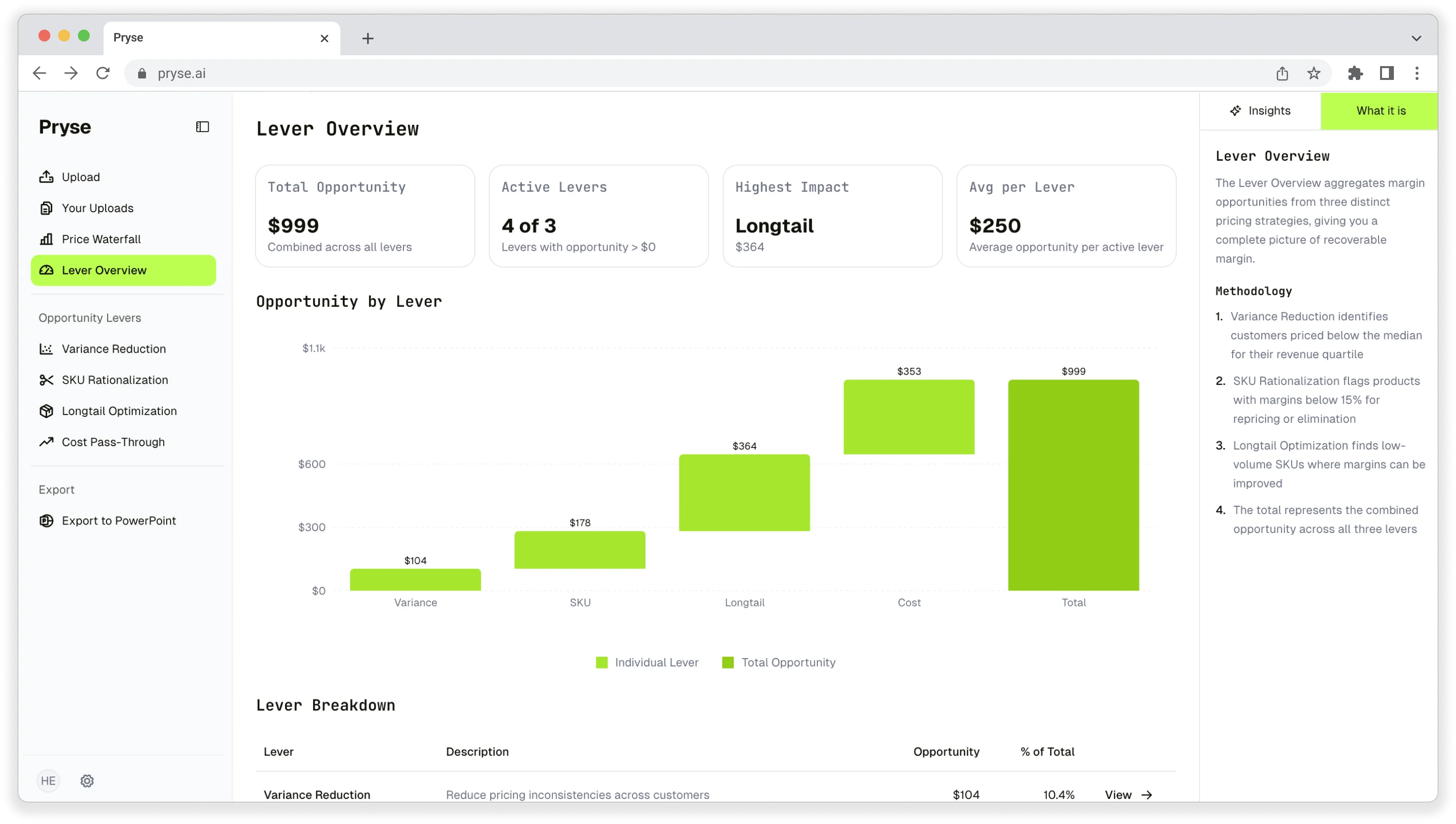
Want to analyze your entire product catalog?
Pryse automatically identifies margin leakage across thousands of SKUs. Upload your data and find hidden profit in 24 hours.
One-time $1,499 diagnostic. No subscription required.