 Pryse
PryseB2B vs B2C Pricing: Why Distribution Companies Can't Use Consumer Playbooks
The structural differences between B2B and B2C pricing, and why mid-market distributors and manufacturers need a fundamentally different approach.
B2B vs B2C pricing isn't just a difference of degree. It's a difference of kind. B2C companies set a price, display it, and let consumers decide. B2B companies negotiate prices across thousands of customer-product combinations, manage contracts that span years, and watch margins erode through dozens of off-invoice deductions that nobody tracks properly.
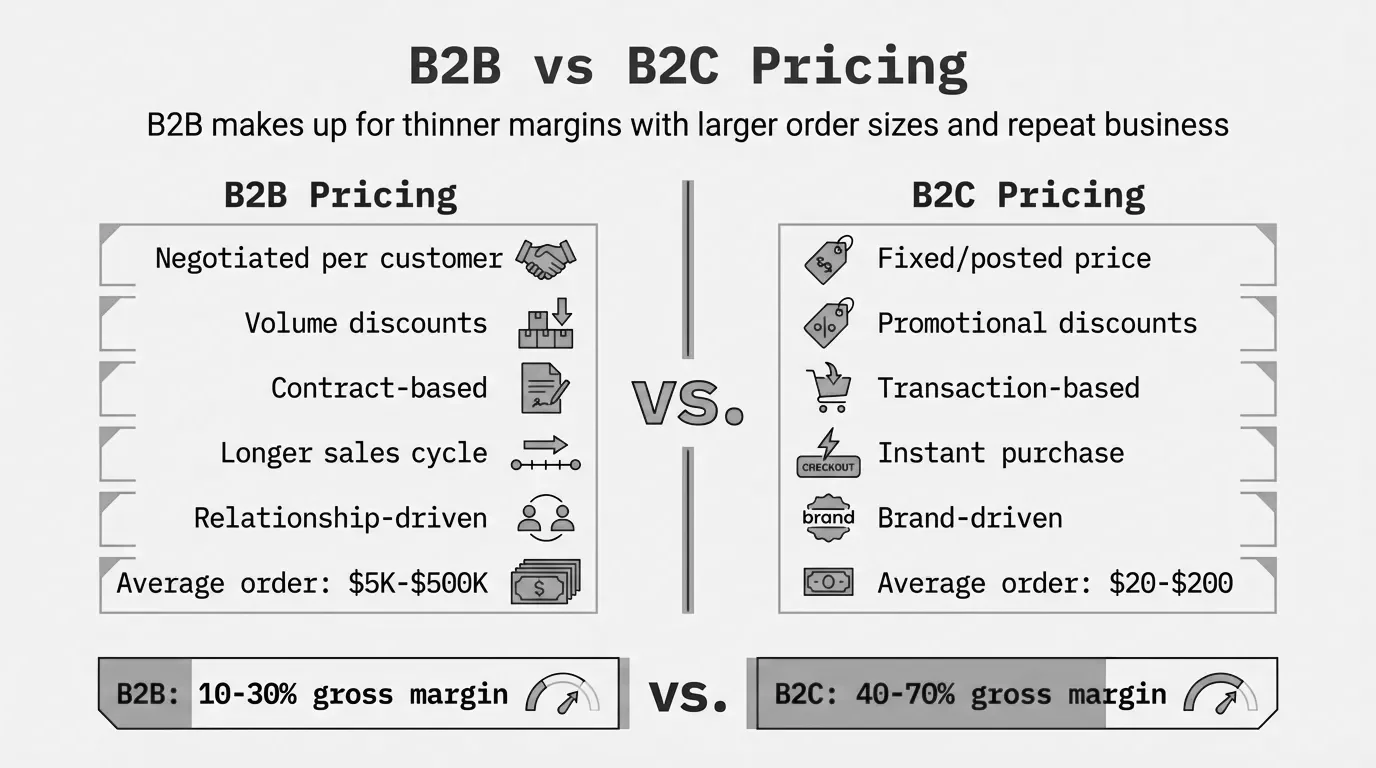
If you're running pricing for a distribution or manufacturing company with 5,000 to 100,000 SKUs, the B2C playbook won't just underperform. It'll actively hurt you. Here's why these two worlds operate on entirely different rules, and what that means for your margin.
For a broader framework on building your pricing approach, see our Pricing Strategy Guide.
B2B vs B2C Pricing: The Structural Differences
The gap between B2B and B2C pricing isn't about sophistication. Plenty of B2C companies run incredibly advanced pricing operations. The gap is structural. The mechanics of how prices get set, communicated, and realized are fundamentally different.
Who's Buying
A B2C transaction involves one person making one decision. Even for big-ticket consumer purchases like cars or appliances, you're dealing with one or two decision-makers spending their own money.
B2B is a different animal. Forrester's "The State of Business Buying, 2024" report, based on a survey of over 16,000 global business buyers, found that the average B2B purchase now involves 13 stakeholders, with 89% of buying decisions crossing multiple departments. A distributor selling industrial fasteners isn't convincing one person. They're navigating a procurement manager, an operations lead, a finance approver, and sometimes a plant manager who has opinions about thread quality.
That stakeholder complexity directly shapes pricing. Each buyer has different priorities. Procurement wants the lowest unit cost. Operations wants reliable delivery. Finance wants favorable payment terms. Your "price" isn't a single number. It's a package of unit cost, volume discounts, freight terms, payment windows, and service levels that has to satisfy all of them.
Price Visibility
B2C prices are public by default. A consumer can pull up five browser tabs and compare prices in under a minute. This transparency forces B2C companies into tight competitive bands. You can't charge 30% more for the same commodity without a strong brand story.
B2B prices are opaque by design. According to WinSavvy's 2025 "B2B vs B2C Pricing Strategy Trends" analysis, only 43% of B2B companies actively benchmark competitor pricing, and even those efforts are approximate because prices hide behind custom quotes, contracts, and relationship-based agreements. A $50M distributor might have 200 different prices for the same SKU across different customer agreements, and none of those prices are visible to the broader market.
This opacity cuts both ways. It creates room for value-based pricing that captures real differentiation. But it also creates room for inconsistency, unauthorized discounts, and margin leakage that nobody notices until it shows up in quarterly financials.
Transaction Economics
Here's where the math diverges most dramatically:
| Dimension | B2C | B2B Distribution/Manufacturing |
|---|---|---|
| Average order value | $20-$500 | $2,000-$500,000 |
| SKU count | 100s-1,000s | 5,000-100,000+ |
| Price points per SKU | 1 (maybe 2-3 with tiers) | 10-200+ (customer-specific) |
| Sales cycle | Minutes to days | Weeks to months |
| Discount authority | Centralized (marketing) | Distributed (sales reps) |
| Price change frequency | Daily to weekly | Quarterly to annually |
| Revenue at risk per pricing error | $5-$50 | $5,000-$500,000 |
A B2C retailer mispricing a product by 5% loses a few dollars per transaction. A distributor mispricing a product line by 5% across a major customer contract loses tens of thousands per quarter. Multiply that across hundreds of customer-product combinations, and the exposure becomes material.
Why B2C Pricing Tactics Fail in B2B
It's tempting to borrow from the B2C world. Those companies invest millions in pricing optimization. Shouldn't their lessons transfer? Some do. Most don't. Here's what breaks.
Dynamic Pricing Doesn't Scale the Same Way
Amazon changes prices 2.5 million times per day. Airline pricing shifts by the minute. This works in B2C because consumers accept price variation across time and channel. They're annoyed but not surprised when the same flight costs more on a Thursday than a Tuesday.
Try that with your B2B customers. A distribution customer who discovers they're paying 15% more than a comparable account for the same product won't shrug it off. They'll call your sales rep. Then they'll call your competitor. B2B relationships are long-term, contract-governed, and built on trust. Unpredictable pricing erodes that trust.
That doesn't mean B2B prices should be static. It means changes need to be systematic, defensible, and communicated. A well-built B2B pricing strategy accounts for cost pass-throughs, market adjustments, and volume triggers, not algorithmic price jockeying.
Charm Pricing Is Irrelevant
$9.99 instead of $10.00 works on consumers because they're making fast, emotional decisions. B2B buyers are calculating total cost of ownership across a 12-month contract for 47 line items. Nobody in procurement is swayed by psychological price points.
What B2B buyers do respond to is price grooving, and not in a good way. Zilliant's pricing software research found that price grooving, where sales reps round prices to the nearest dollar or standard margin tier, is a major source of margin leakage, contributing to the 100-300 basis points in incremental margin most distributors leave on the table. A rep quoting 30% margin when 33.5% would have won the deal is leaving real money behind. Across 50,000 transactions per year, those half-points compound fast.
Loss Leaders Don't Work Without the Basket
B2C grocery stores sell milk at cost because they know you'll buy $80 worth of higher-margin items while you're there. The basket economics make the loss leader profitable.
B2B distribution doesn't have that natural basket dynamic. A customer buying commodity fasteners at razor-thin margins isn't necessarily buying high-margin specialty products from you too. They might source those from a different distributor entirely. Loss leaders in B2B usually just become losses, especially when the discounted price gets locked into a contract and becomes the new baseline for all future negotiations.
Where B2B Companies Actually Lose Margin
Understanding the B2B vs B2C pricing gap matters because it highlights where B2B margin actually disappears. It's not at the list price. It's in the execution.
The Price Waterfall Problem
In B2C, the price on the shelf is roughly what the company collects. There's a credit card fee and maybe a return allowance, but the gap between sticker price and realized price is small.
In B2B distribution, the gap between list price and pocket price, what you actually collect after everything is deducted, can be enormous. Most distributors lose 15% to 45% between list and pocket price through a cascade of deductions:
Pocket Price = List Price - On-Invoice Discounts - Off-Invoice Rebates - Freight Costs - Payment Term Costs - Returns & Allowances
Each of those deductions might be justified individually. Collectively, they represent a margin waterfall that most companies don't track at the customer-SKU level. They know their average margin. They don't know which of their 50,000 customer-product combinations are profitable and which are underwater.
For a deeper look at how this works in practice, see our Pricing Strategy Guide.
The Spreadsheet Gap
Here's the stat that should concern every mid-market distribution CFO: Zilliant's 2024 Global B2B Distribution Benchmark found that distribution companies lose up to 28.5% of annual revenue and up to 15.7% of annual margin to leakage. For a $100M distributor, that's potentially $15.7M in margin walking out the door.
Much of this leakage traces back to manual pricing processes. Excel-based pricing creates errors that compound silently. A cost change that doesn't propagate to all customer price sheets. A discount override that never expires. A freight absorption that gets applied to accounts that shouldn't receive it. These aren't dramatic failures. They're small, systematic leaks across thousands of transactions that nobody sees until they run the numbers.
Annual Margin Leakage = Transactions per Year x Average Leakage per Transaction
Example: 50,000 transactions x $12 average leakage = $600,000 per year
Discount Proliferation
In B2C, discounts are centrally controlled. Marketing runs the promotion. The system applies the discount. Nobody in the store can override the price without manager approval.
In B2B distribution, discount authority is typically distributed across the sales team. A rep facing a competitive situation can cut price on the spot. WinSavvy's 2025 "B2B vs B2C Pricing Strategy Trends" analysis shows that 58% of B2B pricing decisions are finance-led in theory, but in practice, sales teams make hundreds of price concessions daily that finance only sees in aggregate after the quarter closes.
The result: smaller accounts often receive the same discount levels as major accounts. Customer-specific price exceptions proliferate without review processes. And once a discount is given, it becomes the customer's new expectation, making it nearly impossible to claw back.
What B2B Distributors Should Actually Do Differently
Knowing the differences is step one. Acting on them is where the margin improvement lives.
Segment Your Pricing, Not Just Your Customers
B2C segments by demographics and behavior. B2B needs to segment by margin opportunity. Not all SKU-customer combinations deserve the same pricing attention.
A practical starting point:
| Segment | Characteristics | Pricing Approach |
|---|---|---|
| High-volume commodity | Price-sensitive, many alternatives | Cost-plus with tight controls |
| Specialty / low-competition | Few alternatives, high switching cost | Value-based with wider margins |
| Tail SKUs (low volume) | Rarely ordered, often mispriced | Margin floors, automated pricing |
| Strategic accounts | High revenue, negotiated contracts | Custom waterfalls, quarterly review |
Most mid-market distributors treat all four segments the same. They apply a flat markup, maybe with a volume break. That underprices specialty products where customers aren't shopping around and overprices commodities where they are.
Track Pocket Price, Not List Price
The single most important metric in B2B pricing isn't your list price, your average margin, or your revenue. It's your pocket price: what you actually collect after every deduction. If you're managing pricing off list prices, you're flying blind.
Pocket Margin % = (Pocket Price - COGS) / Pocket Price x 100
Target: Track at the customer-SKU level, not just in aggregate
This requires data that most mid-market companies don't have organized in one place. Transaction records live in the ERP. Rebate agreements live in spreadsheets. Freight costs live in the logistics system. Pulling it together is hard, but it's the only way to see where you're actually making money and where you're not.
Build Guardrails, Not Gates
B2C companies control pricing centrally because they can. One price, applied everywhere, enforced by the system. B2B can't do that because every customer relationship has context that a rigid system can't account for.
The answer isn't central control or total sales autonomy. It's guardrails. Set margin floors by product segment. Require approval for discounts beyond a threshold. Review customer-specific exceptions quarterly. Give sales reps the flexibility they need to close deals while preventing the slow margin erosion that happens when nobody's watching.
Audit Before You Automate
Enterprise pricing software from PROS, Vendavo, or PriceFX costs $100K+ per year and takes 6-18 months to implement. For a $200M manufacturer, that might be worthwhile. For a $50M distributor, it's usually overkill.
Before committing to a platform, run a diagnostic on your current pricing. Upload your transaction data, identify where the biggest gaps between list and pocket price exist, and quantify the dollar opportunity. The 2023 EY-Parthenon Global PE Pricing Study found that companies investing in advanced pricing capabilities achieve significantly higher price realization and margin growth. For a $100M business, even a 1-2% improvement in realized pricing translates to $1M to $2M in additional annual profit. You don't need a six-figure tool to find the first million.
B2B vs B2C Pricing: Quick Reference
| Factor | B2C Pricing | B2B Pricing |
|---|---|---|
| Price visibility | Public, posted | Hidden, quoted |
| Price per SKU | 1 price (occasionally tiered) | Dozens to hundreds of customer-specific prices |
| Decision-maker | Individual consumer | 6-13 stakeholders (Forrester, 2024) |
| Negotiation | Rare (haggling is niche) | Standard for most transactions |
| Discount control | Centralized (marketing) | Distributed (sales team) |
| Margin leakage risk | Low (small gap list to realized) | High (15-45% waterfall from list to pocket) |
| Price change frequency | Daily or weekly | Quarterly or annually |
| Primary pricing driver | Consumer psychology, competition | Cost structure, relationship, volume |
| Biggest margin threat | Competitive pressure | Internal leakage and inconsistency |
The Bottom Line
B2B and B2C pricing share the same goal: capture value fairly. But the mechanics are so different that treating them interchangeably is a recipe for margin erosion.
If you're a distribution or manufacturing company managing thousands of SKUs, your pricing challenge isn't about setting the right list price. It's about making sure that list price actually reaches your pocket after all the discounts, rebates, exceptions, and concessions that accumulate between quote and cash.
That's a B2B-specific problem, and it requires a B2B-specific approach. Start by understanding your actual pocket prices at the customer-SKU level. The gap between what you think you're charging and what you're actually collecting is where the profit opportunity lives.
For a full walkthrough of how to build a pricing strategy that accounts for these B2B realities, read our B2B Pricing Strategy post or the complete Pricing Strategy Guide.
Last updated: February 1, 2026
Frequently Asked Questions
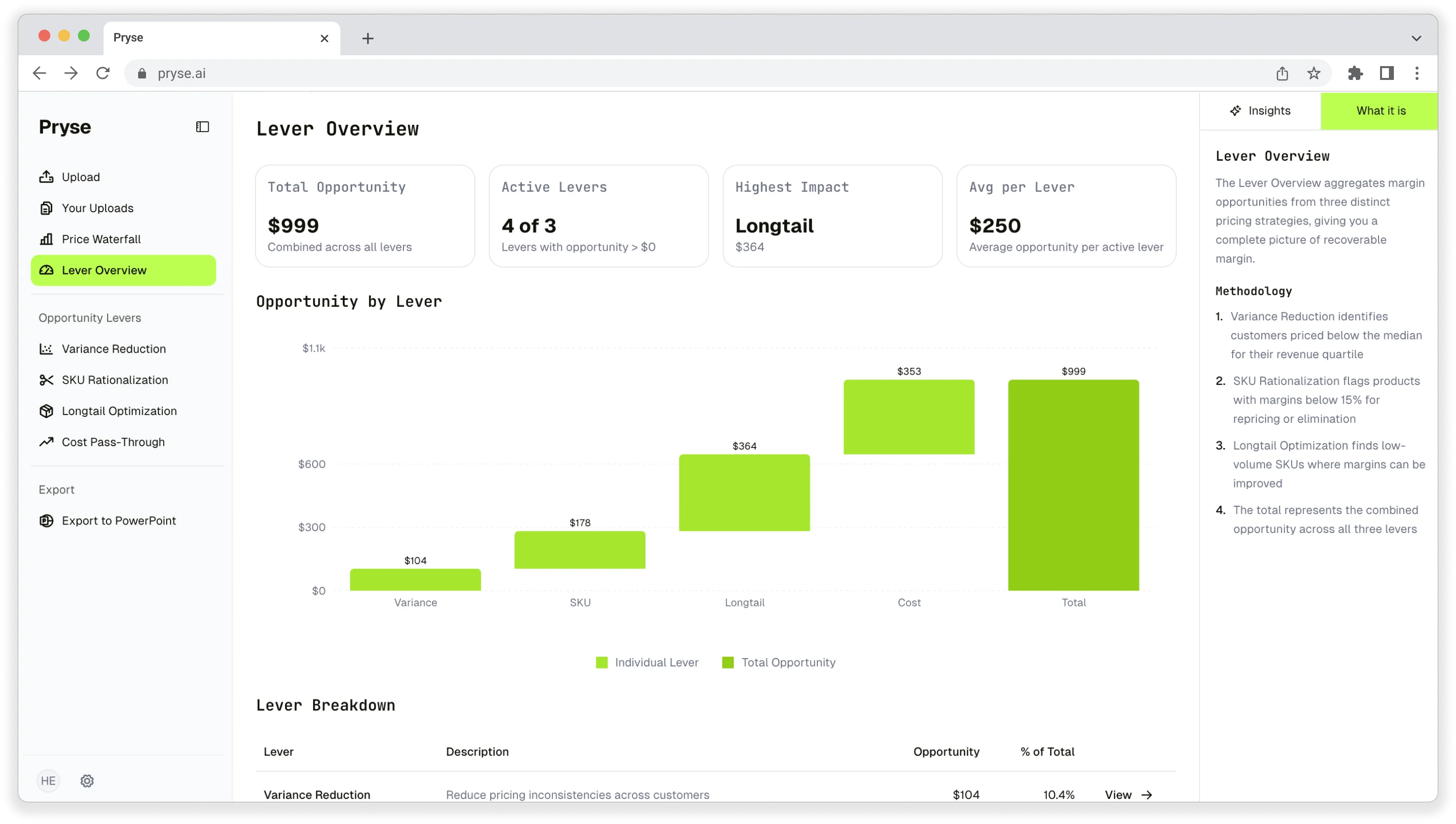
Want to analyze your entire product catalog?
Pryse automatically identifies margin leakage across thousands of SKUs. Upload your data and find hidden profit in 24 hours.
One-time $1,499 diagnostic. No subscription required.