 Pryse
PrysePricing Strategy for a New Product: A Practical Guide for Distributors and Manufacturers
How to price new products in distribution and manufacturing without guessing. Covers cost-plus floors, value-based ceilings, and the margin math that matters.
A pricing strategy for a new product is the method you use to set an initial price that covers costs, reflects market value, and positions you for profitable growth. It isn't a single number you pick from a spreadsheet. It's a framework that accounts for what the product costs you, what alternatives exist, and what it's worth to the buyer.
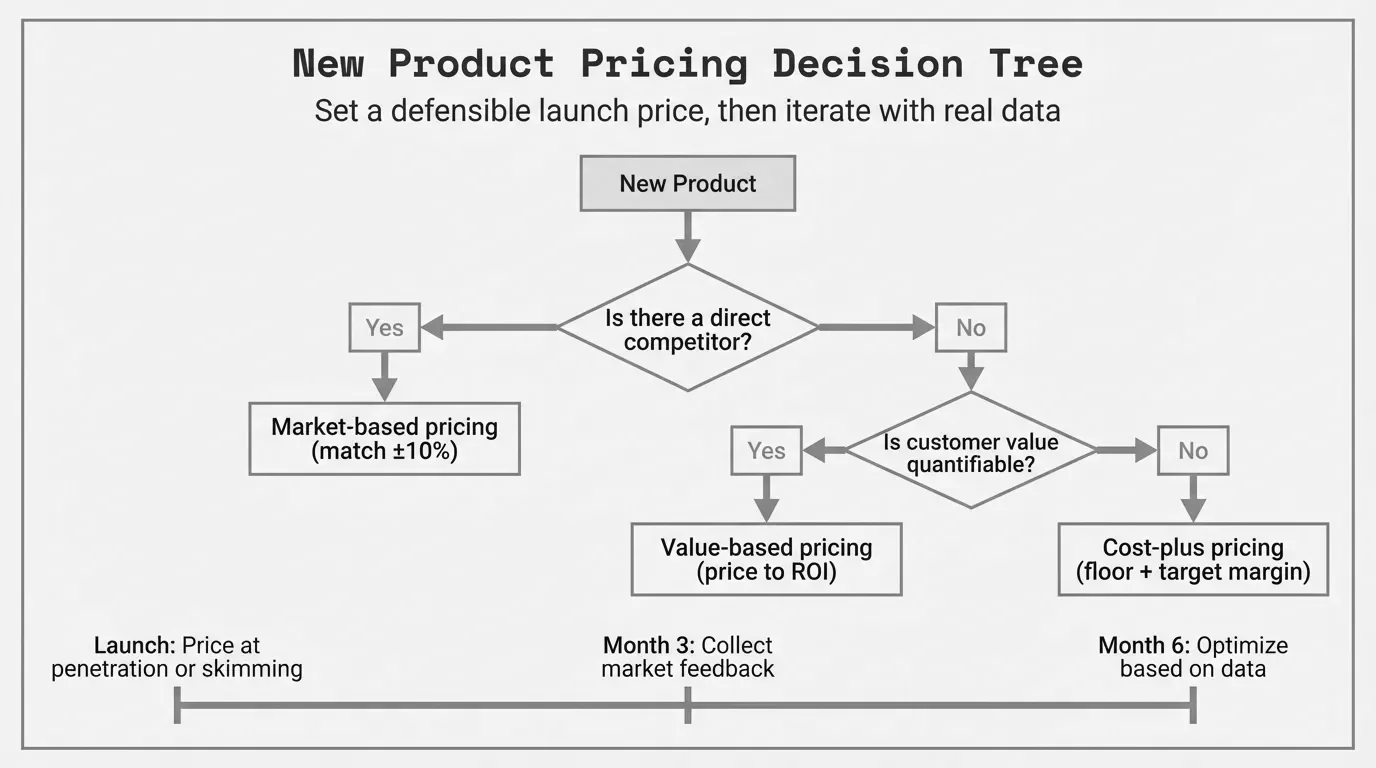
Most mid-market distributors and manufacturers get this wrong on day one. They default to their standard cost-plus markup, slap 30% on the new SKU, and move on. Six months later they're either losing quotes because they priced too high on a competitive item, or they're winning every deal and leaving thousands in margin on the table because they priced a differentiated product like a commodity.
According to Bain & Company's 2018 survey of 1,700 B2B companies, published in Harvard Business Review as "A Survey of 1,700 Companies Reveals Common B2B Pricing Mistakes," the top-performing firms tailor pricing carefully for each customer-product combination rather than applying blanket markups. That discipline matters even more for new products, where you don't have historical transaction data to guide you and the stakes of getting it wrong are highest.
This guide walks through how to price new products in distribution and manufacturing, step by step, without needing enterprise pricing software or a six-month consulting engagement. For the broader framework, see our complete Pricing Strategy Guide.
Why New Product Pricing Deserves More Attention Than It Gets
Here's something that doesn't get said enough: the price you set at launch sticks. It becomes the anchor. Every future negotiation, every discount, every contract renewal references that initial number. Set it too low and you'll spend years trying to crawl back to where you should've started.
McKinsey's 2003 article "The Power of Pricing" shows that a 1% improvement in realized price drives an 8% increase in operating profit for the average S&P 1500 company. Now think about that in the context of a new product where you have full control of the starting point. You're not fighting against incumbent pricing expectations or legacy contracts. You get to set the anchor.
Profit Impact of Initial Price Decision = (Optimal Price - Actual Price) x Expected Unit Volume x Product Lifespan in Years
Example: ($5 underpriced) x 2,000 units/year x 5 years = $50,000 in foregone margin from one SKU
Multiply that across a dozen new product introductions per year and you're looking at real money walking out the door before the products even gain traction.
The Five Core Pricing Strategies for New Products
Every new product pricing decision in distribution and manufacturing draws on some combination of these five approaches. Understanding when each one applies, and when it doesn't, is the difference between strategic pricing and guessing.
1. Cost-Plus Pricing
Cost-plus pricing starts with your total cost to acquire or produce the product and adds a fixed markup percentage. It's the floor, the price below which you lose money on every sale.
Selling Price = Total Unit Cost x (1 + Markup %)
Example: $60 cost x (1 + 0.35) = $81 selling price
Where it works for new products: When you're adding a commodity SKU to fill a catalog gap, where differentiation is minimal and customers will compare prices across suppliers. It's also a reasonable starting point when you genuinely have no data on customer willingness to pay.
Where it falls apart: Cost-plus treats every product the same regardless of its value to the buyer. A $60 specialty gasket that prevents $10,000 in downtime is worth far more than $81 to the customer. Pricing it at cost-plus 35% leaves enormous margin on the table.
Industry data from the National Association of Wholesaler-Distributors (NAW) shows the average B2B distributor gross margin ranges from 20% to 35%, but that average masks enormous variation between commodity and specialty items. Cost-plus gives you the floor. It shouldn't be the ceiling.
2. Value-Based Pricing
Value-based pricing sets your price according to the economic benefit the product delivers to the buyer. It requires you to understand your customer's world: what problem they're solving, what alternatives exist, and what those alternatives actually cost them when you factor in labor, downtime, waste, and risk.
Value-Based Price Ceiling = Next Best Alternative Cost + Switching Costs + Measurable Value Differential
Example: $50 alternative + $0 switching + $35 labor savings = $85 ceiling
Where it works for new products: Differentiated items. Products that solve a specific, quantifiable problem. Anything where your offering reduces the buyer's total cost of ownership even if the sticker price is higher.
Where it falls apart: Commodity additions where the customer has five suppliers selling the exact same thing. You can't claim value-based pricing on a standard hex bolt.
Here's a real scenario. A distributor introduces a new self-sealing pipe fitting that costs $22 to source. The traditional fitting costs $14 but requires a $30 service call to seal properly. The customer's true cost with the old approach: $44. The self-sealing fitting priced at $32 saves the customer $12 per installation and delivers 45% gross margin to the distributor. Cost-plus at 35% would've priced it at $29.70 and left $2.30 per unit on the table. Across 5,000 units a year, that's $11,500 in margin the spreadsheet approach throws away.
3. Competitive Pricing
Competitive pricing positions your new product relative to what's already in the market. You choose to match, undercut, or sit above the competition based on how your product compares.
Where it works for new products: Categories where buyers actively compare prices. Online channels with price transparency. Markets where you're entering against established players and need to give buyers a reason to try you.
Where it falls apart: When you don't actually have reliable competitive data. Simon-Kucher's Global Pricing Study 2025, which surveyed over 2,200 business leaders across 28 countries, warns that exclusive focus on competitor prices can trigger price wars that compress everyone's margins. And in distribution, "competitive intelligence" often means a sales rep relaying what a customer told them, which is about as reliable as it sounds.
If you're going to price competitively, invest in actual data. Pull competitor pricing from their websites, request quotes through procurement channels, or use pricing intelligence tools. Don't base a product's margin trajectory on one anecdote from a sales call.
4. Price Skimming
Skimming means launching high and reducing the price over time as the market matures or competition enters.
Where it works for new products: Patented or proprietary items where you're the only supplier. Truly innovative products that solve problems nobody else can address. Situations where early adopters will pay a premium for first access.
Where it falls apart: Most new products in distribution and manufacturing aren't truly novel. They're catalog additions, line extensions, or sourcing changes. Skimming on a me-too product just means you'll lose quotes until you eventually drop the price to where it should've started.
5. Penetration Pricing
Penetration pricing launches low to grab market share fast, with the intent to raise prices once you've established volume and customer stickiness.
Where it works for new products: When you need volume to justify a production run. When the product benefits from network effects or installed-base economics. When breaking into a new category where incumbents have entrenched relationships.
Where it falls apart: In B2B distribution, low initial prices create anchoring problems. Customers remember what they paid first. Trying to raise prices 20% after six months generates pushback that erases whatever goodwill the low price bought you. Penetration pricing also signals to buyers that your product is the budget option, which is hard to undo.
A Step-by-Step Framework for Pricing New Products
Theory is fine. Here's the practical process that works for companies managing thousands of SKUs without dedicated pricing teams.
Step 1: Calculate Your True Cost Floor
This sounds obvious, but most companies get it wrong. Your cost floor isn't just the purchase price or manufacturing cost. It includes everything that goes into getting the product to the customer.
True Cost Floor = Purchase/Manufacturing Cost + Inbound Freight + Warehousing Allocation + Handling + Outbound Freight Estimate + Sales Cost Allocation
A $50 product that costs $4 to ship inbound, $2 to warehouse, and $6 to deliver has a true cost floor of $62, not $50. Your markup needs to cover the full picture. I've seen distributors introduce new products at "30% margin" only to discover they were making 18% after logistics costs nobody factored in.
Step 2: Research the Competitive Landscape
Before you price in a vacuum, find out what's already out there:
- Direct competitors: What do comparable products sell for? Get actual price points, not assumptions.
- Substitute products: What alternative approaches do customers currently use? What do those cost, all-in?
- Customer's internal cost: Sometimes the alternative isn't another supplier's product. It's the customer doing something in-house. What does that cost them?
Document these reference points. They form the range within which your price needs to make sense.
Step 3: Quantify Your Product's Value Differential
This is where most companies skip straight to the markup spreadsheet. Don't.
Ask yourself: what does this new product do for the buyer that the current alternatives don't? Be specific. Use numbers.
- Does it reduce waste? By how much per unit?
- Does it cut labor time? How many minutes, at what labor rate?
- Does it prevent downtime? What's an hour of downtime worth to this customer?
- Does it improve yield? By what percentage?
If you can't quantify the differential, you'll price to cost. If you can quantify it, you'll price to value, and you'll capture significantly more margin.
Step 4: Set Your Initial Price Using the Three-Layer Model
Combine your three reference points into a pricing decision:
| Layer | Source | Role |
|---|---|---|
| Floor | Cost-plus analysis | Minimum viable price (never sell below this) |
| Reference | Competitive data | Market positioning benchmark |
| Ceiling | Value-based analysis | Maximum the customer would rationally pay |
Your launch price should sit between the reference point and the ceiling, adjusted for how differentiated the product actually is.
For a commodity catalog addition, price near the reference (competitive) point. For a differentiated product, price closer to the ceiling. For something in between, split the difference and test.
Launch Price = Cost Floor + [(Value Ceiling - Cost Floor) x Differentiation Factor]
Where Differentiation Factor: 0.3 for commodity, 0.5 for moderate, 0.7+ for highly differentiated
Step 5: Segment Your Pricing by Customer Type
Don't offer the same price to everyone. Your B2B pricing strategy should reflect customer segments:
| Customer Segment | New Product Pricing Approach |
|---|---|
| Strategic accounts (high volume, growth potential) | Competitive pricing, early access, volume commitments for better rates |
| Core accounts (steady, reliable) | Standard margin targets, modest introductory discounts |
| Opportunistic accounts (low volume) | Full margin, no introductory incentives |
A new product introduction is actually a useful test of your customer margin analysis. If you're giving your best new-product pricing to accounts that don't generate strong margins on existing lines, you're compounding a problem.
Step 6: Set Discount Guardrails From Day One
This is critical. New products are especially vulnerable to discounting because sales reps don't have confidence in the price yet. They don't know the product well enough to sell value, so they default to selling on price.
Before you release a new SKU to the sales team:
- Set a floor price that requires VP-level approval to break
- Define a standard discount band (e.g., reps can flex 0-5% without approval)
- Create a brief value statement that explains why the product is worth the price
- Track every quote and discount for the first 90 days
If reps are discounting more than 15% of the time in the first 60 days, either the price is genuinely too high, or you haven't equipped the team to sell the value. Figure out which one before you react.
New Product Pricing Mistakes That Erode Margin
After working through hundreds of product introductions in distribution and manufacturing, these patterns show up over and over.
Defaulting to the Same Markup as Everything Else
The worst thing you can do with a new product is treat it like everything else in your catalog. A new specialty chemical doesn't deserve the same 28% markup as a commodity fastener. Yet that's exactly what happens when pricing decisions live in a spreadsheet with a single markup column.
SPARXiQ calls this "peanut butter pricing," spreading the same markup across everything. It's the number one margin killer in mid-market distribution.
Pricing to Win Instead of Pricing to Profit
There's a natural temptation to price new products aggressively to "get them moving." But in B2B, low introductory prices create expectations that are brutally hard to reset. Your customer won't remember that it was an introductory rate. They'll remember what they paid.
If you want to stimulate trial, offer a time-limited introductory price with a clear expiration, and document the standard price in the same communication. Something like: "$85 introductory price through Q2, standard price $102 effective July 1." This gives you an on-ramp without permanently anchoring low.
Ignoring the Price Waterfall on New Products
New products get introduced with a list price. Then the standard discount schedule applies. Then the volume tier kicks in. Then the rep matches a competitor nobody verified. Then freight gets thrown in free because it's a "new relationship."
Before you know it, your $100 list price new product has a $74 pocket price and you're wondering why the gross margin report doesn't match your pricing spreadsheet. Build a price waterfall for new products within the first 90 days to catch leakage early.
Skipping the 90-Day Review
Most companies set a new product price, launch it, and don't look at it again until the annual review. By then, the price has drifted through discounting, competitive pressure, and cost changes that never got passed through.
Review new product pricing at 30, 60, and 90 days. Track these metrics:
- Quote-to-close ratio compared to similar products
- Average discount given vs. your guardrails
- Unit volume vs. forecast
- Actual margin vs. target (not list margin, pocket margin)
Cost-Plus vs. Value-Based: When to Use Each on New Products
This isn't an either-or decision. It's a question of which one leads.
| Scenario | Lead Strategy | Supporting Strategy |
|---|---|---|
| Commodity catalog fill | Cost-plus | Competitive reference |
| Me-too product entry | Competitive | Cost-plus floor |
| Differentiated product | Value-based | Cost-plus floor |
| Proprietary/patented item | Value-based (skimming) | Cost-plus floor |
| Market share play | Penetration | Cost-plus floor, competitive reference |
Notice that cost-plus always appears as a floor. You should never sell below fully loaded cost unless you have a deliberate, time-limited strategic reason. But cost-plus as your primary strategy for differentiated products is leaving margin on the table every single time.
The data backs this up. Revology Analytics' 2025 Revenue Growth Analytics Maturity Report, analyzing nearly 2,000 companies, shows that a 1% improvement in net price realization yields a median 6.4% increase in operating profit, making pricing the single most potent financial lever for most businesses. For new products where you control the starting price, that leverage is even higher.
How to Price New Products Without Enterprise Software
You don't need Vendavo, PROS, or PriceFX to get new product pricing right. Those tools earn their keep at scale, but a mid-market distributor or manufacturer can build a solid process with what they already have.
What you need:
- A spreadsheet that calculates true cost floor (all-in, not just purchase price)
- Competitive price data from 2-3 sources per product category
- A value differential estimate for each differentiated new product
- A pricing matrix that maps product type to customer segment
- Discount guardrails with approval thresholds
- A 90-day review calendar for every new SKU
What accelerates this:
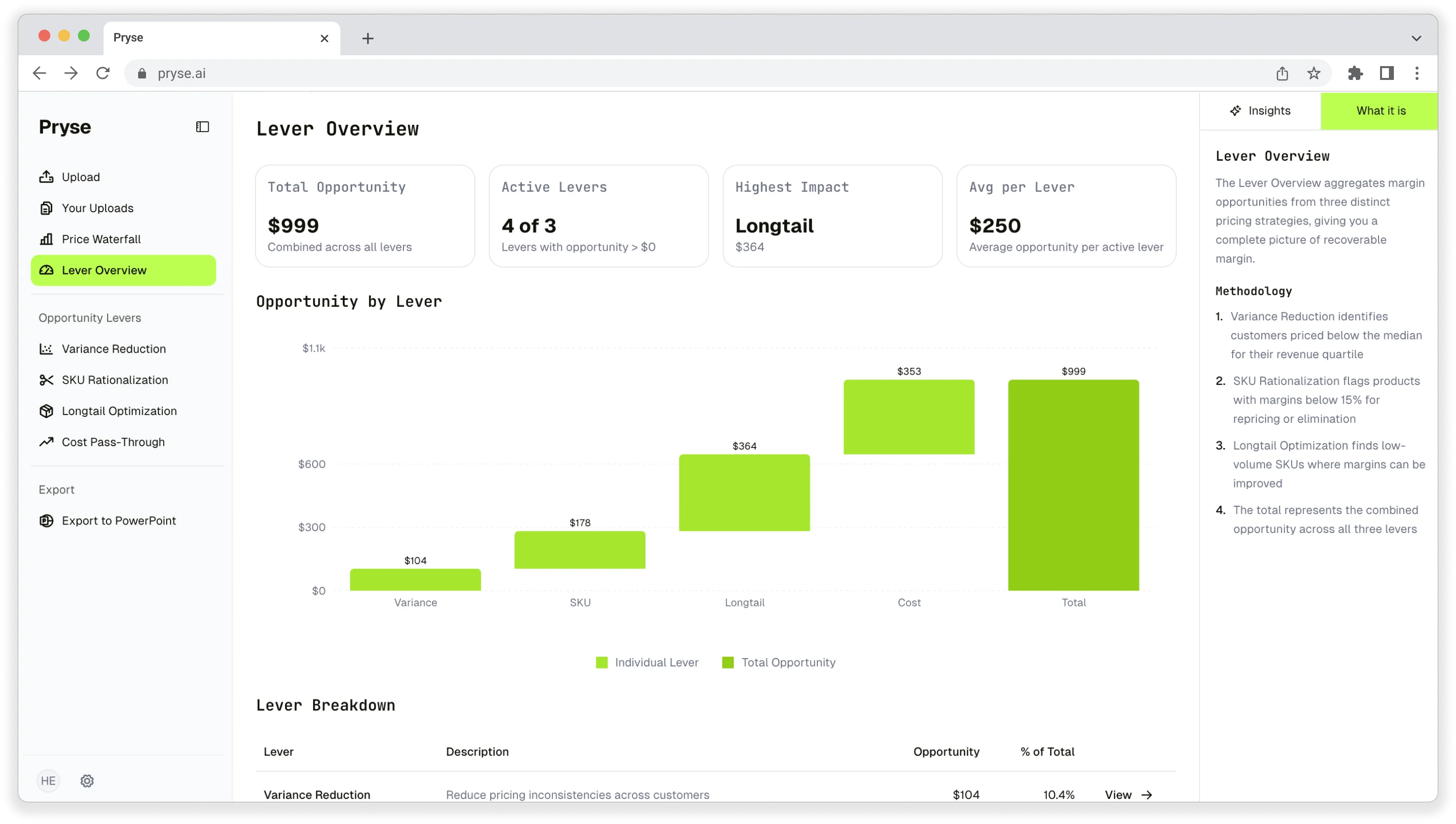
Upload your transaction data to a tool like Pryse and you'll have your margin analysis, leakage detection, and opportunity sizing done in 24 hours instead of building it manually in Excel over weeks. That gives you the baseline to set smarter prices on new introductions and catch problems before they compound.
For more on how to run this analysis yourself, see our guides on margin analysis in Excel and margin analysis templates.
Tying New Product Pricing to Your Overall Strategy
A new product doesn't exist in isolation. Its price affects how customers perceive your existing catalog, your competitive positioning, and your overall margin mix.
If you're adding a premium product to a category where you've historically competed on price, the new SKU needs to justify its position. That means value selling, not just a higher number on the quote.
If you're adding a commodity product to a category where you sell premium, be careful about downward price pressure on your existing lines. Customers will ask why they're paying $120 for product A when product B (from the same supplier) costs $65 and does "basically the same thing."
Think about your new product price in the context of your full channel pricing strategy and your B2B pricing approach. Every new SKU is either reinforcing or undermining your overall price position.
For the complete framework that ties all of this together, see our Pricing Strategy Guide.
Last updated: Invalid Date
Frequently Asked Questions
Want to analyze your entire product catalog?
Pryse automatically identifies margin leakage across thousands of SKUs. Upload your data and find hidden profit in 24 hours.
One-time $1,499 diagnostic. No subscription required.