 Pryse
PryseChannel Pricing Strategy: How to Set Prices Across Multi-Tier Distribution
Learn how to build a channel pricing strategy that protects margins across distributors, dealers, and resellers. Includes MAP policies, tier structures, and conflict resolution.
Channel pricing is the practice of setting different prices for the same product based on which sales channel, partner type, or distribution tier is selling it. It's how manufacturers and distributors structure margins so that everyone in the supply chain can make money without destroying the end-user price.
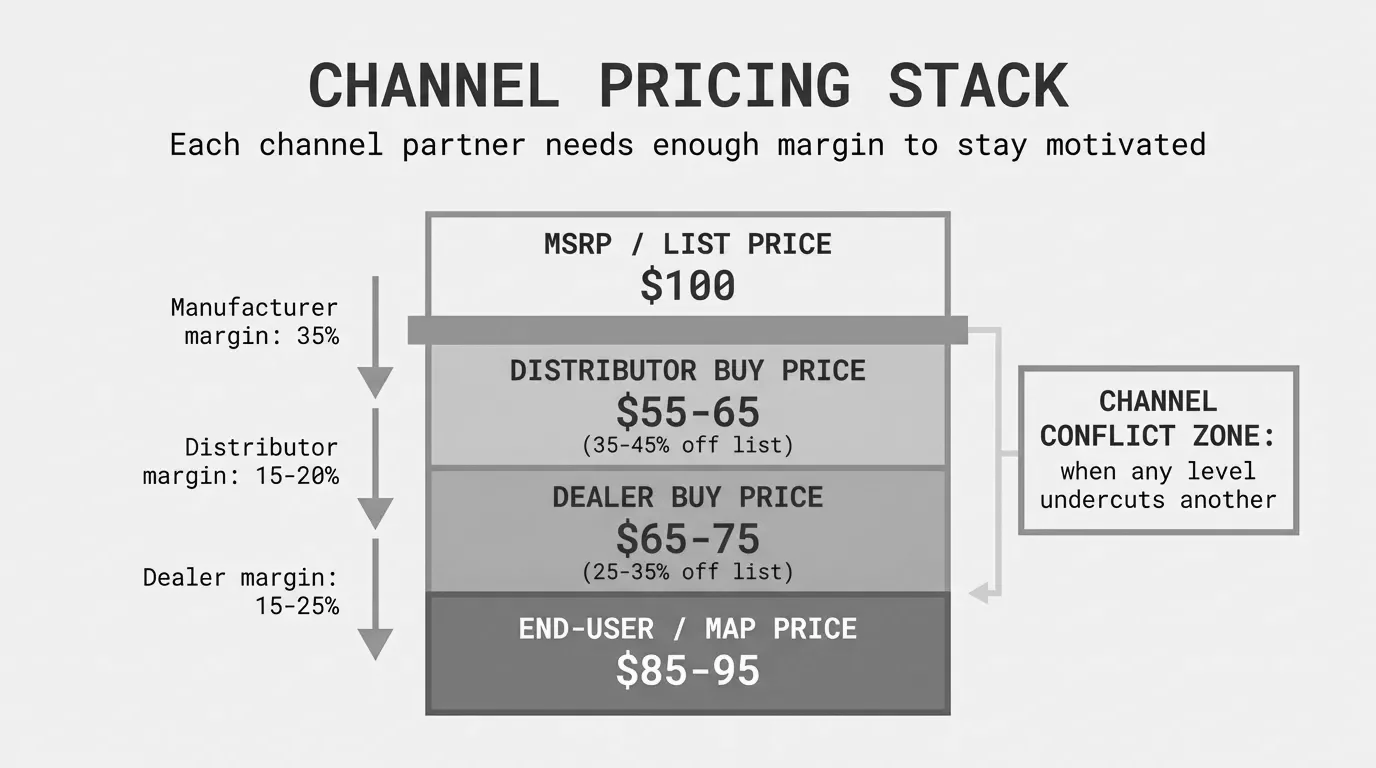
That sounds simple. It isn't. A $50M manufacturer selling through three distributor tiers, two dealer networks, and a direct ecommerce channel has dozens of price points for every SKU. Each one represents a margin decision. Get those decisions wrong and you'll bleed margin through channel conflict, unauthorized discounting, and partner defection.
This guide covers how to structure channel pricing that actually holds up, from tier design to MAP enforcement to the math that connects list price to pocket price across every intermediary.
Why Channel Pricing Breaks Down
Most channel pricing problems don't start as pricing problems. They start as relationship problems, inventory problems, or communication problems that eventually show up in your margins.
Here's what I saw repeatedly during my years in pricing consulting: a manufacturer sets a distributor discount schedule, hands it off to sales, and moves on. Six months later, gross margins have dropped 3-4 points and nobody can explain why.
The usual culprits:
Inconsistent discounting across reps. Sales rep A gives Distributor X a 5% additional discount to close a deal. Sales rep B hears about it and matches it for Distributor Y. Within a quarter, the "exception" is the new baseline.
Untracked off-invoice adjustments. Volume rebates, co-op advertising credits, freight absorption, early payment discounts. Each one is small. Together they can represent 8-15% of list price that never shows up in the discount field.
Channel-on-channel competition. Your distributor and your direct channel are quoting the same end customer. The distributor drops price to compete. You lose either the sale or the partner relationship.
Double marginalization. Each tier in your distribution chain adds its own markup independently. A 20% manufacturer markup plus a 25% distributor markup plus a 30% dealer markup doesn't equal 75%. It compounds, pushing the end-user price 15-25% higher than it needs to be. The customer buys from a competitor.
According to the 2023 PartnerPath SaaS Channel Survey, 67% of channel partners rank "competitive margins" as one of their top three criteria when selecting vendor partnerships, ranking higher than product quality or market demand. When pricing is inconsistent, partners lose trust and deprioritize your products. That should alarm any manufacturer who relies on indirect channels.
The Channel Pricing Stack
A channel pricing strategy has four layers. Miss any one and the others fall apart.
Layer 1: List Price
List price is your anchor. It's the starting point from which every channel discount, tier adjustment, and promotional allowance gets calculated.
List Price = Target Pocket Price / (1 - Total Channel Discount %)
If you want a $60 pocket price and your total channel discount (across all tiers) averages 40%, your list price needs to be $100. Simple math, but most manufacturers set list price based on cost-plus logic and then try to back into channel discounts. That's backwards.
Set list price last. Start with the end-user price the market will bear, subtract channel margins, and work backward to the price you need.
Layer 2: Tier Structure
Tier structure defines who gets what discount. The goal is to reward behaviors you want (volume, loyalty, market coverage) while maintaining enough margin at each level.
Typical distribution tier structures look like this:
| Partner Tier | Discount off List | Expected Gross Margin | Typical Requirements |
|---|---|---|---|
| Master distributor | 40-50% | 10-15% (pass-through) | $5M+ annual volume, full territory coverage |
| Regional distributor | 30-40% | 20-25% | $500K+ annual, warehousing, credit extension |
| Dealer/reseller | 20-30% | 25-35% | Active selling, product training |
| Direct/online | 0-10% | Full margin | End-user purchases |
The numbers in this table aren't arbitrary. According to the 2023 PartnerPath SaaS Channel Survey, 67% of partners rank competitive margins as a top-three criterion when selecting vendor partnerships. Partners who can't achieve at least 15% gross margin will deprioritize your products in favor of more profitable alternatives. If your tier structure doesn't give partners room to operate above that threshold, they'll sell someone else's product.
Layer 3: Channel Controls
Controls are the rules that prevent your tier structure from collapsing. The three main controls:
MAP (Minimum Advertised Price). The lowest price a reseller can advertise publicly. MAP doesn't restrict the actual selling price in a negotiation, but it prevents the race-to-the-bottom pricing that erodes brand value. In 2026, with Amazon and Google Shopping driving price transparency, MAP enforcement is more important than ever.
Deal registration. A partner registers an opportunity before quoting. If approved, they get 10-15% additional margin protection on that deal for 60-90 days. This prevents multiple partners from competing on the same opportunity and driving each other's margins to zero.
Territory or segment exclusivity. Assign specific geographies, verticals, or account sizes to specific partners. Overlap creates conflict. The less overlap, the less pressure on pricing.
Layer 4: The Price Waterfall
The price waterfall tracks every adjustment between list price and pocket price. It's where margin leakage hides and where channel pricing strategy either works or doesn't.
Pocket Price = List Price - On-Invoice Discounts - Off-Invoice Adjustments - Cost to Serve
A typical manufacturer's waterfall from list to pocket might look like:
| Waterfall Step | Example Adjustment | Cumulative |
|---|---|---|
| List price | $100.00 | $100.00 |
| Distributor discount (35%) | -$35.00 | $65.00 |
| Volume rebate (3%) | -$3.00 | $62.00 |
| Co-op advertising (2%) | -$2.00 | $60.00 |
| Freight absorption | -$1.50 | $58.50 |
| Early pay discount (2%) | -$2.00 | $56.50 |
| Cash discount (1%) | -$1.00 | $55.50 |
That's a 44.5% total discount off list. The distributor discount was 35%. Where did the other 9.5 points go? Off-invoice adjustments that most manufacturers don't track at the SKU-customer level.
For a deeper look at how to build and analyze this waterfall, see our pocket price waterfall guide.
How to Structure Pricing Across Multi-Tier Distribution
If you sell through more than one tier, you need to think about pricing as a system, not a series of individual discount decisions.
Step 1: Map Your Channel Economics
Before setting any prices, map out the actual economics of each channel path. For every route your product takes to the end user, calculate:
- How many intermediaries touch the product
- What margin each intermediary needs to stay viable
- What the end-user price needs to be to remain competitive
- What pocket price you need to cover your costs and hit target margins
Most mid-market manufacturers I've worked with have 3-5 distinct channel paths. Each one has different economics.
Example: An industrial parts manufacturer selling a $100 list-price product:
| Channel Path | Mfg Pocket | Distributor Margin | Dealer Margin | End-User Price |
|---|---|---|---|---|
| Mfg → Master dist → Dealer → User | $52 | 12% | 28% | $100 |
| Mfg → Regional dist → User | $62 | 22% | — | $80 |
| Mfg → Direct (online) | $78 | — | — | $85 |
Three paths, three completely different pocket prices for the manufacturer. If you're managing these in Excel, you probably don't know these numbers by channel path. You know the blended average, and the blended average hides the problem.
Step 2: Set Margin Floors by Channel
Every channel needs a margin floor: the absolute lowest pocket price you'll accept through that path.
Margin Floor = COGS + Allocated Operating Cost + Minimum Acceptable Profit
Below this floor, the sale destroys value no matter how much volume it generates. I've seen distributors chase volume through a channel that was underwater on a per-unit basis because nobody calculated the fully loaded cost-to-serve for that path.
Set margin floors per channel and per customer tier. Then make them non-negotiable. Sales reps should know these floors before they walk into a negotiation.
For more on how to calculate these thresholds, our pricing strategy guide walks through the full methodology.
Step 3: Build in Conflict Prevention
Channel conflict happens when two or more partners compete for the same end customer. It's inevitable in multi-channel distribution, but you can contain the damage.
Price parity rules. Your direct channel should never undercut your partners. If you sell direct, price at or above MAP. Your partners will notice, and if they're being undercut by the manufacturer they represent, they'll find a new manufacturer.
Segment separation. Assign channels to segments where they add the most value. Large project opportunities go through distributors who can warehouse inventory and extend credit. Small orders go direct. Technical applications go through specialty dealers.
Transparent rebate structures. When partners can see what others are earning and why, they fight less about pricing. Opacity creates suspicion. Publish your tier requirements and associated benefits.
A healthy channel pricing program treats dealer pricing and reseller pricing as separate strategies that connect through a common framework, not as copies of the same discount sheet.
MAP Policy: The Foundation of Channel Price Integrity
A Minimum Advertised Price (MAP) policy is the lowest price a reseller can publicly advertise a product for sale. It doesn't restrict what they charge in a private negotiation, but it prevents the advertised price from spiraling downward.
Without a MAP policy, your lowest-price partner sets the expectation for every other partner. Every time one partner drops their advertised price by $5, another matches it. Within a few months, advertised prices are 15-20% below your intended retail, and partners are losing money on every sale.
What a MAP Policy Should Include
Keep it specific. Vague policies don't get enforced.
- Covered products. List every SKU that's subject to MAP, along with the specific minimum price.
- Covered channels. Specify where MAP applies: website, marketplace listings, print advertising, email marketing.
- Exemptions. Define what's excluded: in-store pricing, phone quotes, loyalty discounts to existing customers.
- Violation consequences. Graduated penalties. First violation: written warning. Second: temporary suspension of special pricing. Third: termination of partnership. Write this out.
- Review schedule. MAP prices should be reviewed quarterly and adjusted based on market conditions.
Enforcement in Practice
MAP policies are worthless if you don't enforce them. And manual enforcement doesn't scale. You can't check every Amazon listing, every Google Shopping ad, every partner website every week.
For manufacturers with fewer than 50 active resellers, a monthly manual audit might be enough. Above that threshold, automated MAP monitoring tools like TrackStreet, PriceSpider, or MAPP Trap become necessary.
The most common enforcement failure isn't unwillingness. It's inconsistency. If you let your largest partner violate MAP because you're afraid of losing their volume, every other partner will know within a week. Enforce for everyone or don't bother having a policy.
Legal note: MAP policies are legal in the United States when structured as unilateral policies rather than agreements. You announce the policy and the consequences. Partners decide whether to comply. You don't negotiate MAP. That distinction matters from an antitrust perspective.
Measuring Channel Pricing Performance
You can't improve what you don't measure. Here are the metrics that tell you whether your channel pricing is working.
Pocket Price Realization by Channel
Pocket Price Realization = Actual Pocket Price / List Price x 100
Track this by channel, by partner, and by product category. The gap between your best and worst channel on this metric will surprise you. In my experience, the spread is typically 12-18 percentage points.
A $50M manufacturer with an 18-point spread between their best and worst channels has roughly $1.5-2M in annual margin leakage hiding in that gap. Most of it is recoverable through better discount governance and off-invoice tracking.
Channel Margin Consistency
Compare the standard deviation of discounts within each tier. High variance means reps are making ad hoc pricing decisions. Low variance means your tier structure is holding.
| Tier | Average Discount | Std Deviation | Interpretation |
|---|---|---|---|
| Master distributor | 42% | 1.8% | Tight, controlled |
| Regional distributor | 33% | 5.2% | Moderate variance |
| Dealer | 24% | 8.7% | Reps are winging it |
When standard deviation exceeds 5 points, you have a pricing governance problem, not a strategy problem.
MAP Compliance Rate
Track the percentage of active partners who are advertising at or above MAP at any given time. Industry benchmarks suggest 85-90% compliance as a reasonable target. Below 80% indicates your policy or your enforcement has gaps.
Cost-to-Serve by Channel
Some channels cost more to support than others. A distributor who demands same-day delivery, takes small orders, pays on 90-day terms, and calls your support line weekly costs more to serve than one who buys in bulk and pays on 30-day terms.
True Channel Margin = Pocket Price - COGS - Channel-Specific Cost to Serve
Until you calculate true channel margin, you don't actually know which channels are profitable. I've seen cases where a manufacturer's "best" channel (by revenue) was their worst (by margin) once cost-to-serve was included.
Common Channel Pricing Mistakes
I've audited channel pricing for mid-market manufacturers and distributors across dozens of verticals. These mistakes come up over and over.
Mistake 1: One Discount Sheet for All Partners
A master distributor buying $3M annually and a small regional dealer buying $200K annually should not get the same discount. They're providing different levels of market access, carrying different levels of inventory risk, and requiring different levels of support.
Yet plenty of manufacturers use a single discount schedule because it's easier to manage in Excel. That simplicity costs them 2-4 margin points because they're either overpaying small partners or underpaying large ones.
Mistake 2: Ignoring Off-Invoice Leakage
On-invoice discounts are visible. Off-invoice adjustments are invisible. Freight absorption, co-op advertising credits, volume rebates, early payment discounts, warranty cost sharing, and return allowances all reduce your pocket price. If you're only tracking on-invoice discounts, you're seeing half the picture.
Run a full price waterfall analysis across your top 20 channel partners. The gap between invoice price and pocket price typically runs 8-15 percentage points.
Mistake 3: Letting Sales Own Pricing
Sales reps are optimized for volume, not margin. If they have discretion over channel pricing without margin-floor guardrails, they will use every available discount to close deals. That's not a criticism. It's how incentive structures work.
Build pricing authority into your channel program. Define which discounts are standard (no approval needed), which require manager approval, and which require VP sign-off. Tie approval thresholds to margin impact, not discount percentage.
Mistake 4: No Regular Pricing Reviews
Channel economics change. Supplier costs shift. Competitors adjust pricing. New partners enter the market. A channel pricing strategy set two years ago is probably misaligned today.
Review pricing quarterly. Audit discount compliance monthly. Run a full margin analysis at least twice a year.
Putting It Together: A Channel Pricing Audit
If you're reading this and suspecting your channel pricing has gaps, here's a quick diagnostic you can run this week.
-
Pull your top 50 accounts by revenue. For each, calculate the actual pocket price across all SKUs they buy. Not the invoice price. The pocket price after every adjustment.
-
Sort by channel type. Group those accounts into your distribution tiers. Calculate average pocket price realization per tier.
-
Find the outliers. Which accounts are getting pocket prices significantly below their tier average? Why? Is it a legitimate competitive situation or a rep-level discount that became permanent?
-
Estimate the margin gap. If you brought every below-average account up to just the tier average (not even best-in-class), how much margin would you recover?
For most mid-market manufacturers with $20M-$200M in revenue and 5,000+ SKUs, this exercise reveals $200K-$2M in recoverable margin. The companies running this analysis in Excel can do it in about a week. Using a tool like Pryse, you can get to the same answers in about 24 hours.
Key Takeaways
Channel pricing isn't a set-it-and-forget-it exercise. It's a system that requires clear tier structures, enforceable controls, and regular measurement.
The companies that get channel pricing right share three traits: they track pocket price (not invoice price) across every channel path, they enforce MAP consistently, and they review their pricing at least quarterly.
If you're managing channel pricing in spreadsheets, start with the audit above. Find the gap between where you are and where your tier structure says you should be. That gap is your margin opportunity.
For a broader framework on building your pricing strategy from the ground up, see our complete pricing strategy guide. And if you're selling through B2B channels specifically, that guide covers the nuances of business buyer pricing.
Last updated: Invalid Date
Frequently Asked Questions
Want to analyze your entire product catalog?
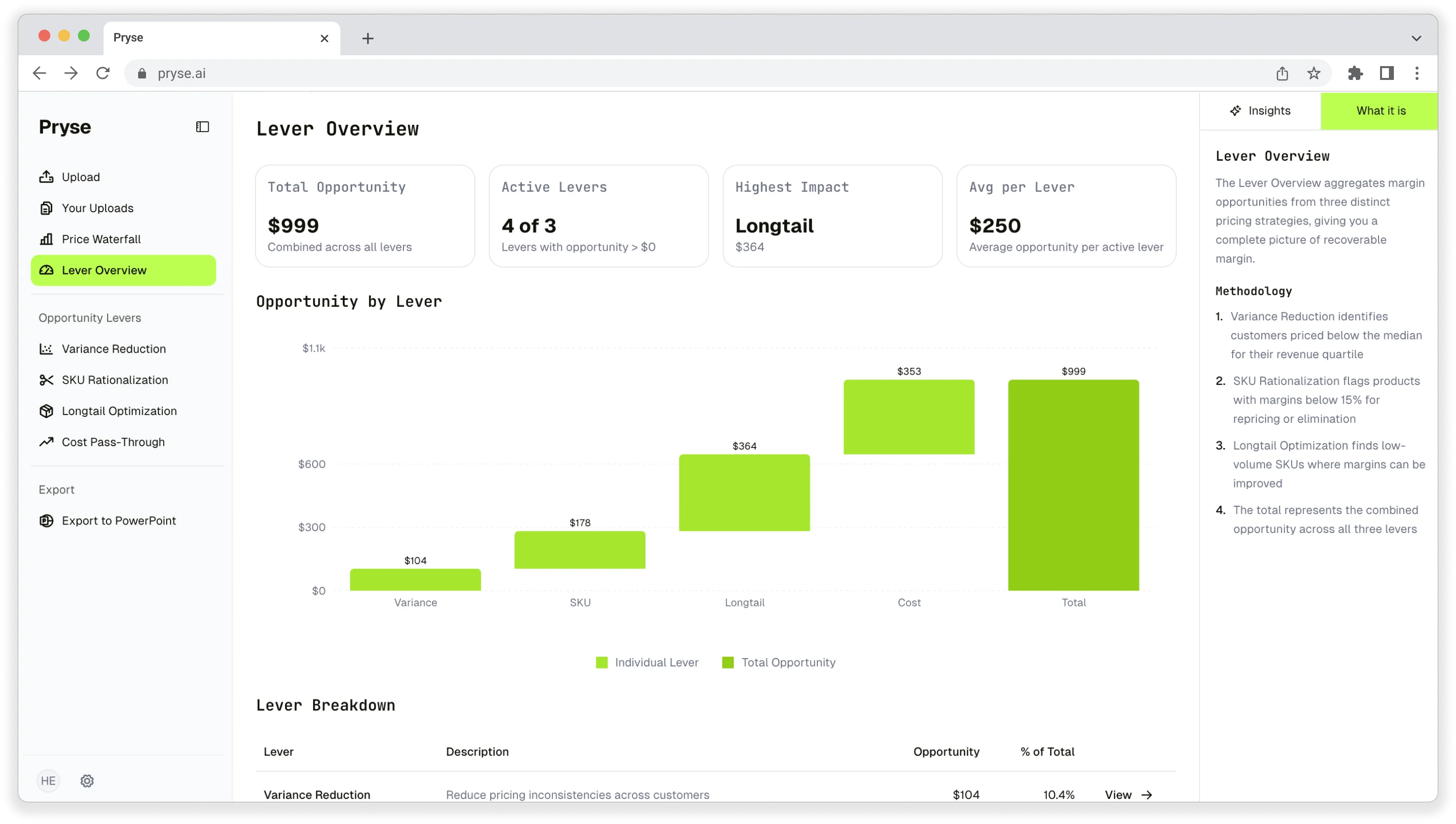
Pryse automatically identifies margin leakage across thousands of SKUs. Upload your data and find hidden profit in 24 hours.
One-time $1,499 diagnostic. No subscription required.