 Pryse
PrysePricing Strategy in Marketing: What Distribution and Manufacturing Companies Get Wrong
A pricing strategy in marketing is the method a business uses to set prices that drive revenue, position the brand, and protect margins. Here's how B2B companies should think about it.
A pricing strategy in marketing is the method a business uses to determine what to charge for its products or services. It sits at the intersection of cost structure, competitive landscape, customer perception, and profit targets. Of the four Ps in marketing (product, price, place, promotion), price is the only one that directly produces revenue. The other three cost money.
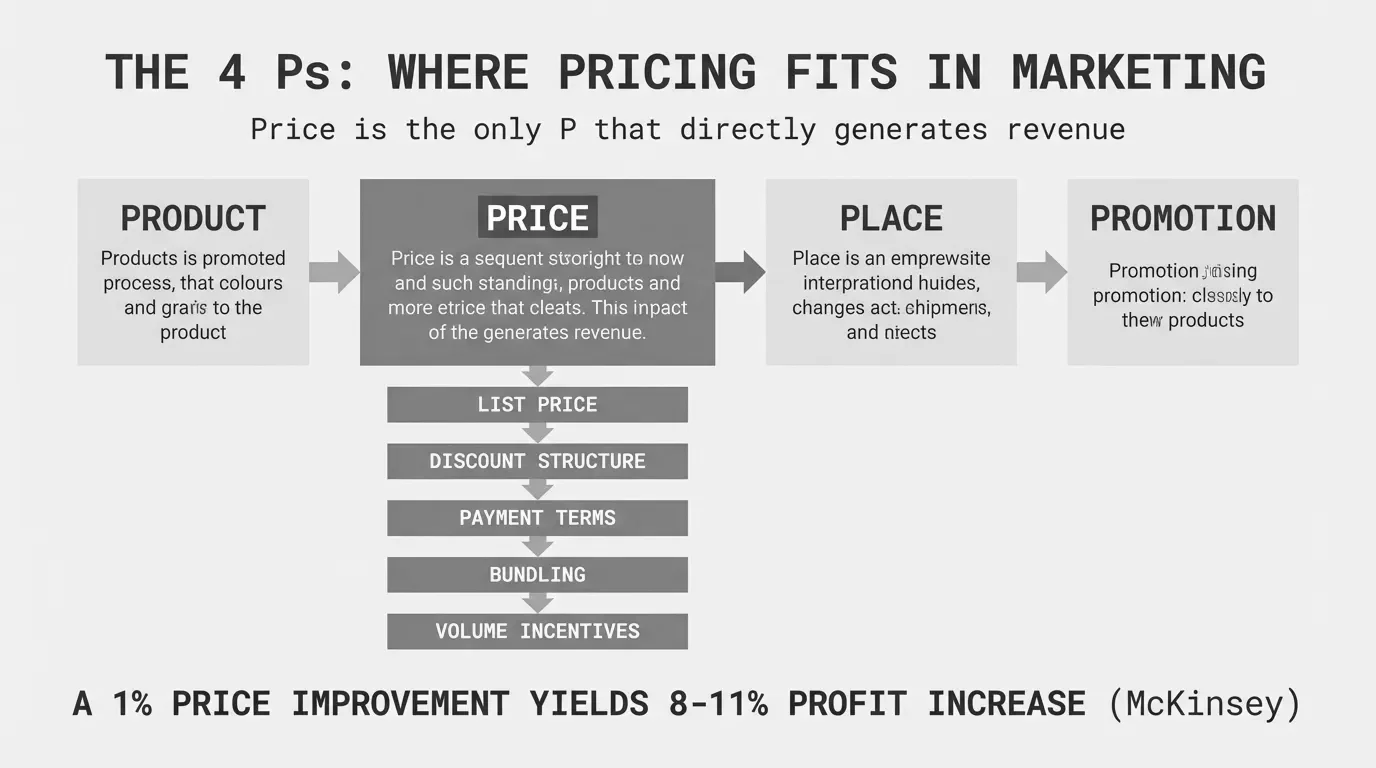
That distinction matters more than most marketing textbooks let on. You can run brilliant campaigns, build a great product, and nail your distribution. But if your pricing strategy is wrong, none of it compounds the way it should. McKinsey's 2003 article "The Power of Pricing" (McKinsey Quarterly, by Marn, Roegner, and Zawada) demonstrated that a 1% improvement in price realization has 2-4x the profit impact of a 1% improvement in volume or cost. For a $75M distributor running 4% operating margins, that 1% price improvement translates to roughly $600K in additional profit. Same customers. Same products. No new sales required.
Yet most mid-market distribution and manufacturing companies don't treat pricing as a marketing function. They treat it as a finance exercise (cost-plus markup) or a sales exercise (whatever the rep negotiates). That gap between what pricing could do and what it actually does is where margin leakage lives.
This post covers how pricing strategy fits into your broader marketing approach, the models that work in B2B, and where companies in the $20M-$200M range consistently leave money on the table.
For the complete framework, see our Pricing Strategy Guide.
Why Pricing Strategy Belongs in Your Marketing Conversation
Marketing teams in B2B companies tend to own messaging, lead generation, and brand. They rarely own pricing. That's a problem, because pricing is the single strongest signal your brand sends to the market.
Consider two industrial distributors selling the same SKU catalog:
- Distributor A prices everything at cost-plus 25%. Their marketing says "reliable supply, competitive prices."
- Distributor B prices commodity items tight to market, charges premium on specialty and hard-to-source items, and bundles value-added services. Their marketing says "we solve problems, not just ship boxes."
Distributor B's pricing strategy is their marketing strategy. The price structure reinforces the brand position. Distributor A's pricing strategy undermines theirs, because "competitive prices" on commodity items is the table stakes every distributor claims.
Price shapes perception. As Utpal Dholakia explained in his August 2016 Harvard Business Review article "A Quick Guide to Value-Based Pricing," customers use price as a quality signal when they can't independently evaluate a product. In B2B, that happens more often than you'd think. A procurement manager evaluating three quotes for a specialty chemical doesn't have a lab to test purity. They use price, along with brand reputation, as a proxy for quality.
That's why pricing strategy isn't just a P&L optimization exercise. It's a positioning tool. And marketing teams that ignore it are working with one hand tied behind their back.
The Core Pricing Strategies (and How They Apply in B2B)
Every pricing strategy falls into one of several foundational approaches. Here's how each one translates from the marketing textbook to the reality of distribution and manufacturing.
Cost-Plus Pricing
Cost-plus pricing is the most common approach in B2B. You calculate your cost of goods, add a target markup percentage, and that's your selling price.
Selling Price = Cost of Goods x (1 + Markup %)
Example: $80 cost x (1 + 0.30) = $104 selling price
It's straightforward, easy to explain to customers, and keeps you from selling below cost. For commodity products with thin differentiation, cost-plus is often the right foundation.
But here's where it breaks down in marketing terms: cost-plus pricing communicates nothing about value. It anchors your price to your cost structure, not to what the customer gets. A $12 specialty fastener that prevents a $5,000 production shutdown is worth far more than $12 plus 30%. Pricing it at $15.60 is technically profitable. It's also strategically lazy.
SPARXiQ's research across over 500 distributors found that companies applying uniform markups, what CEO David Bauders calls "peanut butter pricing," typically have 200 to 400 basis points of uncaptured profit compared to those using segmented approaches.
Competitive Pricing
Competitive pricing sets your price relative to what others charge. You position above, at, or below market rates depending on your strategy.
In consumer markets, competitive pricing data is everywhere. In B2B distribution? It's anecdotal at best. When a sales rep reports "the customer says they can get it 10% cheaper from ABC Supply," that's not competitive intelligence. That's a negotiation tactic filtered through someone whose commission depends on closing the deal.
Simon-Kucher's 2023 Global Pricing Study found that only 65% of companies worldwide truly possess pricing power, and warns that over-reliance on competitive pricing in B2B creates a race to the bottom. Everyone matches everyone else's discounts until margins compress industrywide. The firms that outperform don't try to win every price comparison. They compete on availability, technical support, and reliability, then charge accordingly.
Where competitive pricing works well: High-visibility commodity items (the 500-1,000 SKUs that customers actively price-shop). Use market data to stay competitive on these. Recover margin elsewhere.
Where it fails: Specialty products, value-added services, and situations where switching costs exist. Here, matching competitors' prices signals you don't understand your own value.
Value-Based Pricing
Value-based pricing anchors to the economic value your product or service delivers to the customer, not what it costs you.
This is the strategy marketing textbooks love. It's also the one most B2B companies struggle to execute, because quantifying value requires understanding how your customers use what you sell.
Here's a concrete example from distribution. You sell a pre-assembled wiring harness for $320. Your cost is $185. A competitor sells the individual components for $210, but the customer spends 4 hours of electrician labor ($75/hour) assembling them on-site. The customer's true cost of the alternative:
Customer's Total Cost (Alternative) = Component Cost + Assembly Labor
$210 + (4 hours x $75/hour) = $210 + $300 = $510
Your $320 harness saves the customer $190 per unit compared to the build-it-yourself approach. You could price at $400 and still deliver $110 in savings. At $320, you're leaving $80 per unit on the table.
Value-based pricing is the most profitable approach when you can quantify and communicate the value. It also happens to be the best marketing message: "We save you $190 per unit compared to sourcing components separately."
Dynamic Pricing
Dynamic pricing adjusts prices in real time based on demand, supply conditions, inventory levels, and market signals. Airlines and hotels have used it for decades. B2B is catching up.
In distribution and manufacturing, dynamic pricing doesn't mean changing prices hourly like Amazon. It means adjusting faster than the traditional annual price increase cycle. During the 2022-2024 inflation surge, manufacturers that updated prices quarterly (or more frequently) protected margins. Those that stuck to annual increases absorbed 6-9 months of cost increases before passing them through.
According to Copperberg's "Pricing Excellence Report and Outlook 2024" (produced in partnership with Vendavo), AI-powered dynamic pricing tools can now analyze cost fluctuations, customer buying patterns, and competitive signals to recommend price adjustments in near real time. But for most mid-market companies, the gap isn't technology. It's discipline. Moving from annual to quarterly price reviews captures most of the benefit without requiring enterprise software.
Penetration Pricing
Penetration pricing means entering a market with prices below the competition to grab market share, then raising prices over time.
In B2B, this shows up when distributors offer below-market pricing to win a new account, planning to raise prices once the relationship is established. It works when you genuinely have lower costs or better efficiency. It backfires when customers anchor to the introductory price and resist any increase.
The risk for distributors: you acquire customers who chose you on price. Those customers will leave you on price. They're the first to switch when a competitor undercuts you by 3%.
Premium Pricing
Premium pricing positions your offering above market rates, supported by genuine differentiation. For distributors, that differentiation usually isn't the product itself (since you're often selling the same brands as competitors). It's the service wrapped around it: same-day delivery, technical expertise, kitting, inventory management, emergency availability.
Premium pricing only works if your marketing clearly communicates why you're worth more. "We charge more because we're better" isn't a strategy. "We stock 40,000 SKUs locally so you never wait for a critical part" is.
The Marketing Mix and Pricing: How the 4 Ps Connect
Pricing doesn't exist in isolation. It interacts with every other element of your marketing strategy.
Product x Price
Your product portfolio determines which pricing strategies are available. Commodity products with many substitutes push you toward cost-plus or competitive pricing. Differentiated or exclusive products open the door to value-based and premium pricing.
For distributors carrying 10,000+ SKUs, the right approach is segmented:
| Product Category | Pricing Approach | Marketing Message |
|---|---|---|
| High-visibility commodities | Competitive / cost-plus | "Sharp pricing on the items you buy most" |
| Standard catalog items | Blended (cost-plus floor, margin targets) | "Broad selection, consistent value" |
| Specialty / hard-to-source | Value-based / premium | "We stock what others can't get you" |
| Value-added services (kitting, assembly) | Value-based | "Reduce your total cost, not just unit price" |
Place x Price
Where and how you sell affects what you can charge. A customer ordering through your ecommerce portal at 2 AM for next-day delivery is in a different value situation than one placing a quarterly blanket order through their procurement system.
Channel-specific pricing is a real strategy, not a margin erosion problem. Counter pickups cost you less to fulfill than delivered orders. Online self-service orders cost you less than phone orders requiring inside sales time. Price should reflect cost-to-serve differences.
For more on managing prices across channels, see our post on channel pricing strategy.
Promotion x Price
Discounts and promotions are pricing decisions disguised as marketing tactics. Every time you run a promo, you're temporarily changing your pricing strategy. The question is whether that change is intentional or reactive.
In distribution, the most common "promotion" is the sales rep discount, the ad-hoc price reduction to close a deal. These invisible promotions don't show up in marketing reports, but they move more margin than any formal campaign.
Track them. Quantify them. A distributor doing $50M in revenue with sales reps overriding prices on 30% of orders at an average 4% discount is running a $600K annual "promotion" that nobody approved.
Hidden Discount Cost = Revenue x Override Rate x Average Discount %
$50M x 30% x 4% = $600,000 per year
Where Mid-Market Companies Get Pricing Strategy Wrong
After looking at pricing data across distribution and manufacturing companies in the $20M-$200M range, the same patterns show up repeatedly.
Mistake 1: Separating Pricing from Marketing
When pricing lives exclusively in finance or operations, it becomes disconnected from market positioning. Finance optimizes for margin targets in a spreadsheet. Marketing promises value in the field. Sales negotiates something in between. Nobody's aligned.
The fix: pricing strategy should be a joint effort. Marketing owns the positioning rationale ("why we charge what we charge"). Finance owns the margin targets. Sales owns execution within guardrails. Weekly or biweekly pricing meetings with all three functions prevent drift.
Mistake 2: One Markup Fits All
Applying the same markup percentage across 15,000 SKUs is the single most expensive pricing mistake in distribution. It overprices commodity items where customers will switch suppliers over 2%, and underprices specialty items where customers wouldn't blink at paying 20% more.
Bain & Company's 2018 brief "Dynamic Pricing: Building an Advantage in B2B Sales" found that well-executed pricing transformations generate 2 to 7 percentage points of sustained margin improvement, with segmented approaches consistently outperforming flat markups. The segmentation doesn't need to be complex. Even a simple A/B/C product classification with different target margins is better than flat markup.
Mistake 3: Ignoring Pocket Price
Most companies track gross margin at the invoice level. They don't track pocket margin, the cash that actually lands after all off-invoice deductions: rebates, freight allowances, payment term discounts, returns, and warranty claims.
Zilliant's Global B2B Industry Benchmark Report found that traditional distributors leak between 2% and 11.7% of margin on average through uncontrolled off-invoice deductions, stale pricing, and siloed discount decisions. For a $100M distributor, that's millions in margin erosion that doesn't show up in standard reporting.
The pocket price waterfall is the diagnostic tool that exposes this gap. Until you measure it, you can't manage it.
Mistake 4: Treating Price Increases as a Marketing Event
The annual price increase letter is a ritual in B2B. "Effective January 1, prices will increase 3-5% across our catalog." It's predictable. Customers prepare for it. Savvy ones stock up in Q4 to avoid it.
Strategic pricing isn't about one big annual adjustment. It's about continuous alignment between costs, value, and market conditions. Companies that adjust prices quarterly based on segment-specific data outperform those that rely on blanket annual increases.
During the tariff volatility of 2025, distributors that could adjust pricing within weeks protected their margins. Those locked into annual pricing cycles absorbed months of cost increases, sometimes permanently. As Vendavo and Copperberg's "Pricing Excellence Report and Outlook 2024" notes, static annual pricing is no longer viable in markets with volatile input costs.
Mistake 5: No Feedback Loop Between Pricing and Marketing Data
Your marketing data tells you which customers are growing, which segments are responding to campaigns, and where competitive pressure is intensifying. Your pricing data tells you which products are being discounted, which customers negotiate hardest, and where margin is leaking.
Most companies never connect these two datasets. The marketing team doesn't know that the segment they're targeting aggressively is also the segment where sales reps give the deepest discounts. The pricing team doesn't know that the product category losing margin is the same one marketing is positioning as "premium."
Connect the data. The insights are usually immediate and uncomfortable.
Building a Pricing Strategy That Supports Your Marketing Goals
Here's a practical framework for mid-market distributors and manufacturers. No enterprise software required.
Step 1: Audit Your Current Pricing Reality
Pull 12 months of transaction data and calculate realized margins, not list margins, by:
- Product category (top 10 categories by revenue)
- Customer segment (top 20 customers vs. everyone else)
- Sales channel (if you sell through multiple channels)
Compare realized margins to your target margins. The gap between the two is your pricing strategy problem stated in dollars.
Step 2: Segment Your Catalog
Divide your SKUs into three tiers based on price sensitivity and competitive visibility:
- Market-sensitive items (10-15% of SKUs, 40-50% of revenue): Price these competitively. They're your "front of store" items.
- Core catalog (30-40% of SKUs, 35-45% of revenue): Apply margin targets with room for customer-specific adjustments.
- Tail items (50-60% of SKUs, 10-20% of revenue): Price for margin. Nobody price-shops a $6 specialty fitting.
Step 3: Align Pricing to Your Brand Position
If your marketing says "trusted partner with deep expertise," your pricing should reflect expertise value, not commodity pricing. That means:
- Charging more for value-added services (kitting, custom packaging, technical support)
- Pricing hard-to-source items at a premium
- Offering competitive pricing on commodity items to maintain the overall relationship
Your price structure should reinforce, not contradict, your marketing message.
Step 4: Install Guardrails
Pricing strategy breaks down at the point of sale without guardrails:
- Floor prices by product segment (the absolute minimum, non-negotiable)
- Approval tiers for discounts (rep authority up to 3%, manager up to 7%, VP above 7%)
- Margin alerts that flag deals below target in real time
- Quarterly reviews of discount patterns and override frequency
Step 5: Measure What Matters
Track these metrics monthly:
- Pocket margin by segment (not just invoice margin)
- Price override rate (what percentage of transactions get manual discounts)
- Average discount depth (how much margin reps are giving away)
- Price realization rate (actual revenue as a percentage of list price)
Price Realization Rate = Total Pocket Revenue / Total List Price Revenue x 100
Example: $42M pocket revenue / $50M list price revenue = 84% realization
If your realization rate is below 80%, you have a pricing execution problem, regardless of how good your strategy looks on paper.
Pricing Strategy and Marketing: The B2B Disconnect
In consumer businesses, pricing and marketing are tightly integrated. Apple's premium pricing is the marketing. Dollar Shave Club's economy pricing was the marketing. The price tells the story.
In B2B distribution and manufacturing, pricing and marketing rarely talk to each other. Marketing builds the website and runs the trade shows. Pricing lives in an ERP spreadsheet managed by someone in finance. Sales does whatever they want.
The companies that outperform close this gap. They treat pricing as a marketing lever, not just a finance calculation. They use pricing to reinforce brand positioning, segment customer value, and create defensible competitive advantages.
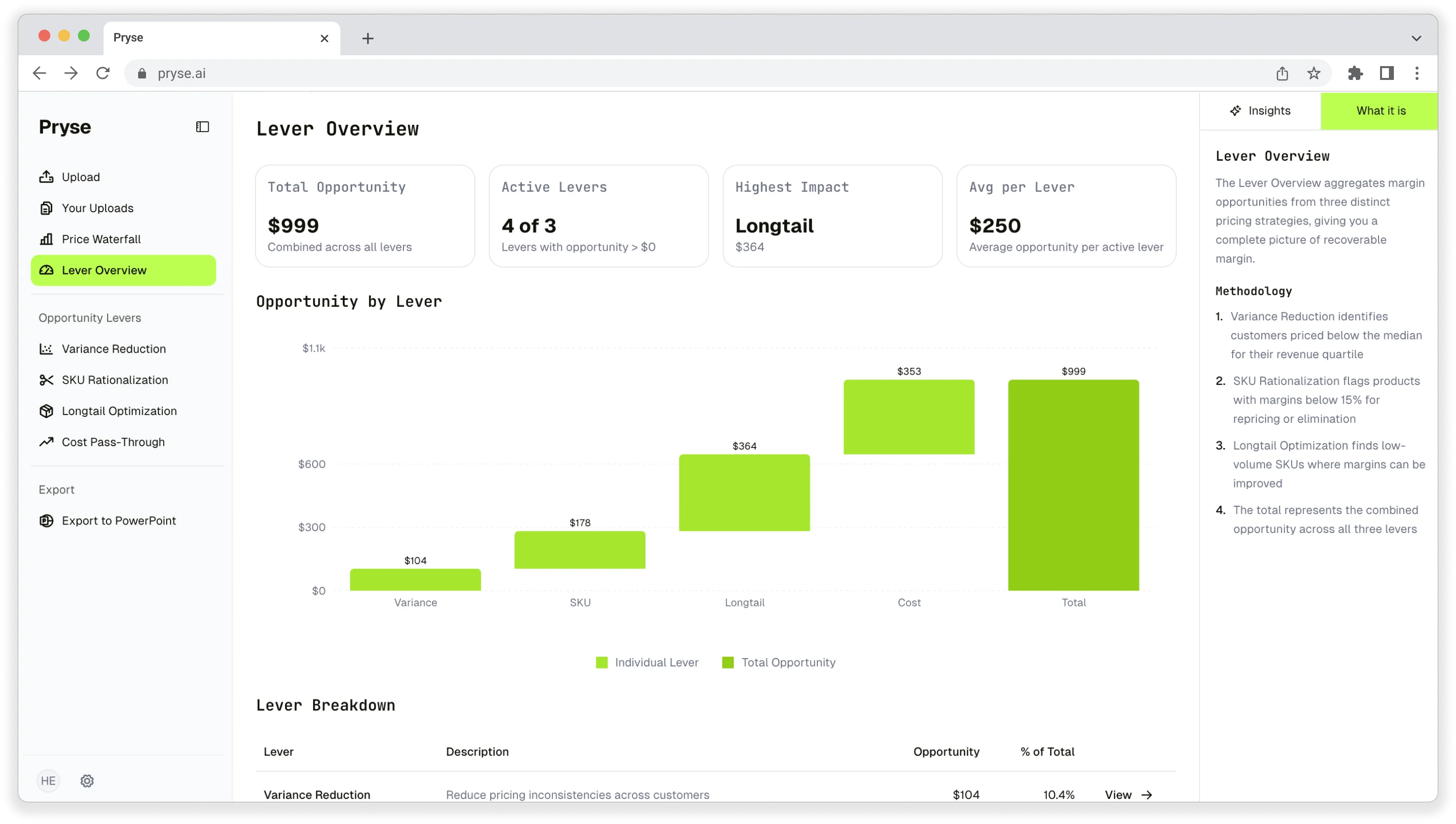
You don't need a $100K pricing platform to start. You need visibility into what's actually happening to your prices between list and pocket. Pryse builds that visibility in 24 hours from a CSV upload. No implementation. No consultants. Just the data you need to make better pricing decisions.
For a deeper dive into pricing models and execution, see our guide on B2B pricing strategy. To understand where margin disappears in your price waterfall, start with our pocket price waterfall analysis.
Last updated: Invalid Date
Frequently Asked Questions
Want to analyze your entire product catalog?
Pryse automatically identifies margin leakage across thousands of SKUs. Upload your data and find hidden profit in 24 hours.
One-time $1,499 diagnostic. No subscription required.