 Pryse
Pryse9 Pricing Strategy Examples That Actually Work in Distribution and Manufacturing
Real pricing strategy examples from distribution and manufacturing companies. See cost-plus, value-based, tiered, and more with formulas, margin impacts, and when to use each.
A pricing strategy example shows how a company translates costs, market data, and customer value into an actual selling price. It's the difference between "we marked it up 30%" and "we priced this product at $108 because that's where margin, competition, and customer value intersect."
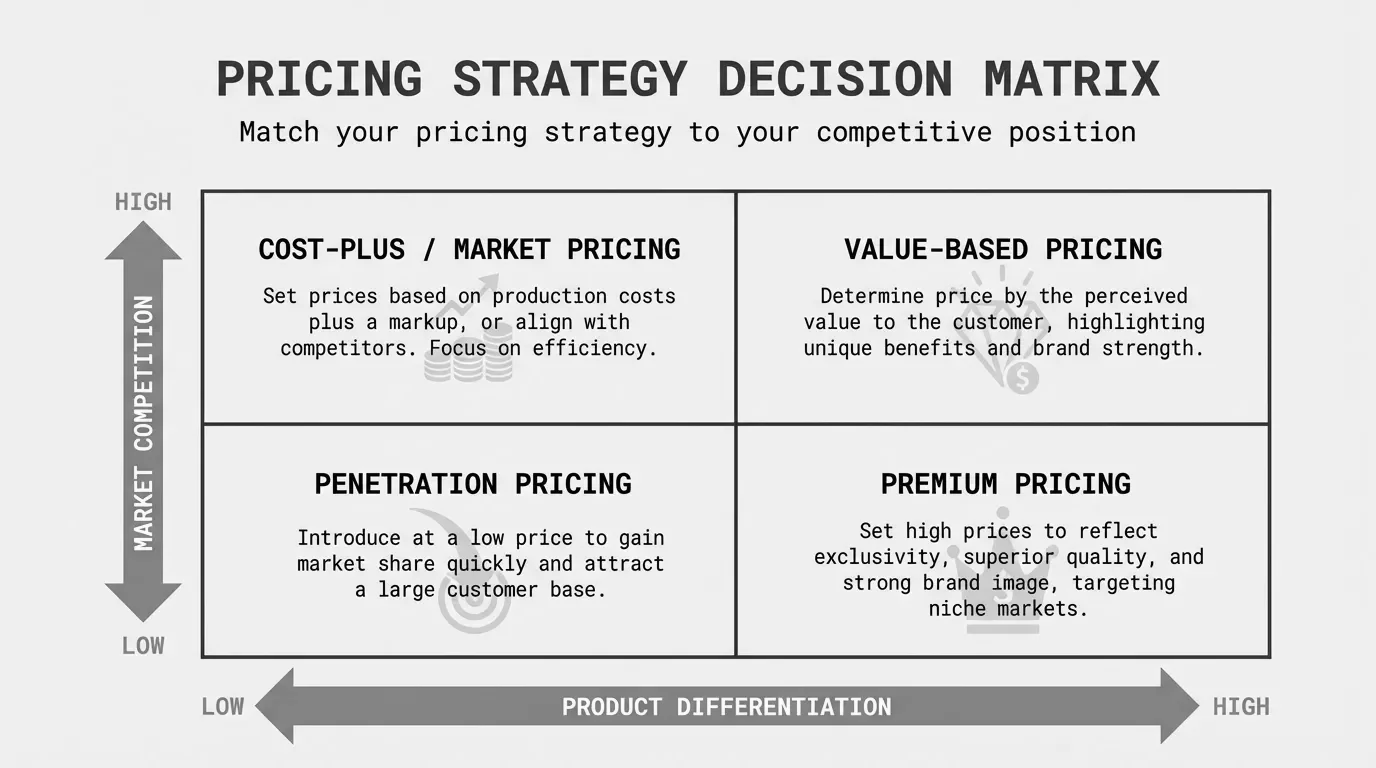
Most mid-market distributors and manufacturers don't lack pricing strategy options. They lack clarity on which strategy fits which situation. A $75M electrical distributor with 22,000 SKUs can't price every product the same way. Commodity wire needs one approach. Specialty connectors need another. Custom assemblies need a third.
This post walks through nine pricing strategy examples with real numbers, formulas, and specific guidance on when each works and when it doesn't. If you want the full framework, see our Pricing Strategy Guide. For B2B-specific models, check B2B Pricing Strategy.
1. Cost-Plus Pricing
Cost-plus pricing is a strategy where you calculate the total cost to produce or acquire a product, then add a fixed percentage markup to arrive at the selling price. It's the most widely used approach in distribution and manufacturing because it's simple, predictable, and ensures you don't sell below cost.
Selling Price = Unit Cost × (1 + Markup %)
Example: A plumbing distributor buys PVC fittings for $4.20 each. They apply a 40% markup.
$4.20 × (1 + 0.40) = $5.88 selling price
Gross margin = ($5.88 - $4.20) / $5.88 = 28.6%
The margin on that 40% markup is 28.6%, not 40%. This is a common point of confusion. Markup and margin aren't the same thing. A 40% markup always produces a 28.6% margin. A 50% markup gets you to 33.3% margin.
When it works:
- Commodity products where differentiation is low
- Passing through supplier cost increases during inflationary periods
- New product lines where you don't have competitive data yet
- Government contracts that require cost transparency
When it fails:
- You're selling a specialty product that solves an expensive problem. A 35% markup on a $12 part that prevents $2,000 in downtime is leaving serious money on the table.
- Your competitors are pricing based on value or market dynamics, and your cost-plus number lands way above or below theirs for reasons that have nothing to do with the customer.
Cost-plus is a floor, not a strategy. It answers "what's the minimum I should charge?" but not "what should I charge?"
2. Value-Based Pricing
Value-based pricing sets the price based on the economic value your product delivers to the customer, not what it costs you to produce or acquire it. It requires understanding what your customer's alternative is and what switching to that alternative would actually cost them.
Value-Based Price Ceiling = Next Best Alternative Price + Switching Costs + Differential Value
Example: A manufacturer sells a specialty industrial adhesive for $45 per unit. Production cost is $14. The next-best alternative adhesive costs $28 but requires double the application time, adding $30 in labor costs per use.
Customer's total cost with alternative = $28 + $30 labor = $58
Value-based price ceiling = $58
Current price of $45 saves customer $13 per application
Room to increase price: up to $58 before customer is indifferent
At $45, the manufacturer earns a 68.9% gross margin and the customer still saves $13 per application compared to switching. That's a pricing sweet spot. But if the manufacturer had used cost-plus at 50% markup, they'd have priced at $21 and left $24 per unit on the table.
When it works:
- Differentiated or specialty products with few direct substitutes
- Products bundled with technical expertise or value-added services
- Situations where you can quantify the customer's cost of alternatives
- Custom or engineered products
When it fails:
- True commodity products that customers can source from five other suppliers with identical specs
- Markets where price transparency makes value arguments hard to sustain
Value-based pricing is harder to implement than cost-plus. You need to understand your customer's economics, not just your own. But for the right products, it's where the real margin sits. According to a Pricing Solutions (now Iris Pricing Solutions) case study of an $870M oil and gas manufacturer, a 16-week pricing transformation across five business units uncovered $12.1M in additional profit in the first quarter, driven by updated list prices, improved annual price increase practices, and more consistent pricing policies.
3. Competitive Pricing
Competitive pricing uses competitors' prices as the primary reference point. You set your price at, above, or below competitors depending on your positioning and differentiation.
Example: An industrial supply distributor sells safety gloves across three quality tiers. For the mid-tier glove, they track three competitors:
| Competitor | Price per Pair |
|---|---|
| Competitor A | $8.50 |
| Competitor B | $9.20 |
| Competitor C | $8.75 |
| Market average | $8.82 |
The distributor's cost is $5.10. They price at $8.99, slightly above market average, because they offer same-day delivery and technical selection support. Their gross margin is 43.3%.
If they'd used cost-plus at their standard 35% markup, they'd have priced at $6.89 and left $2.10 per pair (23% of the selling price) on the table.
When it works:
- High-visibility products that customers actively price-shop
- Online channels where comparison is easy
- Commodity categories where you're competing on price and availability
When it fails:
- When you don't actually have reliable competitive data. Simon-Kucher, in their 2023 Global Pricing Study, warns that reacting to sales rep anecdotes about competitor pricing isn't competitive pricing. It's anecdotal discounting.
- When it triggers a price war. If you drop prices and a competitor matches, and you drop again, everyone's margins compress and nobody wins.
The biggest trap with competitive pricing: treating every "the customer said they can get it cheaper" as market intelligence. SPARXiQ's research across over 500 distributors found that sales reps routinely cave to customer price pushback, and that transient small customers often receive equal or better pricing than the largest strategic accounts. Verify competitive claims before you adjust.
4. Tiered (Volume) Pricing
Tiered pricing offers lower per-unit prices as purchase volume increases. It rewards larger orders and encourages customers to consolidate purchases with you instead of splitting across suppliers.
Example: A fastener distributor structures hex bolt pricing in four tiers:
| Order Quantity | Price per Unit | Gross Margin |
|---|---|---|
| 1-99 | $0.48 | 52% |
| 100-499 | $0.41 | 43.5% |
| 500-999 | $0.36 | 36.5% |
| 1,000+ | $0.31 | 26.1% |
Cost per unit is $0.23. The lowest tier still maintains a 26.1% margin, which works because large orders have lower cost-to-serve: one pick, one pack, one invoice instead of ten separate small orders.
Break-even volume for tier discount = Margin lost per unit × Units at new tier / Margin gained from incremental units
When it works:
- Products where your cost-to-serve drops with volume
- Categories where you want to capture a larger share of the customer's spend
- B2B relationships where purchase consolidation is realistic
When it fails:
- When customers game the tiers. They order 1,000 units once to lock in the low price, then don't order again for six months. Add time-based conditions (e.g., volume measured over rolling 90 days).
- When the tiers are too easy to reach. If 80% of your customers automatically qualify for the top tier, you're not tiering. You're just discounting.
For more on structuring tiers in B2B, see our guide on B2B tiered pricing.
5. Price Skimming
Price skimming starts with a high price for a new or differentiated product, then gradually reduces the price over time as competition enters or the market matures.
Example: A manufacturer releases a new automated torque calibration tool. They're first to market.
| Timeline | Price | Gross Margin | Target Segment |
|---|---|---|---|
| Launch (months 1-6) | $2,400 | 71% | Early adopters, large OEMs with immediate need |
| Month 7-12 | $1,800 | 61% | Mid-market manufacturers |
| Year 2+ | $1,350 | 48% | Broad market, competing against alternatives |
The $700 production cost stays roughly constant. The manufacturer recovers R&D investment quickly from the premium segment, then expands the addressable market as they lower price.
When it works:
- Genuine product innovation with no direct competitor
- Markets where early adopters will pay a significant premium for time-to-value
- Products with high R&D costs that need to be recouped
When it fails:
- Distribution, mostly. Distributors rarely have unique products. Skimming is primarily a manufacturer's strategy.
- Markets where competitors can copy quickly. If a knockoff appears in three months, your skimming window is too short.
6. Penetration Pricing
Penetration pricing is the opposite of skimming. You enter a market with a low price to gain share quickly, then raise prices once you've established a customer base.
Example: A regional building materials distributor enters a new metro market. They price 8-12% below the two established competitors on their top 200 SKUs (the products customers price-shop most).
| Phase | Pricing Approach | Goal |
|---|---|---|
| Months 1-6 | 8-12% below market on A items | Win accounts, build order history |
| Months 7-12 | Match market on A items, standard margin on B/C items | Normalize margins, customers now buy full catalog |
| Year 2+ | Market pricing across all items | Full margin, customer retention via service |
The key: the low pricing only applied to the 200 high-visibility items. The other 15,000 SKUs in their catalog were at standard margins from day one. Customers anchor on the prices they check. They don't comparison-shop the $3 specialty bracket.
When it works:
- Entering a new geographic market or customer segment
- Breaking into accounts held by entrenched competitors
- Products with high switching costs once adopted (customers won't leave over a 5% increase later)
When it fails:
- When you can't raise prices later. If your only value proposition is "we're cheaper," you're stuck being cheaper forever.
- When it triggers a price war with established competitors who have deeper pockets.
- When the low prices attract only price-sensitive buyers who'll leave the moment someone undercuts you.
7. Bundle Pricing
Bundle pricing combines multiple products or services into a single package at a price lower than buying each component separately. In distribution, this often looks like kitting or program pricing.
Example: An electrical distributor creates a "motor starter kit" bundle:
| Component | Individual Price | Bundle Price |
|---|---|---|
| Motor starter | $142.00 | - |
| Overload relay | $67.00 | - |
| Contactor | $89.00 | - |
| Mounting hardware | $23.00 | - |
| Individual total | $321.00 | - |
| Bundle price | - | $279.00 (13% discount) |
The distributor's blended cost on the bundle is $168. The bundle generates $111 in gross profit (39.8% margin) versus an average of 34% margin when items are sold individually. How? Because the contactor and mounting hardware have high standalone margins that subsidize the discount on the motor starter, which is the price-shopped item.
When it works:
- You sell complementary products that are often bought together
- One item in the bundle is a known, price-shopped product and the others aren't
- You want to increase average order value and reduce cost-to-serve
When it fails:
- When customers only want one item in the bundle and feel forced to buy the rest
- When the bundle discount is so deep it erodes more margin than the incremental volume justifies
8. Matrix Pricing (Customer-Product Segmentation)
Matrix pricing assigns different target margins based on the intersection of customer segment and product category. It's the antidote to peanut butter pricing, where every customer and every product gets the same markup.
Example: A $60M industrial distributor segments their business:
| Segment | A Products (top 20% revenue) | B Products (middle 30%) | C Products (bottom 50%) |
|---|---|---|---|
| Strategic customers | 18-22% margin | 25-29% margin | 30-35% margin |
| Core customers | 23-27% margin | 29-33% margin | 34-39% margin |
| Opportunistic customers | 27-31% margin | 33-37% margin | 38-44% margin |
This distributor had been running a flat 28% markup across the board. After implementing matrix pricing, their blended margin increased from 24.3% to 27.8% within two quarters. On $60M in revenue, that 3.5-point improvement added $2.1M in gross profit.
The biggest gains came from C products sold to opportunistic customers. Nobody was price-shopping those transactions, but the flat markup had them priced the same as high-visibility commodity items.
When it works:
- Companies with a large SKU count (5,000+) and diverse customer base
- Situations where current pricing is a single markup or a handful of customer-specific price lists with no strategic logic
- Any distributor or manufacturer ready to move beyond "cost plus whatever"
When it fails:
- When you don't have the transaction data to segment properly. You need 12+ months of order history to build meaningful segments.
For a detailed walkthrough of building a pricing matrix, see our Pricing Strategy Guide.
9. Dynamic (Market-Based) Pricing
Dynamic pricing adjusts prices in response to real-time or near-real-time market signals: commodity costs, competitive moves, demand patterns, and inventory levels.
Example: A steel distributor links their pricing on commodity flat-rolled products to the CRU index. When spot steel prices move, their selling prices adjust within 48 hours.
Target Price = Current Index Price × (1 + Base Markup %) + Service Fee
Example: $820/ton CRU index × 1.18 markup + $45 service fee = $1,012.60/ton
When the index was at $720, the price was $894.60. When it spiked to $1,100, the price moved to $1,343. The distributor's dollar margin per ton increased during the spike, and they didn't get caught holding inventory at stale prices during the decline.
When it works:
- Products tied to volatile commodity inputs (steel, copper, resins, lumber)
- High-velocity items where competitive prices change frequently
- Companies with the systems to update prices quickly (ERP integration, automated price lists)
When it fails:
- When customers need price stability for budgeting and planning. Offer index-based contracts with caps and floors instead.
- When you lack the operational capability to update prices fast enough. A pricing strategy that requires daily updates but your ERP takes two weeks to process changes is a recipe for margin loss.
In a case study published by The Lab Consulting ("Pricing Capability Improvement & Automation to Recapture Margin"), a distributor found that 50% of all orders contained price overrides, with sales staff routinely granting them because margin wasn't top-of-mind and few clear approval thresholds existed. After implementing automated override monitoring and pricing governance, overrides dropped to 18% of orders and override amounts fell by 45%. Dynamic pricing without discount controls is like having a gas pedal with no brakes.
How to Pick the Right Strategy for Your Business
You won't use just one of these. Most distribution and manufacturing companies need three or four strategies running simultaneously across different parts of their catalog.
Here's a practical framework:
Step 1: Categorize your products.
- Commodities with high price transparency → competitive pricing or cost-plus
- Standard products with moderate differentiation → matrix pricing with tiered volumes
- Specialty or technical products → value-based pricing
- Products tied to volatile inputs → dynamic pricing
Step 2: Categorize your customers.
- High-volume strategic accounts → tighter margins, volume tiers, contract pricing
- Core accounts → standard matrix pricing
- Small or infrequent buyers → full margin, no negotiated pricing
Step 3: Set guardrails. Every strategy needs a floor price (never sell below cost plus minimum margin) and an approval process for exceptions. Without guardrails, sales reps will override any strategy to close the deal. Bain & Company's 2018 brief "Dynamic Pricing: Building an Advantage in B2B Sales" found that pricing discipline in execution matters more than the sophistication of the strategy itself, with well-executed pricing transformations generating 2 to 7 percentage points of sustained margin improvement.
Step 4: Measure what's actually happening. Pull your transaction data and calculate realized pocket margin by customer and product segment. Most companies are shocked by the gap between their target margins and their actual margins after all discounts, freight costs, rebates, and returns. That gap is your margin leakage.
Pryse builds this visibility from a CSV upload in 24 hours. No six-month implementation. No $100K software license. You upload your transaction data, and we show you exactly where margin is leaking across every customer-product combination.
The Cost of Getting Pricing Wrong
McKinsey's 2003 article "The Power of Pricing" (McKinsey Quarterly, by Marn, Roegner, and Zawada) found that a 1% improvement in realized price produces an 8% increase in operating profit. Flip that around: a 1% erosion in realized price cuts operating profit by 8%.
Profit Impact = Revenue × Price Change % × (1 / Operating Margin %)
Example: $75M × -1% = -$750K / 5% operating margin = -15% profit decline
For a $75M company at 5% operating margin, letting 1% of price slip through unmanaged discounting, stale cost-plus markups, or freight giveaways costs $750K in profit. That's enough to fund two full-time employees or a year of capital investment.
The fix isn't buying enterprise pricing software. It starts with visibility. You can't improve pricing you can't measure. Map your price waterfall from list price to pocket price. Identify where the biggest gaps are. Then apply the right strategy from this list to each product-customer segment.
For the complete framework, start with our Pricing Strategy Guide.
Last updated: Invalid Date
Frequently Asked Questions
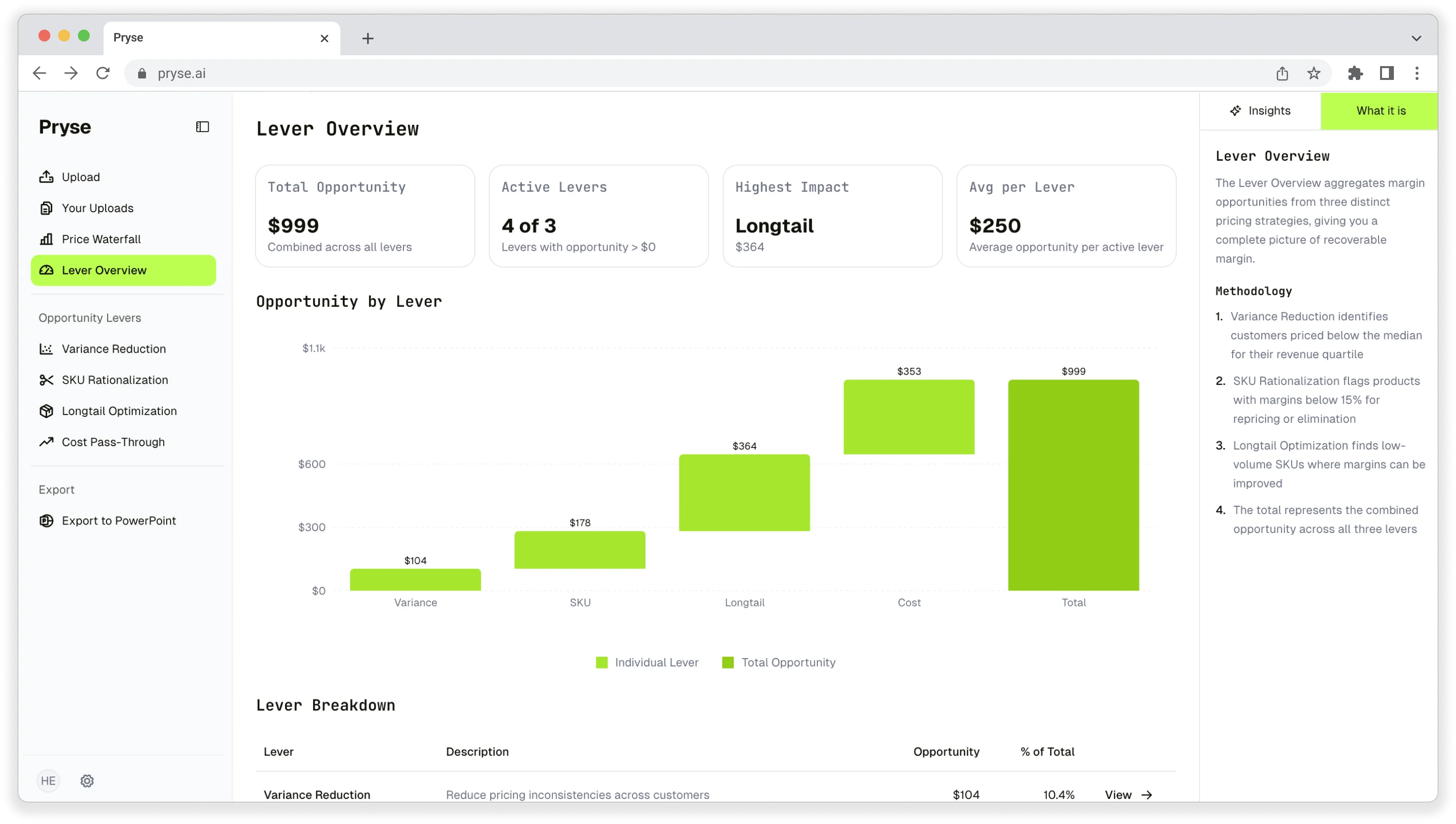
Want to analyze your entire product catalog?
Pryse automatically identifies margin leakage across thousands of SKUs. Upload your data and find hidden profit in 24 hours.
One-time $1,499 diagnostic. No subscription required.