 Pryse
PryseRetail Pricing Strategy: Lessons B2B Distributors Can Apply
Retail pricing strategy has evolved over decades. Learn the key principles — loss leaders, price perception, and segmentation — and how B2B distributors can apply them.
Retail pricing is the most studied, most tested, and most data-driven pricing discipline in business. Companies like Walmart, Amazon, Kroger, and Costco have spent decades refining how they price millions of products to maximize total profitability — not just margin on individual items.
B2B distributors can learn a lot from this body of knowledge. Not the specific tactics (you're not going to run a "buy one get one free" promotion on industrial fittings), but the underlying principles. How retailers think about price perception, product segmentation, and portfolio margin management translates directly to distribution pricing.
The gap is that most distributors still price like it's 1995 — cost-plus markup applied uniformly across the catalog, adjusted occasionally when costs change or customers complain. Retailers abandoned that approach years ago in favor of data-driven, segment-specific pricing. The same shift is overdue in B2B.
This post examines the core retail pricing principles, explains which ones translate to B2B distribution, and shows how to apply them without the million-dollar technology stack that large retailers use.
Core Retail Pricing Principles
Principle 1: Not Every Product Gets the Same Margin
This is the most fundamental retail pricing insight and the one most B2B companies ignore.
Retailers divide their catalog into roles:
Traffic builders (loss leaders). Products priced at or near cost to attract customers. Milk, bread, and bananas at the grocery store. These products lose money individually but drive traffic that generates profit on everything else. Typically 3-5% of SKUs.
Known Value Items (KVIs). Products that customers know the price of and use to judge your overall pricing. Retailers obsess over KVI pricing because being overpriced on these 50-200 items shapes customer perception of your entire catalog. Typically 5-10% of SKUs.
Core margin products. The bulk of the catalog — products customers buy regularly but don't actively compare prices on. This is where retailers make most of their margin. Typically 60-70% of SKUs.
Destination items. Products that bring customers specifically to your store because you carry them and competitors don't, or because you have better selection. These sustain premium margins. Typically 10-20% of SKUs.
Tail products. Infrequently purchased items with high margins. The customer buying a specialty gadget at 2 AM doesn't comparison-shop. Typically 10-15% of SKUs.
Retailers know exactly which products fall in each category and price accordingly. The milk might carry a 5% margin. The specialty cheese carries 50%. The average is 30%. But no individual product is priced at 30%.
Principle 2: Price Perception Is Managed, Not Accidental
Customers don't evaluate your pricing across every product. They form opinions based on a small sample of products they know the price of. Retailers manage this perception actively.
How retailers manage price perception:
- Price KVIs at or below competitor levels — this makes customers feel your store is "fair" or "affordable"
- Recover margin on products customers don't compare — which is the vast majority of the catalog
- Use price endings ($9.99 vs. $10.00) to signal value
- Position private label alternatives near premium brands to anchor perceived value
- Communicate competitive pricing through ads, price-match guarantees, and in-store signage
The result: a customer walks out of Walmart thinking everything is cheap, even though some products carry healthy margins. The perception is shaped by the 50-100 items the customer actually checked, not the 100,000 items they didn't.
Principle 3: Use Data to Set Prices, Not Formulas
Retailers invest heavily in price elasticity measurement — understanding how volume responds to price changes for each product and customer segment. This data drives pricing decisions.
A retailer knows that raising the price of their house-brand ketchup by 10 cents loses 8% volume but raising the price of organic artisanal mustard by $0.50 loses only 1% volume. They price accordingly.
Most B2B companies don't measure price elasticity at all. They apply the same markup to ketchup and mustard — metaphorically speaking — and leave money on the table on every transaction.
Translating to B2B Distribution
B2B Lesson 1: Segment Your Catalog by Pricing Role
Just like retailers, distributors have traffic drivers, KVIs, core margin products, and tail items. The categories map directly:
| Retail Category | B2B Equivalent | Example (Electrical Distributor) |
|---|---|---|
| Loss leaders | Competitive commodities | Standard Romex wire, basic EMT conduit |
| KVIs | Price-comparison items | Common breakers, standard receptacles |
| Core margin | Standard assortment | Boxes, fittings, connectors, tools |
| Destination items | Specialty expertise | Explosion-proof fixtures, control panels |
| Tail products | One-off special orders | Obsolete parts, specialty adapters |
The pricing implication: Price your competitive commodities aggressively (at or slightly above cost) to maintain account relationships and price perception. Recover margin on core and specialty products where customers aren't comparing.
Most distributors do the opposite: they maintain high margins on commodities (because the cost-plus formula says so) and don't push margins on specialty items (because they've always priced them the same way). This results in losing commodity orders to competitors while leaving specialty margin uncaptured.
B2B Lesson 2: Manage Price Perception Intentionally
Your customers judge your pricing based on the 50-100 products they buy frequently and can benchmark against competitors. Everything else is priced in the dark — the customer has no reference point.
Identify your KVIs. These are the products your customers mention when they say "you're expensive" or "your pricing is fair." They're usually high-volume commodities that competitors carry and customers buy from multiple sources.
Price KVIs competitively. Being 2-3% above market on KVIs is fine. Being 8-10% above market shapes your entire price reputation negatively. Spend the margin on these items — it pays back through retained accounts and higher pricing power on non-KVI products.
Recover margin on non-KVIs. The 90% of your catalog that customers don't benchmark is where margin should live. Specialty items, low-volume products, and products where you're the primary or sole source can carry premium margins without competitive consequence.
B2B Lesson 3: Measure Price Sensitivity From Your Data
Retailers calculate price elasticity from millions of transactions. You can estimate it from thousands. The method is the same — just rougher.
Look for natural experiments in your data:
- When you raised prices on a product line, what happened to volume?
- When you lost a product to a competitor on price, how sensitive was the volume response?
- When you offered promotional pricing, how much incremental volume did it generate?
Even rough elasticity estimates are better than none. Knowing that your safety equipment line has low price sensitivity (customers don't switch suppliers for 5%) while your commodity pipe fittings have high sensitivity (customers will switch for 3%) fundamentally changes how you price each category.
B2B Lesson 4: Use Promotions Strategically, Not Habitually
Retailers use promotions to drive specific outcomes: clear excess inventory, attract trial of new products, build basket size during key seasons. They don't discount randomly.
Where B2B promotions make sense:
- Excess inventory clearance. If you're sitting on 18 months of stock on slow-moving items, a promotional price that moves inventory is better than carrying costs plus eventual write-off.
- New product launch. Introductory pricing that gives customers a reason to try a new product or brand you've onboarded.
- Cross-sell into new categories. Promotional pricing to get an existing customer buying from a product category they currently source elsewhere.
Where B2B promotions backfire:
- Regular promotional cycles. If customers know you discount every quarter, they'll delay purchases until the promotion. You train them to wait rather than buy at standard prices.
- Broad-based discounts. A 5% off everything promotion reduces margin across the board without driving incremental behavior.
- Price-match promises. Promising to match any competitor price gives customers maximum leverage and minimum incentive to value your service.
The Retail Metrics B2B Should Adopt
Gross Margin Return on Inventory Investment (GMROI)
Retailers measure GMROI — gross margin dollars generated per dollar of inventory investment. A product with 20% margin and 12 turns per year generates 2.4x GMROI. A product with 40% margin and 1 turn generates 0.4x.
Distributors should use the same metric. A high-margin product sitting in your warehouse for 18 months may generate less return than a low-margin product that turns 10 times per year. GMROI helps you price to maximize return on your inventory investment, not just gross margin percentage.
Price Image Score
Retailers survey customers to measure price perception — "how do you rate our pricing compared to alternatives?" Most B2B companies never measure this. Adding a price perception question to customer surveys or annual reviews gives you data on how your pricing is perceived, which matters as much as how your pricing actually compares.
Basket Margin vs. Product Margin
Retailers don't optimize margin on individual products. They optimize margin on the basket — the total order value. A customer who buys a loss-leader commodity and three high-margin specialty items is more profitable than a customer who buys only the high-margin items.
Distributors should think the same way. The profitability of a customer relationship isn't determined by the margin on their largest order. It's determined by the total margin across all products they buy from you over the year. Pricing your commodity items competitively to retain the full relationship often beats pricing them for individual-product margin and losing the account.
Applying These Lessons
You don't need Walmart's pricing technology to apply retail pricing principles. You need three things:
- Visibility into your margin distribution — which products carry high margins, low margins, and inconsistent margins across your catalog
- Rough competitive positioning — which products you're above market on and which you're below market on
- Product segmentation — which products are competitive commodities, which are core assortment, and which are specialty items
A pricing diagnostic gives you the first two. Product segmentation requires your team's product knowledge applied to the data. With all three, you can build a segment-specific pricing strategy that applies retail principles to your B2B catalog — pricing competitively where it matters for perception and capturing margin where customers aren't comparing.
That's what retailers figured out decades ago. The companies that apply these same principles to B2B distribution will outperform those still pricing everything at cost-plus-35%.
Last updated: March 12, 2026
Frequently Asked Questions
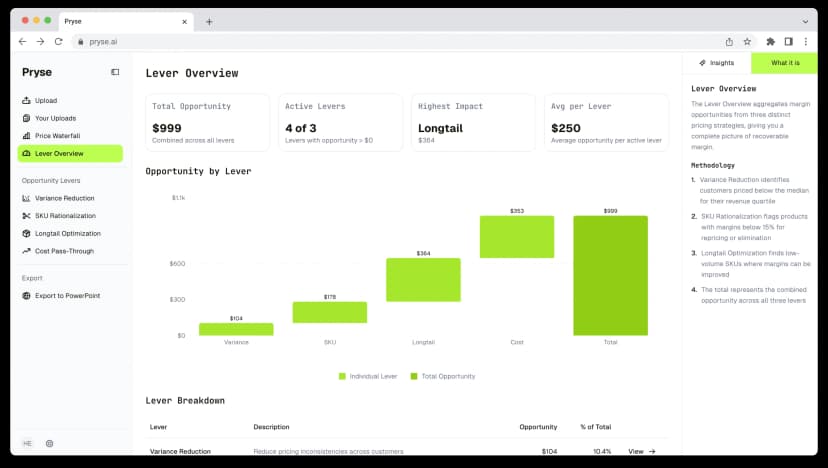
Want to analyze your entire product catalog?
Pryse automatically identifies margin leakage across thousands of SKUs. Upload your data and find hidden profit in 24 hours.
$999/year. Cancel anytime.