 Pryse
PryseDo You Need a Pricing Strategy Consultant? A Practical Decision Guide
When to hire a pricing strategy consultant, what to expect, what they cost, and when cheaper alternatives deliver the same results. A no-fluff decision guide.
A pricing strategy consultant charges $50K-$500K to tell you how to price your products. Sometimes that's the best money you'll ever spend. Sometimes it's a six-figure binder that collects dust on a shelf.
The difference comes down to timing. Consultants solve specific problems at specific moments. Hire one at the right time and you'll recover multiples of their fee. Hire one when you actually need an analyst with a spreadsheet, and you've wasted budget that could have gone directly to margin improvement.
This guide helps you figure out which situation you're in.
What Pricing Strategy Consultants Actually Do
A pricing strategy consultant helps you answer a set of foundational questions:
- How should we structure our pricing? (Cost-plus, value-based, competitive, hybrid?)
- How should we segment customers for pricing? (By size, industry, purchase volume, cost-to-serve?)
- What should our discount policies look like? (Who can give discounts, how much, under what conditions?)
- Where are we leaving money on the table? (Margin leakage analysis, pricing opportunity sizing)
- How do we implement changes without losing customers? (Sequencing, communication, rollout)
The typical engagement runs 3-6 months and involves:
- Discovery — Interviews with sales, finance, and operations. Data extraction and analysis.
- Analysis — Transaction-level margin analysis, customer segmentation, competitive positioning, price waterfall mapping.
- Strategy design — Pricing framework, discount policies, margin targets, segmentation rules.
- Implementation planning — Rollout sequence, customer communication templates, sales enablement materials.
- Handoff — Some firms stay for implementation support. Most hand off a strategy deck and leave.
The deliverable is a pricing strategy. Not a software tool. Not ongoing execution. A plan that your team needs to implement.
When a Consultant Is Worth the Investment
There are three scenarios where pricing consultants consistently deliver strong ROI.
You're fundamentally restructuring your pricing model
If you're moving from cost-plus to value-based pricing, redesigning your customer segmentation, or building a pricing function that doesn't exist yet, a consultant compresses the learning curve.
A company that's been pricing on cost-plus-30% for 20 years doesn't know where to start with value-based pricing. A consultant who's guided 50 similar companies through the transition knows the framework, the pitfalls, and the implementation sequence. What would take an internal team 18 months of trial and error takes 4-6 months with experienced guidance.
You need external authority to drive change
This is the unspoken reason many companies hire consultants. Leadership knows pricing needs to change. Sales leadership resists. The consultant provides political cover.
When McKinsey or Simon-Kucher tells the sales VP that discount levels are 8 points above industry benchmarks, it carries different weight than when the CFO says it. The data might be identical. The organizational impact is not.
Simon-Kucher's 2025 Global Pricing Study found that companies with formal pricing strategies and executive sponsorship significantly outperform those without. Sometimes a consultant's primary value is creating that executive alignment, not the analysis itself.
You're entering a new market with no pricing benchmarks
Launching new products, expanding into new verticals, or entering international markets without pricing data creates real strategy gaps. A consultant with industry-specific benchmarks can establish initial price points, segmentation, and discount structures that would take you months to develop through trial and error.
When a Consultant Is Not Worth It
Consulting engagements fail to deliver ROI in predictable patterns.
You haven't done basic analysis yet
If nobody in your company has exported transaction data and calculated margin by product and customer, you don't need a $200K strategy engagement. You need a spreadsheet.
The first round of margin analysis at most mid-market companies reveals obvious problems: products priced below cost, customers getting 40% discounts when the policy cap is 25%, cost increases from 18 months ago that never hit the price file. Finding these doesn't require a consultant. It requires someone spending a weekend with your ERP data.
Run basic analysis first. If it reveals $50K in fixable margin problems, fix them. If it reveals $500K in problems too complex for spreadsheets to sort out, then the consultant conversation makes sense.
Your problem is execution, not strategy
Many companies already know what to do. They know which customers are under-margin. They know their discounts are too deep. They know freight is eating their profit on small orders. They just haven't done anything about it.
Hiring a consultant to tell you what you already know is expensive confirmation. If the problem is that nobody enforces the existing discount policy, the solution is enforcement, not a new policy. That's a management problem, not a consulting problem.
You can't commit to implementing recommendations
This is the most expensive mistake. A pricing strategy engagement produces a 100-page deliverable with specific, actionable recommendations. If leadership reads it, nods, and then doesn't change anything because "now isn't the right time" or "we can't risk losing customers," the entire investment is wasted.
Before engaging a consultant, get explicit commitment from executive leadership that recommendations will be implemented. Not "considered." Implemented.
Your budget is better spent elsewhere
A $150K consulting engagement consumes budget that could fund:
- A full-time pricing analyst for a year ($80K-$120K)
- A mid-market pricing software subscription ($20K-$100K/year)
- A one-time diagnostic ($999/year) plus direct margin improvements
For companies under $50M in revenue with straightforward product lines, internal resources and tools typically deliver better ROI per dollar than outside strategy consultants.
How to Evaluate Pricing Consultants
If you've decided a consultant is the right move, here's how to avoid the common traps.
Demand industry-specific experience
A consultant who's worked with 30 industrial distributors will deliver faster results than a generalist who mostly works in SaaS or retail. Pricing dynamics in distribution — customer-specific pricing, negotiated contracts, rebate programs, cost-to-serve variation — are different enough that generic pricing frameworks miss the mark.
Ask for case studies from companies your size and industry. Three specific references are worth more than a impressive client logo slide.
Scope tightly with fixed deliverables
Open-ended retainers are how consulting budgets balloon. Instead, define:
- Specific deliverables (pricing framework, discount policy, customer segmentation, implementation plan)
- Clear timeline (12-16 weeks is typical for mid-market)
- Fixed fee or capped budget
- Named consultants who'll actually do the work (not the partner who sells, then delegates to junior analysts)
Require implementation support
The best pricing consultants don't just hand over a strategy deck. They stay through the first wave of implementation — the first customer conversations, the first sales team pushback, the first quarter of results.
Implementation support typically adds 20-30% to the project cost. It's almost always worth it. The gap between strategy and execution is where most consulting engagements fail.
Watch for red flags
- Consultants who won't share their methodology until you sign
- Firms that staff your project with analysts who have less pricing experience than your own team
- Proposals that promise specific margin improvement percentages without seeing your data
- Engagements with no defined end date
The Realistic Timeline
Here's what a typical mid-market pricing consulting engagement actually looks like:
Weeks 1-4: Discovery and data. The consultant interviews 15-25 people across sales, finance, and operations. They request 12-24 months of transaction data. Your team spends 40-80 hours supporting this phase. First data quality issues surface.
Weeks 5-10: Analysis. The consultant builds the margin analysis, price waterfall, customer segmentation, and competitive positioning. Preliminary findings shared. The "aha moment" — specific dollar amounts attached to specific problems.
Weeks 11-14: Strategy design. Pricing framework drafted. Discount policies drafted. Customer communication approach designed. Internal review and iteration.
Weeks 15-20: Implementation planning. Rollout sequence, sales enablement, customer communication, and success metrics defined. Training delivered.
Weeks 21+: Implementation support (if scoped). First price changes rolled out. Customer conversations happen. Early results measured. Adjustments made.
Total elapsed time: 5-7 months from kickoff to measurable results. Your team's time investment: 500-1,000 hours total, spread across finance, sales, operations, and leadership.
Alternatives to a Full Consulting Engagement
If the full engagement doesn't fit your budget or timeline, there are lighter options.
One-time pricing diagnostic. For $999/year, a diagnostic analyzes your transaction data and delivers margin analysis, price waterfall, and opportunity sizing. This gives you the same "where's the money" answer that a consultant spends 4-6 weeks discovering, without the strategy design or implementation support. It's the best starting point if you're not sure whether you need a consultant.
Fractional pricing advisor. Some consultants offer advisory retainers — 10-20 hours per month at $200-$400/hour. You get experienced guidance without a $200K project. Best for companies that have internal analytical capability but need strategic direction.
Industry benchmarking studies. Trade associations like NAW (National Association of Wholesaler-Distributors) and the IRCG Distribution Report publish pricing and margin benchmarks. For $1K-$5K, you get industry context without a consulting engagement.
Internal pricing task force. Assemble a cross-functional team (finance, sales, operations) to review pricing quarterly. Give them authority to implement changes. This costs nothing beyond the time investment and works surprisingly well for companies that simply haven't been paying attention to pricing.
What to Expect After the Engagement
A good pricing consultant leaves you with:
- A pricing framework your team can maintain and evolve
- Discount policies with specific guardrails sales teams follow
- Customer segmentation that differentiates pricing by value delivered
- Quantified results — specific margin improvements you can track
- Capability transfer — your team should be able to run pricing reviews independently
A bad engagement leaves you with a strategy deck nobody references and pricing that reverts to pre-engagement patterns within 6 months.
The difference is almost always about implementation commitment, not consultant quality. The best strategy, delivered by the best firm, fails without organizational follow-through.
For a broader comparison of all pricing improvement approaches, see our pricing consulting vs. software analysis. For pricing strategy frameworks you can apply independently, see our pricing strategy guide.
Last updated: March 12, 2026
Frequently Asked Questions
Want to analyze your entire product catalog?
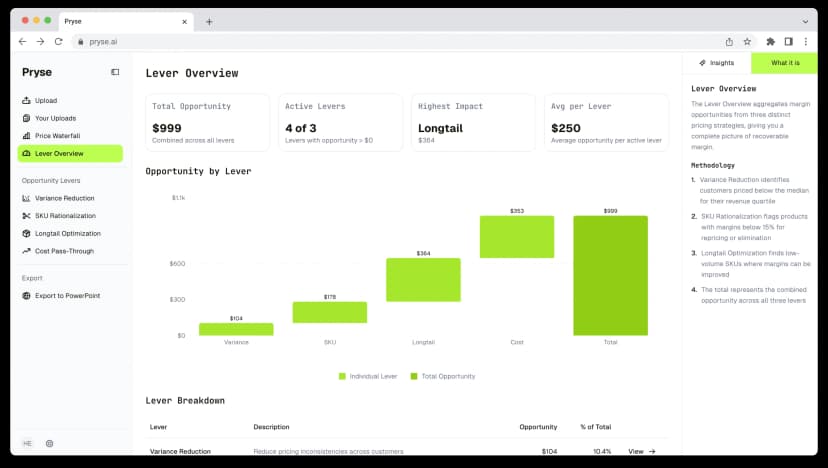
Pryse automatically identifies margin leakage across thousands of SKUs. Upload your data and find hidden profit in 24 hours.
$999/year. Cancel anytime.