 Pryse
PrysePricing Competitiveness: How to Measure and Improve Your Position
Pricing competitiveness measures how your prices compare to the market. Learn how to calculate price indexes, benchmark your position, and fix misalignment.
Pricing competitiveness isn't about being the cheapest. It's about being priced appropriately for what you sell and who you sell it to. A distributor that's 10% below market on every product is competitive but leaving serious margin on the table. A distributor that's 10% above market on commodities is losing volume to competitors who price-shop better.
The real problem most mid-market companies face isn't that they're uncompetitive across the board. It's that they're mispriced — overpriced on the products customers actively compare and underpriced on the products where they have genuine pricing power.
Bain & Company found that a 1% improvement in realized price drives an 8% increase in operating profit for B2B companies — roughly twice the benefit of a 1% improvement in volume or variable costs. Pricing competitiveness determines whether that 1% is available to you. If you're already priced below market on most products, the opportunity is right there waiting to be captured.
This post explains how to measure pricing competitiveness, how to interpret the results, and how to fix the misalignment that exists in almost every distributor's catalog.
What Pricing Competitiveness Means
Pricing competitiveness is your price position relative to alternatives available to your customers. It answers a simple question: for the products you sell, how do your prices compare to what customers could pay elsewhere?
Price Index = (Your Price / Competitor Price) x 100
An index of 100 means you're priced identically to the competitor. Above 100 means you're more expensive. Below 100 means you're cheaper.
Example for a single product:
- Your price: $42.50
- Competitor A: $40.00
- Competitor B: $44.00
- Your index vs. A: 106.3 (6.3% above)
- Your index vs. B: 96.6 (3.4% below)
- Your index vs. market average ($42.00): 101.2
For a single product, this calculation is trivial. The value comes from running it across thousands of SKUs and spotting the patterns — which product categories are you consistently above market, below market, or at market?
Measuring Your Competitive Position
Step 1: Select the Products to Benchmark
You can't benchmark every SKU. Focus on three categories:
Traffic drivers (top 200-500 SKUs by revenue). These are the products customers actively price-shop. If you're overpriced here, you lose orders and potentially entire accounts. If you're underpriced, you're leaving easy margin on the table.
High-visibility items. Products your customers view as market indicators — even if they're not your highest-volume SKUs. In electrical distribution, wire and conduit pricing shapes customer perception. In industrial supply, common fasteners and safety products set the tone.
Margin outliers. Products where your margin is unusually high or low compared to category averages. High margins may indicate you're below market and could go higher. Low margins may indicate competitive pressure you haven't addressed.
Step 2: Collect Competitive Pricing Data
B2B pricing data is harder to collect than retail (where you can scrape websites). Useful sources:
| Source | Reliability | Coverage | Effort |
|---|---|---|---|
| Customer-provided quotes | High | Narrow (specific deals) | Low |
| Sales team intelligence | Medium | Broad (anecdotal) | Low |
| Buy-sell group data | High | Moderate (group members) | Low |
| Public online pricing | High | Varies by industry | Medium |
| Supplier price sheets | Medium | Narrow (list prices only) | Low |
| Win/loss analysis | Medium | Moderate (competed deals) | Medium |
| Third-party price benchmarks | High | Broad | High cost |
No single source gives you the complete picture. Combine at least three for any product category where competitive position matters to your strategy.
Step 3: Calculate Your Price Index by Category
Don't look at individual SKU indexes in isolation. Aggregate to the category level to spot patterns.
Example output:
| Product Category | SKUs Benchmarked | Avg Price Index | Revenue at Stake |
|---|---|---|---|
| Commodity fasteners | 450 | 108 | $8.2M |
| Electrical fittings | 200 | 97 | $5.1M |
| Safety equipment | 150 | 94 | $3.8M |
| Specialty adhesives | 80 | 91 | $2.4M |
| Pipe & valves | 300 | 102 | $12.5M |
This table tells a clear story: you're overpriced on commodities (where customers compare) and underpriced on specialty items (where you have pricing power). That's the most common pattern we see in mid-market distribution.
Interpreting Your Competitive Position
The right price index depends on your product category and strategy. There's no universal target.
Commodity Products: Target 98-102
These are the products customers price-shop actively — standard wire, common fasteners, basic pipe fittings. Being 8% above market on commodities costs you volume and damages your price perception. Being 8% below market on commodities gives away margin you don't need to sacrifice.
Price competitively on commodities. Match or slightly beat the market. This preserves volume and maintains your reputation as a fair-priced supplier — which matters when you're charging premium prices on specialty items.
Core Products: Target 100-108
Your bread-and-butter product lines with moderate competition. Customers compare prices occasionally but don't shop every order. You can sustain a slight premium if your service, availability, or convenience justifies it.
Specialty Products: Target 105-120
Products with limited alternatives, technical complexity, or strong brand preference. Customers buying specialty items are solving a problem, not comparison-shopping. A 10-15% premium is sustainable when you're the obvious source for a specific product category.
Tail Products: Target 110-130
Low-volume items that customers order infrequently. The customer's cost of finding an alternative supplier usually exceeds the price premium. These products should carry higher margins to justify the inventory carrying cost.
Why Most Distributors Are Mispriced
The typical distributor applies a uniform cost-plus markup across their catalog. Buy it for $10, sell it for $14.50 (45% markup). Whether it's a commodity fastener or a specialty fitting, everything gets the same treatment.
This produces predictable mispricing:
Overpriced on commodities. Your 45% markup puts the fastener at $14.50. The competitor with a more targeted approach prices it at $13.00. You're 11.5% above market on a product customers actively compare. You lose the order — and possibly the customer's impression of your overall pricing.
Underpriced on specialties. Your 45% markup puts the specialty fitting at $14.50. The next-best alternative is $18.00 from a specialty supplier. You're 19.4% below market on a product the customer wasn't going to shop. You could charge $16.50 (an additional $2.00 per unit) and the customer wouldn't blink.
The math that matters: If you sell $5M in commodity products at a 108 index and $3M in specialty products at a 92 index, fixing both sides — lowering commodity prices to 101 and raising specialty prices to 105 — costs you $350K in commodity revenue (offset by retained volume) and gains you $390K in specialty margin. Net improvement: positive, with better competitive positioning on the products that shape customer perception.
Improving Your Competitive Position
Fix 1: Reduce Prices on Overpriced Commodities
Identify the specific SKUs where your price index exceeds 105 in commodity categories. Lower these to 100-102. Yes, this reduces margin per unit — but it retains volume you're currently losing and improves customer price perception across your entire catalog.
This is the hardest pill for distributors to swallow. Voluntarily lowering prices feels wrong. But if you're already losing volume on these products to competitors, the margin you think you're making is theoretical — you're not making it on orders that go elsewhere.
Fix 2: Raise Prices on Underpriced Specialties
Identify SKUs where your price index is below 95 in specialty categories. Raise prices to 105-110 in increments — 3-5% per quarter rather than a single large increase.
This is where the easy margin lives. Customers buying specialty products from you do so because you're the convenient or knowledgeable source, not because you're the cheapest. A 5-10% price increase on products with low price sensitivity is almost entirely margin — volume impact is minimal.
Fix 3: Monitor and Maintain
Competitive positions shift. Competitors raise or lower prices. New entrants appear. Cost structures change. A competitive position you measured in Q1 may not be accurate in Q3.
Build a quarterly review cadence for your top 300-500 SKUs. Track your price index over time and flag categories where your position has shifted more than 3 points in either direction.
Connecting Competitiveness to Margin
Pricing competitiveness and margin optimization are two sides of the same coin. When you know where you're overpriced (losing volume) and underpriced (leaving margin), you know exactly where your pricing improvement opportunity lives.
The challenge for most mid-market companies is visibility. They know their aggregate gross margin. They don't know their competitive position by product category, customer tier, or market segment. That blind spot is where margin leaks.
A pricing diagnostic gives you both views simultaneously: your internal margin distribution (where margins are high, low, and inconsistent) and your implied competitive position (where pricing patterns suggest you're above or below market). With both views, the right pricing actions become obvious — lower prices where you're uncompetitive on high-sensitivity products, raise prices where you have room on low-sensitivity products, and tighten discount management where reps are giving away margin unnecessarily.
That's the difference between a pricing strategy and a price list. A price list is static. A pricing strategy actively manages your competitive position to maximize total margin across the catalog.
Last updated: March 12, 2026
Frequently Asked Questions
Want to analyze your entire product catalog?
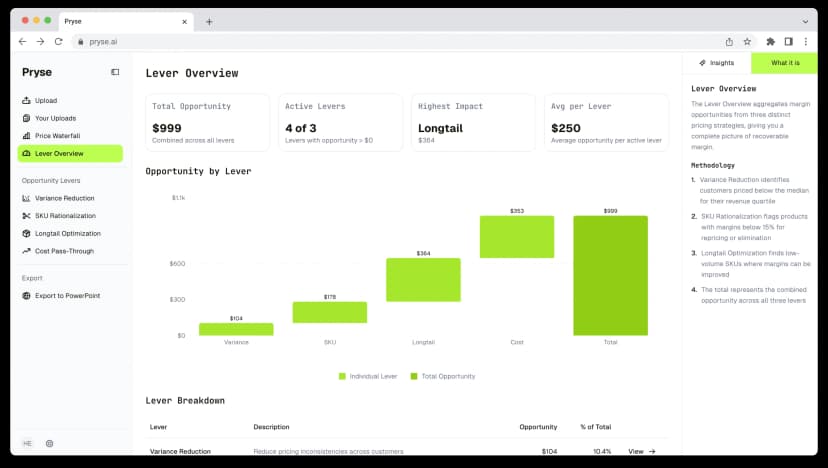
Pryse automatically identifies margin leakage across thousands of SKUs. Upload your data and find hidden profit in 24 hours.
$999/year. Cancel anytime.