 Pryse
PryseAirline Pricing Strategy: What Distribution Companies Can Learn
Airlines pioneered revenue management and dynamic pricing. Learn how yield management, fare segmentation, and overbooking apply to B2B distribution pricing.
Airlines invented modern pricing science. Before deregulation in 1978, ticket prices were set by the government. After deregulation, airlines had to figure out pricing for themselves — and the result was the most sophisticated pricing system in any industry.
According to OAG's research on airline pricing history, American Airlines pioneered yield management in the 1980s under CEO Robert Crandall, and airlines reported an average 14% increase in route profitability from revenue management systems. American Airlines credited the system with $1.4 billion in incremental revenue over three years.
Today, airline revenue management is a $4 billion technology market. Every major carrier runs sophisticated algorithms that adjust prices on millions of seat-route-date combinations continuously. The same New York to Chicago flight might have 15 different prices available on the same day — and those prices change as bookings come in.
For B2B distributors and manufacturers, airline pricing is interesting not because you should copy it, but because the underlying principles — segmentation, inventory awareness, time-based pricing, and systematic measurement — apply more broadly than most people realize.
This post explains how airline pricing actually works, which principles translate to B2B distribution, and which don't — so you can learn from the most advanced pricing discipline without making the mistake of treating your customer relationships like seat assignments.
How Airline Pricing Works
Airline pricing operates on a core reality: an empty seat on a departed flight has zero value. Every unsold seat is pure waste. This creates an intense pressure to maximize revenue per flight — filling seats at the highest possible price while ensuring the plane departs as full as possible.
Fare Class Segmentation
Airlines don't sell "a seat." They sell fare classes — different versions of the same physical seat with different prices, restrictions, and flexibility.
Typical fare class structure:
| Class | Type | Price | Restrictions | Target Customer |
|---|---|---|---|---|
| Y | Full-fare economy | $800 | None — fully refundable, changeable | Business travelers booking last-minute |
| B | Discount business | $550 | Limited changes, partial refund | Business with some flexibility |
| M | Full-fare coach | $400 | Non-refundable, change fee applies | Business booking 7+ days out |
| H | Discount coach | $250 | Non-refundable, change fee, limited dates | Leisure travelers with flexibility |
| Q | Deep discount | $150 | Non-refundable, no changes, advance purchase | Budget-conscious leisure |
The genius of this system is that the product is identical — the same seat, the same flight, the same sandwich. The price difference reflects the customer's willingness to pay, not the cost to serve them. Business travelers who book two days before departure pay 5x what a leisure traveler pays for booking three weeks early, because business travelers value flexibility and time over money.
Demand-Based Inventory Management
Airlines don't just set prices for each class — they control how many seats are available in each class on each flight. This is the inventory management layer of revenue management.
How it works:
- The system forecasts demand for each fare class on each flight based on historical patterns, current bookings, and market conditions
- It allocates seat inventory across fare classes — perhaps 20 seats at the deep discount level, 50 at mid-tier, and the rest at full fare
- As bookings come in, the system adjusts availability — closing cheap fare classes when the flight is filling well, opening them when bookings lag the forecast
- The result: early bookers get cheaper fares (because the airline needs to fill baseline demand), and late bookers pay more (because remaining seats are scarce)
This is fundamentally different from setting a price and seeing what happens. Airlines actively manage how much inventory is available at each price point, adjusting in real time as demand materializes.
Competitive Route Pricing
Airlines don't price in a vacuum. Routes with more competition have lower average fares than routes with limited competition. A route served by four carriers is priced differently from a route where one airline has 80% market share.
The revenue management system incorporates competitive positioning — monitoring competitor fares and adjusting pricing to maintain competitive parity on price-sensitive routes while extracting premium pricing on routes with limited alternatives.
What Distribution Can Learn From Airlines
Lesson 1: Segment Customers by Price Sensitivity
Airlines figured out that business travelers and leisure travelers have fundamentally different price sensitivities — and priced accordingly. The same logic applies to B2B distribution.
Your customer segments have different price sensitivities:
- Emergency orders (equivalent to last-minute business travelers): Customer needs the product today, doesn't have time to shop around. These transactions can carry premium pricing — not gouging, but pricing that reflects the urgency and your cost to fulfill on short notice.
- Planned purchases (equivalent to advance-purchase leisure): Customer is ordering on schedule, has time to compare, and will shop if your pricing is out of line. These transactions need competitive pricing.
- Contract customers (equivalent to corporate travel agreements): Large accounts with negotiated pricing that trades volume commitment for discounted rates. Price based on total relationship value.
- Transactional buyers (equivalent to walk-up passengers): Small customers buying infrequently without negotiated terms. These can sustain standard list pricing.
Most distributors charge the same price regardless of order urgency, customer type, or competitive context. Segmenting by these dimensions — even roughly — creates pricing power that flat-rate pricing leaves on the table.
Lesson 2: Use Inventory as a Pricing Signal
Airlines raise prices as seat inventory decreases. The last 10 seats on a full flight cost more than the first 10 seats. This isn't arbitrary — it reflects genuine scarcity.
B2B application: When a product is backordered or in limited supply, your pricing should reflect that reality. You don't need to surge-price customers — but selling scarce inventory at the same price as abundant inventory means you're subsidizing the cost of scarcity from your margin.
Conversely, when you're sitting on 18 months of inventory on slow-moving items, the carrying cost is real — typically 20-30% of inventory value annually. A price reduction that moves excess inventory may be better economics than holding it at full margin and selling two units per quarter.
Most distributors manage inventory and pricing as separate functions. Connecting them — even loosely — creates better outcomes for both.
Lesson 3: Measure Revenue per Unit Rigorously
Airlines obsess over yield — revenue per available seat mile (RASM). They track this metric by route, day, fare class, and booking channel. It tells them whether pricing decisions are working.
B2B equivalent: Track realized revenue per unit (or revenue per order line) over time. If your average revenue per unit on a product line drops 3% year-over-year, that's a yield problem — and it tells you that discounting, mix shifts, or competitive pressure is eroding your pricing.
Most distributors track gross margin percentage but not revenue yield. Margin percentage can improve while total margin dollars decline if you're losing volume on lower-margin products and retaining only higher-margin transactions. Revenue yield catches these dynamics.
Lesson 4: Practice Disciplined Discounting
Airlines rarely give undisciplined discounts. If they offer a lower fare, it comes with restrictions: advance purchase requirements, non-refundable, limited dates, no changes. The restrictions serve as "fences" that prevent price-insensitive business travelers from accessing fares meant for price-sensitive leisure travelers.
B2B application: When you discount, attach conditions. Volume commitments, extended payment terms favorable to you, product mix requirements, or longer lead time acceptance. Discounting without conditions trains customers to negotiate harder next time for the same unconditional discount.
The worst practice in distribution is reps giving ad-hoc discounts to close deals without attaching any conditions. Every discount should require something in return — whether that's a larger order, a commitment to a product category, or a longer contract term.
What Distribution Should Not Copy From Airlines
Don't Price for Perishability You Don't Have
Airline seats are purely perishable — zero value after departure. Your inventory has carrying cost, but it doesn't expire at 6 PM. The extreme time pressure that drives airline pricing intensity doesn't exist in most distribution businesses.
This means you don't need minute-by-minute price changes. Monthly or quarterly adjustments capture the vast majority of the pricing opportunity without the complexity, cost, or customer confusion of continuous pricing.
Don't Treat Every Transaction as Anonymous
Airlines optimize revenue per transaction because they have no ongoing relationship with most passengers. In distribution, a transaction that maximizes today's margin at the expense of tomorrow's relationship is a bad trade.
Airline pricing optimizes for the flight. Distribution pricing must optimize for the lifetime value of the customer relationship — which sometimes means accepting lower margin on individual orders to retain a profitable long-term account.
Don't Over-Invest in Technology
Airlines spend billions on revenue management technology because the economics of their business demand it — thousands of flights daily, millions of price decisions, razor-thin margins. A $75M distributor with 15,000 SKUs doesn't face the same complexity.
The principles from airline pricing — segmentation, inventory awareness, yield measurement, disciplined discounting — can be implemented with spreadsheets and quarterly reviews. You don't need a revenue management platform to apply revenue management thinking.
Starting With Airline-Inspired Pricing
The most applicable airline pricing principle for distributors is the simplest one: different products and different customers should have different prices based on data, not formulas.
Airlines know exactly what each seat is worth on each route on each date. Distributors should know what each product is worth to each customer segment at the current competitive and cost environment.
Getting that knowledge starts with analyzing your transaction data — understanding your margin distribution, identifying where pricing is inconsistent, and quantifying the dollar opportunity from better-segmented pricing. That analysis replaces guesswork with data, just as yield management replaced gut-feel pricing for airlines 40 years ago.
The airlines that adopted revenue management outperformed those that didn't. The same will be true for distributors that adopt data-driven pricing — even the simplified version — versus those that stick with cost-plus formulas applied uniformly across the catalog.
Last updated: March 12, 2026
Frequently Asked Questions
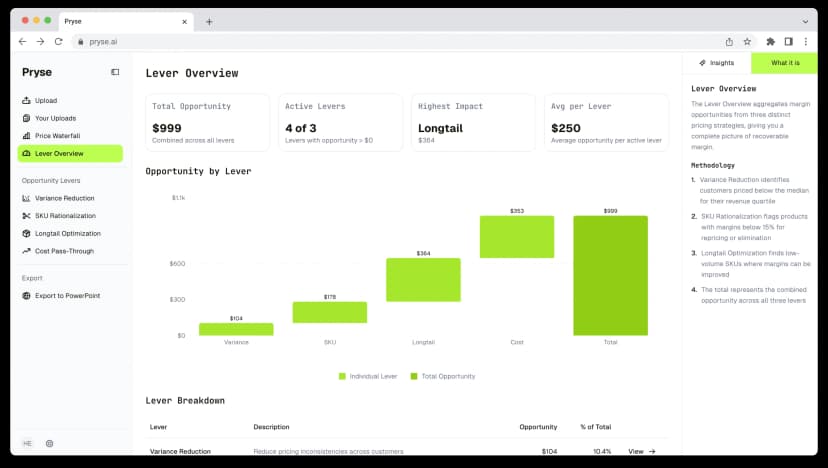
Want to analyze your entire product catalog?
Pryse automatically identifies margin leakage across thousands of SKUs. Upload your data and find hidden profit in 24 hours.
$999/year. Cancel anytime.