 Pryse
PrysePricing Consulting vs. Software: Which Is Right for Your Business?
An honest comparison of pricing consultants, pricing software, and DIY analysis. Learn which approach fits your budget, timeline, and pricing maturity.
There are three ways to improve your pricing: hire a consultant, buy software, or do it yourself. Each one works. Each one fails. The difference is whether you pick the right approach for where your business is right now.
Most mid-market distributors and manufacturers ($20M-$200M revenue) jump to the wrong option. They hire a $200K consultant when they haven't done basic margin analysis. Or they buy enterprise software when a spreadsheet would have found the same leaks. Or they stay in Excel forever because "we've always done it this way," leaving six figures in margin on the table.
This post is an honest look at all three options, including when each one makes sense and when it doesn't.
The Three Approaches to Pricing Improvement
Before comparing costs and timelines, it helps to understand what each approach actually delivers.
Pricing consultants give you strategy and organizational change. They analyze your business, interview stakeholders, benchmark against industry data, and hand you a pricing strategy with recommendations. The deliverable is a plan, not ongoing execution. According to SBI Growth Advisory's pricing audit framework, a pricing audit assesses acquisition, monetization, retention, pricing strategy, and discounts. That's the kind of work a consultant does well.
Pricing software gives you execution at scale. It takes your transaction data and applies rules, analytics, or AI to recommend prices, track margin, and flag leakage. The deliverable is an ongoing system. You still need to decide what to do with the output.
DIY analysis gives you visibility. You export data from your ERP, build spreadsheets, and analyze margins yourself. The deliverable is whatever you build. It's limited by your time, skills, and the number of SKUs you can manage manually.
Each approach solves a different problem. Mixing them up is where companies waste money.
When Consultants Make Sense
Pricing consultants earn their fees in three scenarios.
You need a pricing strategy, not just better prices. If your company has never formalized how it prices — if every sales rep sets prices differently, if there's no discount policy, if nobody knows what your target margins should be — that's a strategy problem. Software can't fix it. You need someone to design the framework first.
You need organizational change. Pricing improvements often require sales teams to change behavior. Reps who've been giving 25% discounts for years won't stop because a spreadsheet says so. Consultants bring the authority, the executive presentation, and the change management playbook to make new policies stick. An internal analyst recommending the same changes often gets ignored.
You're restructuring your pricing model. Switching from cost-plus to value-based pricing. Redesigning your customer segmentation. Rebuilding your discount waterfall. These are strategic decisions with company-wide impact. A consultant who's done it 50 times at similar companies can compress what would take you 18 months into 4 months.
Simon-Kucher's 2025 Global Pricing Study found that companies with formal pricing strategies outperform those without them. Consultants help build that formality. But the study also shows that strategy without execution delivers nothing.
When Consultants Don't Make Sense
Consultants are expensive, and the expense isn't just their fees.
A mid-market pricing engagement runs $50K-$300K over 3-6 months. Boutique pricing firms charge $150-$350/hour. Tier-one firms (McKinsey, Bain, Simon-Kucher) start at $200K+ for strategy projects. On top of fees, your team spends 200-500 hours supporting the engagement: pulling data, attending workshops, reviewing deliverables.
The real risk isn't the cost. It's the shelf. An alarming number of consulting deliverables end up in a binder that nobody opens again. The consultant leaves, the organization goes back to old habits, and the strategy collects dust.
Consultants don't make sense when:
- You haven't done basic margin analysis yet. You're paying $200K for someone to tell you what Excel could have shown you in a weekend.
- Your problem is execution, not strategy. You know what to do, you just can't do it across 15,000 SKUs manually.
- You can't commit to implementing their recommendations. If leadership won't enforce new pricing policies, don't bother hiring someone to design them.
When Software Makes Sense
Pricing software earns its ROI when you've outgrown manual analysis and need to operate pricing as a system, not a project.
You have 5,000+ SKUs and can't manage pricing in spreadsheets. At this scale, price changes, customer-specific agreements, and cost updates become unmanageable in Excel. Software automates what would take a full-time analyst weeks to do manually.
You need ongoing execution, not one-time analysis. Margin leakage isn't a one-time fix. Costs change, competitors move, customers renegotiate. Software monitors continuously and flags when prices need adjustment. A consultant visit every 6 months can't match that cadence.
You already have a pricing strategy and need a tool to enforce it. Software is an execution engine. Feed it your pricing rules, margin floors, and discount policies, and it applies them consistently. Without a strategy, software just automates bad decisions faster.
For a detailed comparison of platforms by company size, see our best pricing software buyer's guide.
When Software Doesn't Make Sense
Enterprise pricing platforms (PROS, Vendavo, Pricefx) cost $100K-$500K annually plus implementation. Mid-market tools run $20K-$100K per year. That's the sticker price. The real cost includes:
- Implementation: 3-18 months and 0.5-3x the annual subscription
- Data cleanup: 20-40% of implementation time fixing ERP data quality
- Training and change management: Getting your team to actually use it
- IT resources: 200-500 hours for enterprise integrations
A $100K annual subscription easily becomes $300K-$500K fully loaded in year one.
Software doesn't make sense when:
- You haven't quantified your margin opportunity yet. You might buy a $100K tool to recover $50K in margin.
- Your data is a mess. Pricing software amplifies data quality — garbage in, garbage out, but faster.
- Nobody will act on the recommendations. The software tells you that 40 customers are below your margin floor. If sales leadership won't have those conversations, the software is expensive reporting.
- You have under 5,000 SKUs. At this scale, the implementation cost outweighs the benefit. Simpler tools deliver the same insight.
When DIY Works
DIY pricing analysis works better than most companies expect, especially as a starting point.
You have under 5,000 SKUs. Excel can handle margin analysis, basic price waterfall visualization, and customer-level profitability at this scale. See our margin analysis in Excel guide for formulas and methods.
You've never done margin analysis before. Your first pricing win almost always comes from the basics: finding products priced below your margin floor, identifying customers who get discounts they shouldn't, and catching cost increases you never passed through. You don't need $100K in software to find those.
Your budget is constrained. For bootstrapped or cost-conscious companies, the choice isn't "consultant vs. software." It's "do something vs. do nothing." DIY means you do something.
The numbers support starting simple. McKinsey's research shows that a 1% price improvement yields an 8% operating profit improvement in B2B companies. Even basic analysis that captures half a point of margin improvement pays for itself immediately.
When DIY Breaks Down
DIY has real limits.
Scale. Beyond 5,000 SKUs, Excel becomes unwieldy. Pivot tables slow down, formulas break, and the analysis takes so long that by the time you finish, the data is stale.
Depth. Excel can show you gross margin by product. It struggles with transaction-level price waterfalls across 10,000+ line items, cost-to-serve allocation, and customer-level pocket margin analysis. The hidden margin leaks live in those details.
Consistency. DIY analysis is a project, not a process. You do it once, find some wins, implement them, and then don't do it again for 6 months. Meanwhile, new leaks develop.
Credibility. A spreadsheet built by one person in finance doesn't carry the same weight as a professional analysis when you're asking sales leadership to change discount behavior.
The Middle Path: Diagnostic First
There's a fourth option that most companies overlook: run a one-time diagnostic before committing to consultants or software.
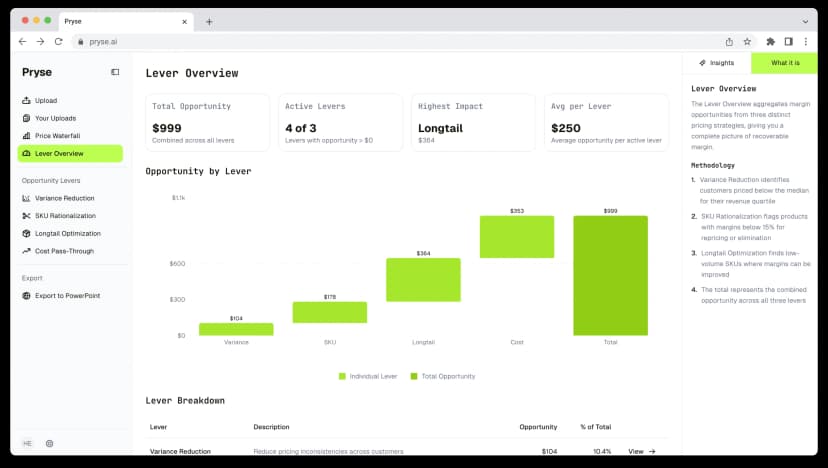
A pricing diagnostic takes your transaction data and produces professional analysis — margin by product and customer, price waterfall visualization, margin leakage sources ranked by dollar impact — without the implementation complexity or ongoing cost of a platform.
The logic is simple. Before you spend $200K on a consultant or $100K/year on software, spend $999/year to find out if you have a $50K problem or a $500K problem. The answer changes which path you take.
For most mid-market distributors, the diagnostic reveals that:
- 60-70% of margin improvement comes from fixing the top 3-5 issues (discount stacking, stale pricing, freight absorption)
- Those top issues can be fixed with targeted policy changes, not enterprise software
- The remaining 30-40% of improvement requires systematic tools, but only after the big leaks are plugged
This isn't a sales pitch for skipping software forever. It's a pitch for knowing your numbers before you buy.
Making the Decision
Here's how to think about the choice based on where you are today.
If you've never analyzed your pricing at the transaction level, start with DIY or a diagnostic. Don't buy anything yet. You need visibility before you need tools.
If you know you have margin leakage but can't quantify it, run a diagnostic. The dollar amount determines your next step. Under $100K in recoverable margin? Fix it manually. Over $100K and growing? Consider software.
If you have a pricing strategy problem — no formal policies, inconsistent discounting, no margin floors — consider a consultant. But scope the engagement tightly. You need a framework, not a 6-month study.
If you have a pricing execution problem — you know what to do but can't do it across 10,000 SKUs — that's where software delivers. Match the platform to your SKU count and complexity.
If you have both, do them in order. Strategy first (consultant or internal), then execution (software). Buying software before you have a strategy is like buying a GPS before you know where you're going.
Cost-Per-Outcome Comparison
Rather than comparing sticker prices, compare what you get per dollar spent.
Consultant ($50K-$300K): You get a pricing strategy, organizational recommendations, and executive-ready materials. The value depends entirely on implementation. If you execute 80% of recommendations, the ROI is strong. If the binder sits on a shelf, it's zero.
Software ($20K-$500K/year): You get ongoing price optimization, automated monitoring, and systematic execution. The value compounds over time as the system learns and catches new leaks. But it takes 6-18 months to see full ROI.
DIY (time only): You get basic visibility and quick wins. Limited ceiling but zero financial risk. Best for companies under 5,000 SKUs or as a precursor to bigger investments.
Diagnostic ($999/year): You get professional analysis, quantified opportunity, and a clear picture of which path makes financial sense. Best as a first step before any major investment.
The common mistake is treating these as mutually exclusive. The best path for most mid-market companies is sequential: DIY or diagnostic first, targeted fixes second, software third (if justified), consultant only if strategy redesign is needed.
What Distributors Get Wrong
Three patterns we see repeatedly in distribution and manufacturing:
Buying enterprise software too early. A $75M distributor with 8,000 SKUs doesn't need Vendavo. The implementation will take 12 months and cost more than the first two years of margin recovery. A mid-market tool or diagnostic-plus-Excel approach delivers faster ROI.
Hiring consultants for execution problems. If the issue is that your prices haven't been updated in 18 months, you don't need a $200K strategy engagement. You need someone to export the data, find the gaps, and update the price file. That's an analyst task, not a consulting project.
Staying in Excel too long. The flip side is companies that keep doing manual analysis when they've clearly outgrown it. If your pricing analyst spends 3 weeks per quarter rebuilding the same spreadsheet and still can't cover all your products, the tool has hit its limit.
The right answer isn't always the same. But the right process is: start with visibility, quantify the opportunity, then invest proportionally.
For a detailed comparison of pricing software platforms, see our best pricing software guide. For more on pricing strategy frameworks, see our pricing optimization guide.
Last updated: March 12, 2026
Frequently Asked Questions
Want to analyze your entire product catalog?
Pryse automatically identifies margin leakage across thousands of SKUs. Upload your data and find hidden profit in 24 hours.
$999/year. Cancel anytime.