 Pryse
PryseOptimized Pricing: How to Set Prices That Maximize Margin
Optimized pricing uses data to set prices that maximize margin without losing volume. Learn the process, common mistakes, and where to start.
Optimized pricing means setting the right price for every SKU-customer combination based on data, not gut feel. It's the difference between applying a blanket 35% markup across your catalog and knowing that fasteners should be at 22% because customers price-shop them, while specialty fittings can hold 48% because buyers don't compare.
Most mid-market distributors and manufacturers don't have a pricing problem. They have a pricing consistency problem. The same product sells at wildly different margins depending on which rep quoted it, which customer asked, and what day of the week it was. That inconsistency is where the money hides.
McKinsey studied 130 distributors and found that a 1% improvement in realized price translates to a 22% increase in EBITDA. For a $50M distributor running 4% EBITDA, that's $440K in annual profit from a one-percentage-point price improvement. The opportunity is real. The challenge is finding where that 1% lives in a catalog of 10,000+ SKUs.
This post explains how to move from flat-rate markups to optimized pricing, step by step, without requiring a six-figure software investment.
Why Most B2B Pricing Isn't Optimized
The typical mid-market distributor sets prices one of three ways:
-
Cost-plus markup. Take the landed cost, add 30-40%, and that's the list price. Every product gets the same treatment regardless of competitive dynamics, customer price sensitivity, or market positioning.
-
Historical pricing. The price is whatever it was last year, plus a 3-5% annual increase. No analysis of whether the increase is above or below what the market supports.
-
Sales rep discretion. The list price exists on paper, but reps negotiate individual deals based on their read of the customer. Some reps consistently discount more than others.
All three approaches leave money on the table, but in different ways.
Cost-plus overprices commodity products (where competitors set the market) and underprices specialty products (where you have pricing power). Historical pricing ignores competitive shifts and cost changes that happen between annual reviews. Sales rep discretion creates margin variance that nobody tracks or manages.
The result: most distributors have a 15-25 percentage point spread between their highest and lowest margin transactions within the same product category. That spread is the optimization opportunity.
The Optimized Pricing Process
Optimized pricing follows a repeatable process. You don't need advanced software to start — just your transaction data and a willingness to look at the numbers.
Step 1: Build Your Pricing Fact Base
Pull 12 months of transaction data from your ERP. Every invoice line with: SKU, customer, invoice price, quantity, cost, date, rep, and channel. Load it into whatever tool you have — Excel, a database, or a pricing diagnostic tool.
Calculate realized margin for every transaction. Not list margin. Not target margin. The actual margin after all discounts, rebates, freight allowances, and overrides.
This step alone is revealing. Most companies don't regularly calculate realized margin at the transaction level. They look at aggregate gross margin by product category or customer and miss the variation hiding inside those averages.
Step 2: Segment Your Catalog
Not all products behave the same way. Group your SKUs into segments based on competitive dynamics:
| Segment | Characteristics | Pricing Approach |
|---|---|---|
| Traffic drivers | High-volume commodity items customers price-shop actively | Price to market — match or beat competitors |
| Core assortment | Bread-and-butter products with moderate competition | Cost-plus with competitive guardrails |
| Specialty items | Differentiated products with limited alternatives | Value-based — price to the value you deliver |
| Tail SKUs | Low-volume items ordered infrequently | Higher margins to cover carrying costs |
Most catalogs break down roughly 15% traffic drivers, 50% core, 20% specialty, and 15% tail. The pricing strategy for each segment should be fundamentally different.
Step 3: Find Your Margin Outliers
Within each segment, identify transactions where the margin deviates significantly from the segment average. You're looking for two things:
Low-margin outliers: SKU-customer combinations selling at 10+ points below the segment average. These are your immediate recovery opportunities. Common causes include outdated customer-specific pricing, habitual discounting by specific reps, or cost increases that weren't passed through to prices.
High-margin outliers: Transactions at margins well above the segment average. These might be sustainable (the customer isn't price-sensitive) or at risk (the customer hasn't noticed yet and will eventually push back or leave). Either way, they inform your pricing ceiling.
The gap between your 25th percentile and 75th percentile margin within a segment tells you how much inconsistency exists. A 5-point gap is normal. A 15-point gap means you have significant margin leakage from inconsistent pricing.
Step 4: Set Target Price Bands
For each segment, establish a target margin range — not a single price point. This gives sales teams flexibility while preventing the extreme discounting that destroys margin.
Example for a core assortment segment:
- Floor: 28% gross margin (requires manager approval below this)
- Target: 33% gross margin (standard pricing)
- Ceiling: 38% gross margin (achievable for less price-sensitive customers)
The floor prevents the worst margin destruction. The target guides standard quoting. The ceiling ensures you're capturing value where the market supports it.
Step 5: Address the Outliers
Start with the low-margin outliers — they represent the fastest payback.
For each outlier, determine the root cause:
- Cost increase not passed through: Raise the price to restore the target margin. Customers expect prices to follow costs.
- Excessive rep discounting: Tighten discount authority. Require approval for discounts exceeding the floor.
- Outdated customer agreement: Renegotiate. A contract from 2019 doesn't reflect 2026 costs.
- Competitive pressure: If the customer has a credible lower-priced alternative, the low margin may be justified. Keep it but track it.
Don't try to fix everything at once. Prioritize by dollar impact: margin points below target multiplied by annual revenue for that SKU-customer combination.
Common Optimized Pricing Mistakes
Every company that starts optimizing prices makes at least one of these errors.
Mistake 1: Optimizing List Prices Instead of Realized Prices
Your list price is a fiction. It's the starting point for negotiation, not the price customers actually pay. Optimizing list prices while ignoring the discounts, rebates, and overrides that happen between list and invoice is like budgeting based on salary before taxes.
The metric that matters is pocket price — the actual revenue you receive after every deduction. Optimize that.
Mistake 2: Raising Prices Across the Board
A blanket 5% price increase is not optimization. It's inflation-passing. It treats your most price-sensitive commodity products the same as your differentiated specialty items.
The result: you lose volume on commodities (where competitors don't follow your increase) and leave money on the table on specialty items (where you could have gone higher). Targeted, segment-specific adjustments outperform blanket increases every time.
Mistake 3: Ignoring Sales Team Buy-In
The best pricing analysis in the world is worthless if your sales team won't implement it. Reps who've been quoting their own prices for years will resist changes to their pricing authority.
The fix: show them the data. When a rep sees that their average margin is 26% while the team average is 31%, and that the difference costs their commission $15K a year, behavior changes. Make it about their outcomes, not corporate mandates.
Mistake 4: Setting Prices Once and Walking Away
Pricing optimization isn't a project. It's a process. Costs change, competitors adjust, customer behavior shifts. If you optimize prices in Q1 and don't review until next year, you'll have a new set of outliers by Q3.
Build a quarterly review cadence at minimum. Monthly reviews for your top 500 SKUs by revenue are even better.
Measuring Optimized Pricing Results
Track three metrics to know if your optimization is working.
Metric 1: Margin improvement by segment. Compare average realized margin before and after optimization within each product segment. Expect 1-3 percentage points of improvement in the first 6 months from fixing outliers.
Metric 2: Price realization rate. What percentage of your target price do you actually collect? If your target is $100 and average invoice price is $92, your realization rate is 92%. This metric captures discounting behavior over time.
Metric 3: Revenue retention. Raising prices on underpriced products should be mostly volume-neutral if done correctly — targeting the right products by the right amounts. If volume drops more than 2-3% on a price-adjusted product, you may have misjudged the customer's price sensitivity.
Don't measure success solely by gross margin percentage. A company that raises prices and loses 15% of revenue hasn't optimized — it's just shrunk. The goal is more margin dollars, not just a higher margin rate.
Where to Start With a Small Team
If you're a pricing manager or controller at a $30M-$150M distributor, you probably don't have a dedicated pricing team. Here's a practical starting sequence.
Week 1: Export and clean your data. Pull 12 months of invoice-level data from your ERP. Clean up cost data — landed costs, not just purchase prices. Upload it to a diagnostic tool or build an analysis workbook.
Week 2: Identify your top 20 opportunities. Sort by dollar impact — margin gap multiplied by revenue. Focus on the 20 SKU-customer combinations where fixing the margin outlier delivers the biggest payback.
Week 3: Get sales team alignment. Share the data with your sales manager. Discuss which of the 20 opportunities are implementable (price increases the customer will accept) versus strategic (low margin justified by relationship or competitive dynamics).
Week 4: Implement and track. Raise prices on the agreed-upon opportunities. Set a 90-day review to measure volume impact and margin improvement.
This process repeats quarterly, working through your catalog segment by segment. Each cycle captures more margin. After a year, you'll have a clear picture of whether ongoing optimization software would earn its keep.
Optimized Pricing vs. Perfect Pricing
Perfect pricing doesn't exist. Every price is a trade-off between margin and volume, short-term revenue and long-term customer retention, competitive positioning and profitability.
Optimized pricing doesn't chase perfection. It chases consistency — making sure every transaction falls within a defensible range based on your data. When your worst-margin transactions improve from 15% to 25%, and your best-margin transactions hold steady at 45%, the aggregate impact on your P&L is significant even though no individual price is "perfect."
For mid-market companies running on Excel and ERP price lists, the gap between current pricing and optimized pricing is usually 1-3% of revenue. On $50M in sales, that's $500K-$1.5M in annual margin improvement. Not from working harder or selling more — just from pricing what you already sell more consistently.
Start with a diagnostic to see where you stand. The numbers will tell you exactly how much opportunity exists and where to focus first.
Last updated: March 12, 2026
Frequently Asked Questions
Want to analyze your entire product catalog?
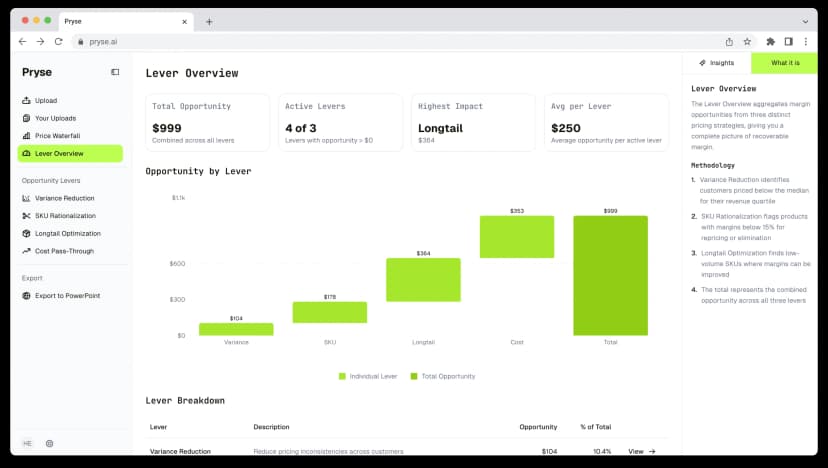
Pryse automatically identifies margin leakage across thousands of SKUs. Upload your data and find hidden profit in 24 hours.
$999/year. Cancel anytime.