 Pryse
PryseTop 7 Simon-Kucher Alternatives for Pricing Strategy (2026)
Looking beyond Simon-Kucher for pricing help? We compare 7 alternatives from boutique consultancies to self-serve tools for B2B companies.
If you are researching Simon-Kucher alternatives, you are probably dealing with one of two situations: you know you have a pricing problem but the budget for a top-tier consulting engagement does not fit, or you have already talked to Simon-Kucher and want to compare your options before signing.
Both are reasonable. Simon-Kucher is widely regarded as the leading pricing consultancy in the world — their expertise is real. But not every company needs a full-scale engagement from a 2,000-person global firm. Sometimes a more focused, faster, or more affordable option makes better sense.
This page covers seven alternatives worth considering, ranging from other global consultancies to boutique pricing firms to self-serve diagnostic tools.
Why Companies Look for Simon-Kucher Alternatives
Simon-Kucher has been the go-to pricing consultancy for four decades. Their 2025 Global Pricing Study surveyed more than 2,200 business leaders across 28 countries, and they have deep expertise across 120+ industries. That kind of breadth and depth is hard to match.
So why look elsewhere?
Budget. Simon-Kucher operates at premium consulting rates. For Fortune 500 companies, that investment often pays for itself many times over. For mid-market companies — particularly those in the $20M-$200M revenue range — the math can be harder to justify, especially for a first pricing project.
Timeline. Consulting engagements take time. Between discovery, analysis, recommendation development, and presentation, even a focused project can stretch across months. Companies that need to act fast may want something quicker.
Scope mismatch. If you already know your pricing is leaking margin and just need to quantify where, a full strategic engagement may be more than you need. A diagnostic or focused analysis might deliver 80% of the value at a fraction of the cost.
Industry specificity. While Simon-Kucher covers many industries, some companies prefer a consultant who works exclusively in their sector — particularly in industrial distribution or manufacturing where the pricing dynamics are quite specific.
1. Bain & Company — Pricing Practice
Bain is a top-three management consultancy with a well-established pricing practice. They have completed over 1,500 pricing projects in the last decade and bring a strong analytical toolkit to the table.
What it is: Bain's pricing team helps companies diagnose pricing performance, develop pricing strategy, and implement new pricing models. They have a proprietary B2B Pricing Database that benchmarks anonymized industry data on pricing KPIs.
Who it is for: Large enterprises ($500M+ revenue) that want pricing advice bundled with broader strategic consulting. Bain often works with companies going through transformations where pricing is one piece of a larger growth strategy.
Key strengths: Global reach, deep analytical capabilities, proprietary B2B pricing benchmarks, and the ability to connect pricing work with broader commercial strategy. Bain has also partnered with Pricefx to offer prepackaged software solutions alongside their consulting.
Key weaknesses: Like Simon-Kucher, Bain operates at premium consulting rates. Their pricing practice is part of a broader firm — pricing is not their only focus, so you may get a generalist team rather than dedicated pricing specialists. Engagement timelines tend to be measured in months.
Pricing model: Custom engagement pricing, not publicly disclosed. Typical of top-tier management consulting.
Best for: Large companies that want pricing strategy as part of a wider commercial transformation.
2. INSIGHT2PROFIT
INSIGHT2PROFIT is a pricing consulting and technology firm founded in 2006 that focuses specifically on pricing and profitability. They combine consulting services with proprietary AI-powered analytics platforms.
What it is: A dedicated pricing consultancy that offers strategic pricing consulting, pricing analytics, and implementation services. They have completed 800+ engagements and employ 250+ pricing specialists.
Who it is for: Mid-market to large B2B companies that want a dedicated pricing partner rather than a general management consultancy. INSIGHT2PROFIT works with both Fortune 500 enterprises and mid-market companies.
Key strengths: Pure pricing focus (not a generalist consultancy), strong track record (10 consecutive years on the Inc. 5000 list), proprietary technology for price elasticity modeling and opportunity identification, and they stay through implementation rather than just delivering recommendations.
Key weaknesses: Smaller global footprint than Simon-Kucher, which matters for multinational engagements. Less brand recognition in executive circles. Engagement timelines can still stretch across several months.
Pricing model: Custom engagement pricing based on scope and complexity. Not publicly disclosed.
Best for: B2B companies that want dedicated pricing expertise with a blend of consulting and technology, and prefer a mid-size firm over a global consultancy.
3. SPARXiQ
SPARXiQ is a pricing and sales analytics firm that has been working specifically with distributors and manufacturers for over 30 years. Founded in 1993, they are one of the pioneers in B2B price optimization for industrial companies.
What it is: SPARXiQ combines pricing analytics software (PriceGPS) with consulting services and sales training, all focused on the distribution and manufacturing sectors. Their tools integrate directly with major ERPs including Epicor, Infor, SAP, and Oracle.
Who it is for: Industrial distributors and manufacturers who want pricing guidance that plugs into their existing ERP systems. SPARXiQ understands the specific dynamics of distribution pricing — cost-plus habits, override cultures, and branch-level inconsistencies.
Key strengths: Deep distribution and manufacturing expertise (30 years in the sector), ERP-native pricing guidance through PriceGPS, Profit Diamond framework for profitability analysis, and sales training that helps reps hold pricing. Claims to help clients increase gross margin by 2-4%.
Key weaknesses: Narrow industry focus — if you are not in distribution or manufacturing, this is not for you. Less suited for companies that need broad pricing strategy work (new market entry, monetization model design). Technology is ERP-dependent.
Pricing model: Combination of software licensing and consulting fees. Not publicly disclosed.
Best for: Industrial distributors and manufacturers that want a long-term pricing partner with deep sector knowledge and ERP integration.
4. McKinsey & Company — Pricing Practice
McKinsey hardly needs an introduction. Their pricing work spans decades, and their research — including the widely cited "1% price improvement = 8% operating profit increase" finding — has shaped how executives think about pricing.
What it is: McKinsey's pricing practice sits within their broader marketing and sales function. They help companies design pricing architectures, build organizational pricing capabilities, and implement pricing transformations. Their approach tends to be top-down and strategy-focused.
Who it is for: The largest enterprises — typically $1B+ revenue — that need pricing woven into a broader strategic initiative. McKinsey pricing engagements often connect to growth strategy, cost transformation, or digital commerce projects.
Key strengths: Unmatched brand prestige (useful for getting board-level buy-in), strong research foundation, ability to staff large global teams, and deep connections across C-suites. Their 2019 distribution pricing study (analyzing 130 distributors) remains one of the most cited works in the industry.
Key weaknesses: The highest price point on this list. Pricing is a fraction of what McKinsey does, so team expertise can vary. Recommendations may be strategic and high-level rather than hands-on and implementable. Engagement timelines are long.
Pricing model: Premium engagement pricing. Not publicly disclosed.
Best for: Very large companies that need pricing as part of a major strategic initiative and value the McKinsey brand for internal alignment.
5. Pryse
Pryse is a self-serve pricing diagnostic tool built specifically for mid-market distributors and manufacturers. Full disclosure: this is our product. We include it here because it solves a genuinely different problem than the other options on this list.
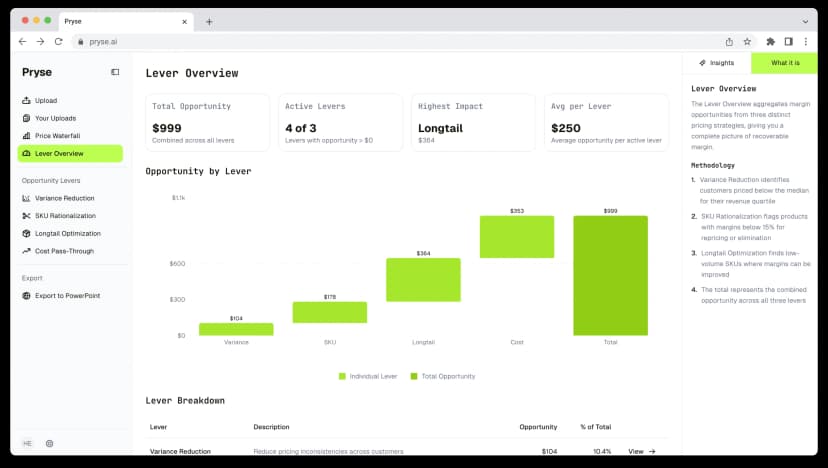
What it is: A diagnostic that takes your transaction data (CSV upload), runs it through price waterfall analysis, identifies margin leakage patterns, and quantifies the dollar opportunity. Results come back within 24 hours. No consultants, no implementation.
Who it is for: Mid-market distribution and manufacturing companies ($20M-$200M revenue) that know pricing is an issue but are not ready to commit to a six-figure consulting engagement. Companies currently managing pricing in Excel or basic ERP systems.
Key strengths: Speed (24-hour turnaround vs. months), $999/year (vs. open-ended consulting fees), self-serve (no meetings, no discovery phase), and specific to the distribution/manufacturing pricing problems we see most — margin leakage, inconsistent discounting, and cost-plus pricing gaps.
Key weaknesses: Not a strategy engagement — you get a diagnostic, not a pricing strategy. No ongoing advisory relationship. Does not replace the depth of a full consulting engagement. Limited to companies that can export transaction data as CSV.
Pricing model: $999/year.
Best for: Mid-market distributors and manufacturers that want to quantify their pricing opportunity before deciding whether to invest in consulting, software, or internal capability building.
6. L.E.K. Consulting
L.E.K. is a global strategy consulting firm with particular strength in pricing strategy for specialty industries including healthcare, industrials, and technology.
What it is: L.E.K.'s pricing and revenue management practice helps companies design and implement pricing strategies. They tend to be strong in situations involving complex deal structures, contract pricing, and value-based pricing for differentiated products.
Who it is for: Mid-size to large companies that need pricing strategy work with strong quantitative rigor. L.E.K. is particularly well-regarded in life sciences, specialty chemicals, and technology — sectors where value-based pricing arguments are critical.
Key strengths: Strong analytical and quantitative approach, good depth in specialty sectors, more accessible than McKinsey/Bain for mid-large companies, and a reputation for practical recommendations that translate to implementation.
Key weaknesses: Smaller than Simon-Kucher's dedicated pricing practice, less depth in commodity distribution and manufacturing pricing, and still operates at premium consulting rates (though typically below the Big Three).
Pricing model: Custom engagement pricing. Not publicly disclosed.
Best for: Companies with complex pricing structures (value-based, contract-heavy) that need rigorous analytical support and are in sectors like healthcare, chemicals, or technology.
7. Revenue Management Solutions (RMS)
RMS is a specialized analytics and consulting firm that focuses on pricing and revenue optimization, particularly for companies with large transaction volumes and complex pricing structures.
What it is: RMS combines consulting expertise with proprietary analytics tools to help companies optimize pricing across products, channels, and customer segments. They are known for bringing a data-driven, quantitative approach to pricing problems.
Who it is for: Companies with large transaction datasets that need analytics-heavy pricing support. RMS works across several B2B and B2C sectors and tends to focus on the intersection of pricing strategy and data science.
Key strengths: Strong quantitative and data science capabilities, proprietary analytics tools, a good bridge between pure consulting and pure software, and a focus on measurable outcomes.
Key weaknesses: Smaller brand recognition compared to the global consultancies, more limited industry coverage, and less suited for companies that need broad commercial strategy beyond pricing.
Pricing model: Custom engagement pricing. Not publicly disclosed.
Best for: Data-rich companies that want a quantitatively rigorous approach to pricing optimization with a blend of consulting and analytics.
How to Choose the Right Alternative
The right Simon-Kucher alternative depends on where you are in your pricing maturity and what you actually need.
If you need broad pricing strategy for a large organization, Bain, McKinsey, or L.E.K. will give you a similar caliber of strategic advice with different flavors. Bain brings the strongest dedicated pricing benchmarks. McKinsey brings the brand. L.E.K. brings quantitative depth at a (relatively) more accessible price point.
If you want a dedicated pricing firm, INSIGHT2PROFIT gives you specialists who do nothing but pricing, with 250+ people focused on it. They are a good middle ground between the prestige of a global consultancy and the specialization you may actually need.
If you are in industrial distribution or manufacturing, SPARXiQ has 30 years of sector-specific pricing experience and tools that integrate with your ERP. That kind of domain depth is hard to replicate with a generalist firm.
If you need a fast, affordable starting point, Pryse gives you a quantified diagnostic in 24 hours for a fixed price. It is not a replacement for consulting — it is a way to understand your opportunity before you decide how to pursue it.
If you need analytics-driven pricing optimization, RMS combines consulting with proprietary data science tools for companies that have the transaction data to support it.
The honest answer is that Simon-Kucher is excellent at what they do. If you are a large company with a significant pricing challenge and the budget to match, they remain the gold standard. The alternatives on this list serve companies where the fit — whether due to budget, timeline, industry focus, or scope — points in a different direction.
Last updated: March 12, 2026
Frequently Asked Questions
Want to analyze your entire product catalog?
Pryse automatically identifies margin leakage across thousands of SKUs. Upload your data and find hidden profit in 24 hours.
$999/year. Cancel anytime.