 Pryse
PrysePricing Assessment: A Step-by-Step Guide for Distribution Companies
How to assess your pricing effectiveness across strategy, execution, and governance. A practical framework with specific metrics and action steps for distributors.
A pricing assessment tells you something a margin report can't: not just where you stand, but why you're there and what's holding you back.
Most mid-market distributors can tell you their overall gross margin. Fewer can tell you their realized pocket margin by customer segment. Almost none can tell you whether their pricing process — the strategy, execution, and governance behind those numbers — is actually working as intended.
That's what an assessment reveals. It looks at the machinery of pricing, not just the output. And for companies where pricing has been managed informally — a markup in the ERP, discretion for the sales team, annual reviews when someone remembers — the assessment usually surfaces significant structural gaps alongside the margin ones.
The Three Pillars of a Pricing Assessment
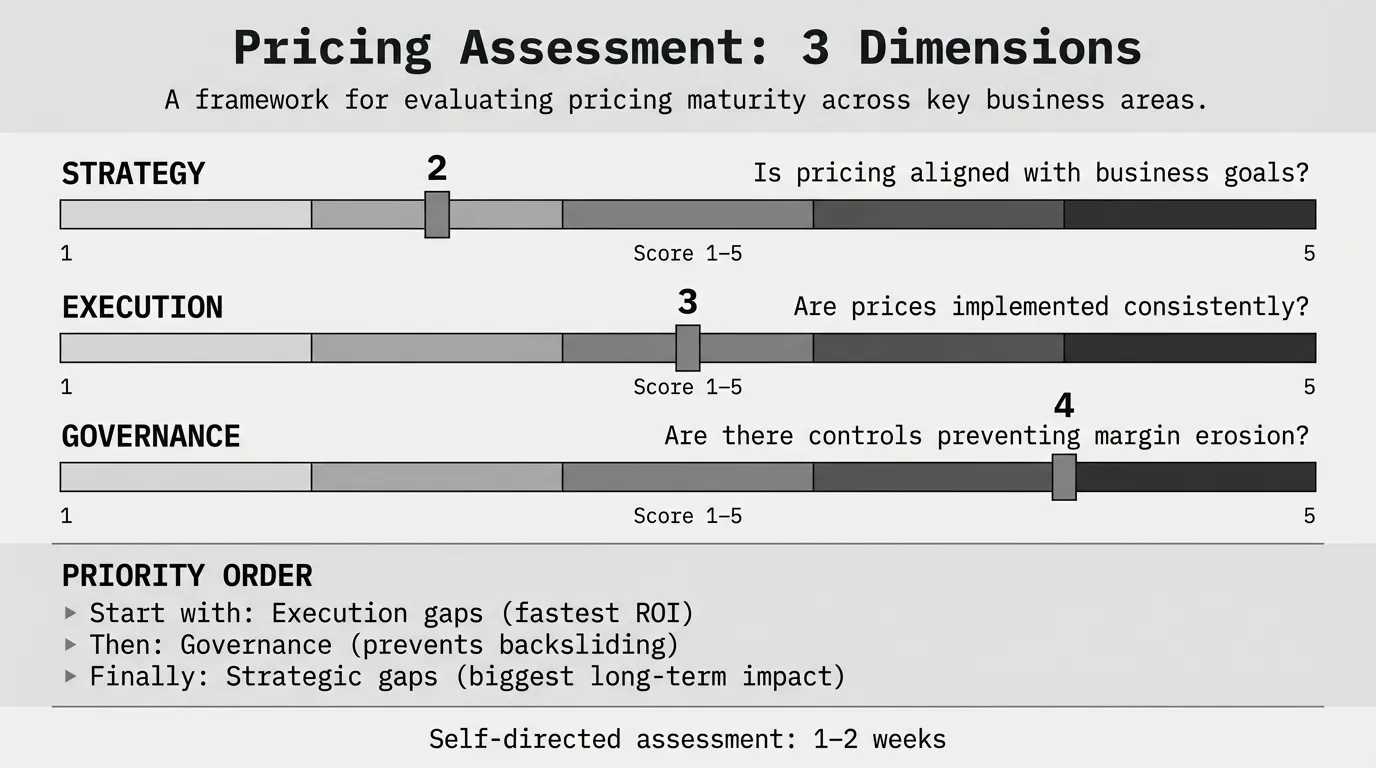
A pricing assessment evaluates three distinct dimensions. Each pillar matters independently, and weakness in any one undermines the others.
Pillar 1: Strategy
Does your pricing approach match your market position, customer segments, and product portfolio?
What to evaluate:
-
Pricing methodology alignment. Are you using the right pricing approach for each product category? Cost-plus for commodities, value-based for specialty items, competitive for high-visibility products? Or are you applying a single markup across the board?
-
Segmentation maturity. Do you differentiate pricing by customer value, product category, and competitive intensity? Or does every customer and every product get the same treatment?
-
Market positioning clarity. Can you articulate where you price relative to the market for each major category? If the answer is "we don't really know," the strategy pillar is weak.
Scoring criteria:
| Score | Strategy Maturity |
|---|---|
| 1 | No defined pricing strategy. Prices set by cost + fixed markup |
| 2 | General strategy exists but not segmented. One approach for all products/customers |
| 3 | Strategy segmented by product category. Customer segmentation is informal |
| 4 | Strategy segmented by product and customer. Clear methodology per segment |
| 5 | Dynamic strategy that adapts to market conditions, cost changes, and competitive moves |
Pillar 2: Execution
Are prices being implemented as your strategy intends? The gap between strategy and execution is where most mid-market companies lose margin.
What to evaluate:
-
Price realization rate. What percentage of your target price actually gets invoiced? If your target is 30% margin and you're realizing 24%, execution is the problem.
-
Discount governance. Who can discount, by how much, and under what circumstances? Are those rules documented and enforced, or are they informal guidelines that get bent daily?
-
Price update frequency. When costs change, how quickly do your selling prices adjust? A 90-day lag in a volatile cost environment is a significant margin leak.
-
Override patterns. What percentage of transactions involve a price override? What's the average override depth? Which reps or regions override most frequently?
Scoring criteria:
| Score | Execution Maturity |
|---|---|
| 1 | No price controls. Reps set prices independently. No override tracking |
| 2 | Basic price lists exist but overrides are common (>50% of transactions). No approval workflow |
| 3 | Price lists maintained. Discount thresholds defined. Overrides tracked but not actively managed |
| 4 | Structured approval workflows. Override rates below 25%. Monthly reporting on price realization |
| 5 | Real-time price guidance. Automated guardrails. Override rates below 15% with documented justification |
Pillar 3: Governance
Do you have the processes, tools, and organizational structure to sustain pricing discipline over time?
What to evaluate:
-
Pricing ownership. Is there a named person or team responsible for pricing? At many mid-market distributors, pricing falls between the CFO, VP of Sales, and product management — and nobody truly owns it.
-
Review cadence. How often are prices formally reviewed? Monthly? Quarterly? Annually? "When someone complains"?
-
Data infrastructure. Can you pull realized margin by segment on demand, or does it take a week to assemble a report from multiple systems?
-
Performance metrics. Are pricing KPIs defined, tracked, and reviewed by leadership? Or is margin something you check when the monthly P&L comes out?
Scoring criteria:
| Score | Governance Maturity |
|---|---|
| 1 | No pricing ownership. No regular reviews. No KPIs beyond top-line margin |
| 2 | Informal pricing ownership (shared between finance and sales). Annual reviews |
| 3 | Named pricing responsibility. Quarterly reviews. Basic KPI tracking |
| 4 | Dedicated pricing function. Monthly reviews. Dashboard with real-time KPIs |
| 5 | Pricing center of excellence. Weekly operational reviews. Predictive analytics |
Running the Assessment: A Practical Process
Week 1: Gather Data and Interview Stakeholders
Data collection (2-3 days):
Pull the same transaction data you'd use for a pricing diagnostic — 12 months of transactions with product, customer, price, cost, and discount fields. Calculate:
- Overall realized margin (pocket, not list)
- Margin by product category
- Margin by customer tier
- Discount frequency and average depth
- Price variance by SKU within segments
Stakeholder interviews (2-3 days):
Interview 4-6 people across functions. Keep the questions consistent:
- How do we decide what to charge for a product? (Tests strategy awareness)
- What happens when a customer asks for a lower price? (Tests execution process)
- How often do we review our prices? (Tests governance cadence)
- What pricing data do you have access to? (Tests data infrastructure)
- What's the single biggest pricing problem we have? (Tests organizational alignment)
The divergence in answers is as revealing as the answers themselves. If the CFO says "we have a defined pricing strategy" and the VP of Sales says "reps figure it out deal by deal," that gap is the finding.
Week 2: Score, Analyze, and Build the Action Plan
Score each pillar (Day 1):
Using the criteria above, assign a 1-5 score to each dimension. Be honest — there's no value in inflating the scores. The whole point is to identify gaps.
Map the findings (Day 2-3):
Most mid-market distributors land in a predictable pattern:
- Strategy: 2-3. A general approach exists but it's not consistently segmented by product-customer combination.
- Execution: 1-2. Prices exist on paper but override rates are high and discount governance is informal. This is where the most margin bleeds.
- Governance: 1-2. Nobody owns pricing as their primary responsibility. Reviews happen when triggered by events (cost increases, lost deals), not on a defined cadence.
If your scores match that pattern, you're normal. You're also leaving money on the table. SPARXiQ's research shows the difference between average (4% EBITDA) and top-quartile (8-12% EBITDA) distributors maps almost directly to their pricing execution and governance maturity.
Build the 90-day action plan (Day 4-5):
Prioritize improvements by sequencing them correctly:
First 30 days — Fix execution gaps. These have the fastest payback. Implement discount approval thresholds. Reprice the SKUs where the diagnostic shows the widest gap between current and target. Set up basic override tracking. These moves recover margin immediately.
Days 30-60 — Build governance foundations. Assign pricing ownership, even if it's adding the responsibility to an existing role. Establish a monthly pricing review meeting with sales and finance. Define the 3-5 KPIs you'll track. This prevents backsliding on execution improvements.
Days 60-90 — Address strategic gaps. Develop product-customer segmentation if you don't have one. Assign pricing methodologies by segment. Set target margins by cell. This is the structural work that unlocks the larger, sustained improvements.
What Good Assessment Results Look Like
For a mid-market distributor ($20M-$200M revenue), here's what "good" looks like at each pillar:
Strategy (Score 4): You have a defined pricing methodology for each major product-customer segment. You know where you price relative to market. You review and adjust the strategy quarterly based on market conditions and financial results.
Execution (Score 3-4): Override rates are below 25%. Discount approval thresholds are defined, documented, and enforced. Prices update within 30 days of cost changes. You can report realized margin by segment on demand.
Governance (Score 3): Someone owns pricing. Reviews happen monthly. KPIs are tracked and shared with leadership. The pricing process is documented, and new hires are trained on it.
You don't need a score of 5 everywhere. A score of 5 implies a dedicated pricing team with real-time analytics — that's enterprise-level capability that most mid-market companies don't need. A consistent 3-4 across all three pillars puts you in the top quartile of mid-market distributors and typically corresponds to the 8-12% EBITDA range that SPARXiQ identifies as elite performance.
Common Assessment Findings
After seeing assessments across dozens of mid-market distributors, these patterns recur:
Finding #1: Strategy exists, execution doesn't. Leadership can articulate a pricing philosophy. But when you trace an actual quote from request to invoice, the philosophy isn't reflected. Reps quote what they think will win the deal, not what the strategy prescribes.
Finding #2: Governance is the weakest pillar. Almost always. Strategy gets attention because it's interesting. Execution gets attention because it touches revenue. Governance — the process, reviews, metrics, and accountability — is the unglamorous work that nobody champions. It's also the pillar that determines whether improvements stick.
Finding #3: Data infrastructure gaps block everything. Companies that can't report realized margin by segment can't manage pricing effectively. If it takes two weeks to assemble a basic pricing report, you can't make timely decisions. The assessment often reveals that the first investment should be in reporting capability, not pricing strategy.
Finding #4: The sales-pricing tension is unresolved. Sales teams want flexibility to close deals. Pricing strategy requires discipline. At most mid-market companies, sales wins every conflict because the governance structure doesn't provide escalation paths or clear authority. The assessment should name this tension and propose a resolution.
Turning Assessment into Improvement
The assessment is the map. The diagnostic — running a margin leakage analysis on your transaction data — fills in the specific dollar amounts. Together, they give you both the structural roadmap and the financial business case.
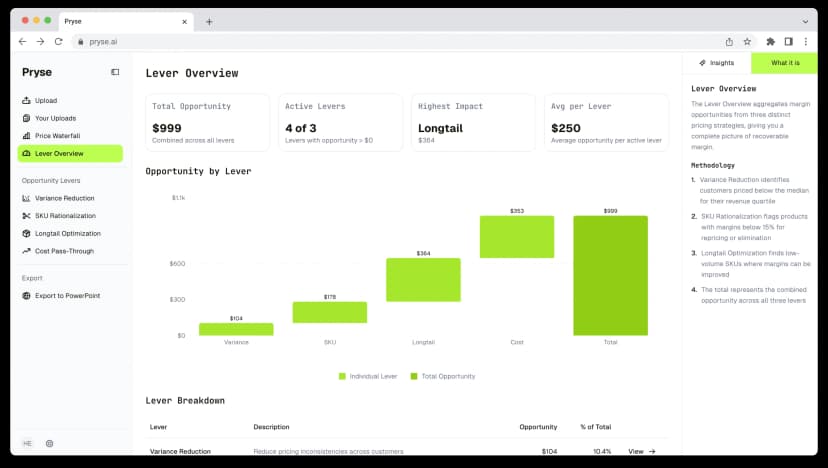
Pryse handles the diagnostic portion: upload a CSV of transaction data and get a price waterfall, margin scatter, and dollar-prioritized opportunity list in 24 hours. That data, combined with the assessment framework above, produces a complete picture of where you stand and where to go.
For the maturity model that extends this assessment into a multi-year progression framework, see our pricing maturity model. For the compliance-focused audit perspective, see our pricing audit guide.
Last updated: March 12, 2026
Frequently Asked Questions
Want to analyze your entire product catalog?
Pryse automatically identifies margin leakage across thousands of SKUs. Upload your data and find hidden profit in 24 hours.
$999/year. Cancel anytime.