 Pryse
PryseSimon-Kucher Pricing: What You Get, What It Costs, and Whether It's Right for Mid-Market
An honest breakdown of Simon-Kucher's pricing consulting: what the engagement looks like, typical costs, strengths, and where mid-market distributors should look elsewhere.
Simon-Kucher & Partners is the most recognized name in pricing consulting. Founded in 1985 in Bonn, Germany, they've grown to over 1,700 employees across 40+ offices worldwide. Their client list reads like the Fortune 500. They've worked on pricing for companies in every industry you can name.
But here's the question nobody asks publicly: is their model built for you? If you're a $50M distributor or a $120M manufacturer running pricing out of Excel, does a Simon-Kucher engagement make financial sense?
This is an honest editorial analysis. Simon-Kucher does excellent work in the right context. The question is whether that context matches mid-market distribution and manufacturing.
Quick comparison: For a structured side-by-side of Pryse and Simon-Kucher, see our Pryse vs Simon-Kucher comparison page.
What a Simon-Kucher Engagement Actually Looks Like
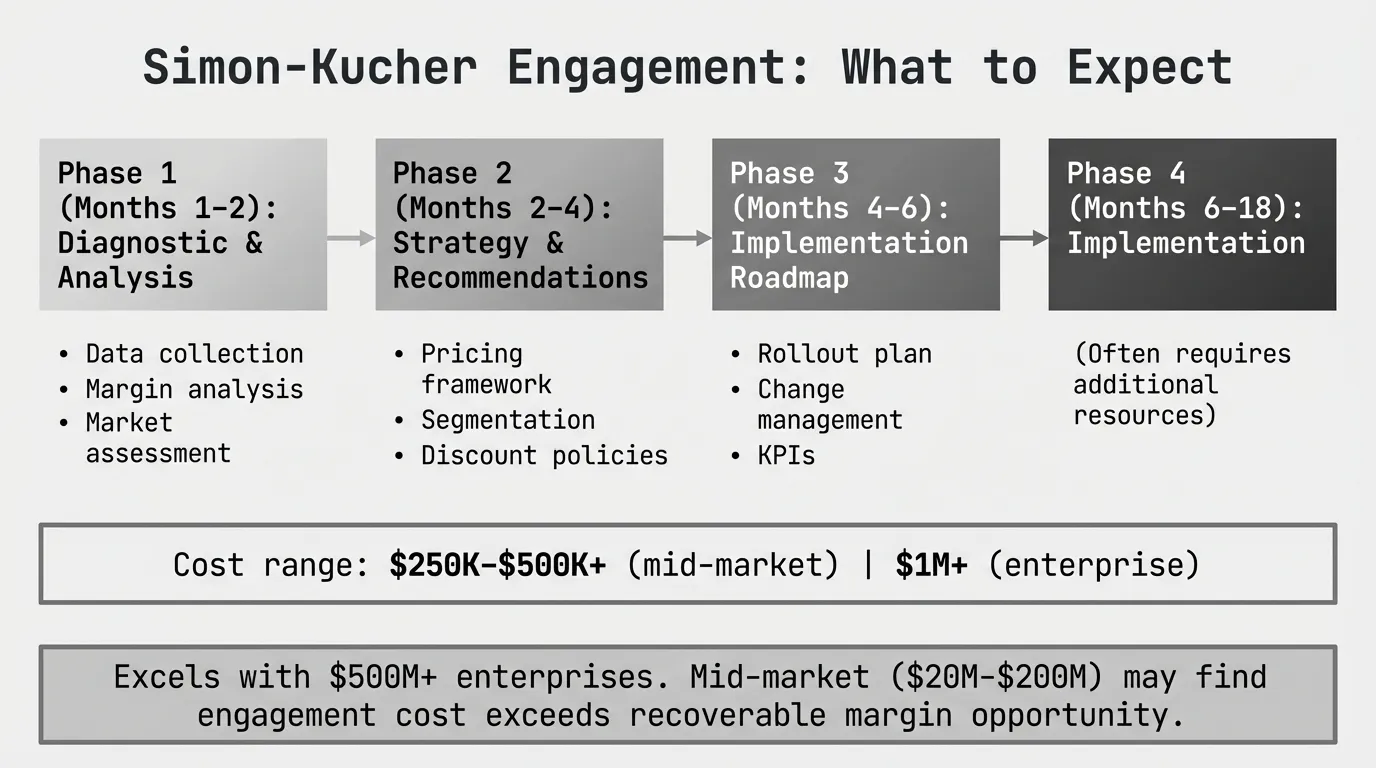
A typical Simon-Kucher pricing project follows a well-defined arc. Their methodology has been refined over nearly four decades, and it shows.
Phase 1: Discovery and Diagnostics (Weeks 1-4)
The team — usually a partner, a project manager, and 2-3 consultants — interviews stakeholders across your organization. Sales leadership, product management, finance, operations. They pull transaction data, analyze your current pricing structure, and benchmark it against their proprietary industry database.
This phase produces a "current state" assessment: where your pricing stands, where margin leaks, and how your realized prices compare to what the market could support.
Phase 2: Strategy Development (Weeks 5-10)
Based on the diagnostic, they develop a pricing strategy recommendation. This typically includes market segmentation, willingness-to-pay analysis (often using conjoint analysis or Van Westendorp surveys), and a proposed pricing architecture — the structure of price lists, discount rules, and approval workflows.
For distribution companies, this phase often centers on moving from flat cost-plus markups to segmented pricing by product-customer combination. It's the right move. The question is whether you need a consulting team to tell you that.
Phase 3: Implementation Planning (Weeks 11-16)
The final phase translates strategy into an operational plan. New price lists, updated discount guardrails, training materials for the sales team, and a rollout timeline. Some engagements include hands-on implementation support, which extends the timeline to 6+ months.
Where Simon-Kucher Genuinely Excels
Credit where it's due. There are things Simon-Kucher does that no software tool or internal team can easily replicate.
Willingness-to-pay research. Their conjoint analysis methodology is rigorous. When you need to understand what customers will actually pay — not what your sales team thinks they'll pay — this kind of primary research is valuable. It's especially relevant for new product launches, market entry decisions, and major pricing architecture changes.
Organizational change management. Most pricing transformations fail not because the strategy was wrong but because the sales team didn't follow it. Simon-Kucher has decades of experience navigating the politics of pricing change inside large organizations. They know how to get a VP of Sales to champion new pricing instead of quietly undermining it.
Industry benchmarking database. After thousands of engagements, they have proprietary data on pricing structures, margin profiles, and willingness-to-pay across industries. No public dataset comes close. When a partner says "companies in your segment typically achieve 28-32% gross margin on this product category," that claim is backed by real data.
Cross-functional alignment. A pricing project touches sales, finance, marketing, product, and operations. An external team with a clear mandate from the CEO can align these functions in ways that internal champions often can't.
The Honest Constraints for Mid-Market Companies
Here's where the picture gets more complicated for distributors and manufacturers in the $20M-$200M range.
The cost math is hard to make work. Simon-Kucher engagements for mid-market companies typically run $250K-$500K. For a $75M distributor running 4% EBITDA (which is the SPARXiQ-documented average for distributors), that's $3M in annual profit. The consulting fee represents 8-17% of your total annual profit. Even if the engagement recovers 2 points of margin ($1.5M annually), you're spending $250K-$500K to find it, plus 3-6 months of internal time.
The timeline doesn't match the urgency. Mid-market companies don't have 6-12 months to wait for pricing improvements. Margins are tight today. Competitors are quoting aggressively this quarter. A 16-week engagement before recommendations even start rolling out is a long time to wait when you're leaving money on the table every day.
The deliverables assume resources you may not have. A Simon-Kucher engagement produces a detailed pricing architecture and implementation roadmap. Executing that roadmap requires a pricing manager, data analytics capability, and often new software. Many mid-market companies don't have a dedicated pricing function at all — the CFO and VP of Sales split the responsibility. The gap between "great recommendation" and "operational reality" can be wide.
The diagnostic is the expensive part. Here's what mid-market companies often discover: the diagnostic phase — analyzing transaction data, identifying margin leakage, quantifying the opportunity — represents the highest ROI portion of the engagement. The strategy and implementation phases build on that foundation. But the diagnostic itself, the part that shows you where money is hiding, can be done faster and cheaper with the right tooling.
A Day-in-the-Life Comparison: Two Workflows
To make this concrete, let's trace how a $60M industrial distributor might approach the same pricing problem through two different workflows.
The consulting workflow:
Week 1-2: Scoping calls, contract negotiation, NDA execution. Assign an internal project sponsor. Schedule stakeholder interviews. Begin data extraction from ERP.
Week 3-4: Consultant team on-site. Interviews with 15-20 stakeholders. Transaction data analysis begins. Initial findings presented to steering committee.
Week 6-8: Segmentation model developed. Willingness-to-pay research designed and fielded (if included). Competitive benchmarking against proprietary database.
Week 10-12: Draft strategy presentation. Feedback loops with leadership. Revised recommendations.
Week 14-16: Final deliverable. Implementation roadmap. Training design.
Week 17+: Implementation begins. First price changes hit the market.
The self-serve diagnostic workflow:
Day 1: Export 12 months of transaction data from ERP. Upload CSV to Pryse.
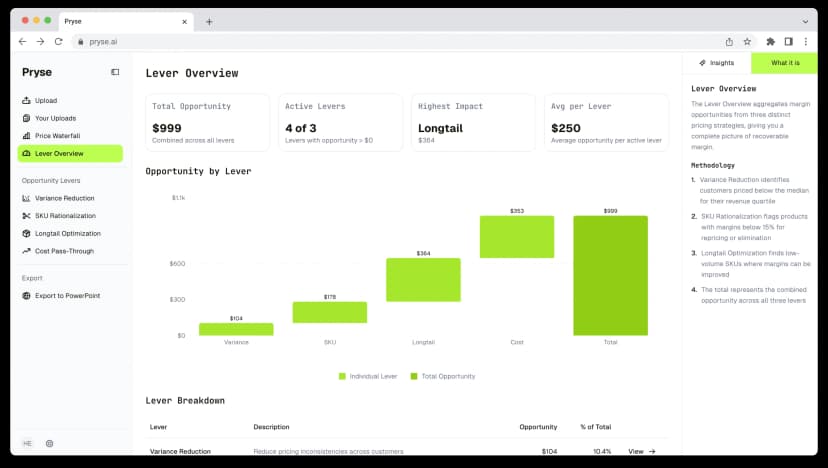
Day 2: Receive margin leakage analysis. Price waterfall visualization showing where margin goes between list price and pocket price. Top leakage sources quantified in dollars.
Day 3-5: Review findings. Identify the 20% of SKU-customer combinations driving 80% of the leakage. Build action plan for the highest-dollar items first.
Week 2: Begin repricing. Start with the low-risk, high-impact changes — products where you're significantly below market and customers have low price sensitivity.
The second workflow won't produce a willingness-to-pay study or an organizational change management plan. It won't align your executive team around a three-year pricing vision. But it will show you where the money is hiding, and it'll do it in days instead of months.
When Simon-Kucher Is the Right Call
I want to be clear: there are situations where hiring Simon-Kucher (or a comparable firm like McKinsey's pricing practice, L.E.K., or Bain) makes perfect sense.
You're above $500M in revenue and pricing changes affect thousands of SKUs across multiple business units, geographies, and channels. The complexity warrants a dedicated team.
You need organizational transformation, not just new prices. If the core problem is that your sales team has full pricing authority with no guardrails, and leadership hasn't been able to change that dynamic internally, an external firm with CEO backing can move the needle.
You're entering a new market or launching a major product line. Primary market research — willingness-to-pay studies, competitive intelligence gathering, pricing architecture design from scratch — is genuinely hard to do internally. This is where consulting expertise earns its fee.
You've already identified the margin opportunity and need help capturing it. If you've run the diagnostic and know you're leaving $3M on the table, but the organizational and technical barriers to capturing it require expert guidance, that's a good use of consulting spend.
When a Different Approach Makes More Sense
For many mid-market distributors and manufacturers, the highest-ROI first step isn't a consulting engagement. It's a diagnostic.
McKinsey's 2019 study of 130 distributors found that a 1% improvement in price realization drives a 22% increase in EBITDA. SPARXiQ's research shows the average distributor runs at 4% EBITDA while top performers hit 8-12%. The gap between average and elite is almost entirely pricing execution.
The first question to answer isn't "what pricing strategy should we adopt?" It's "where are we leaving money on the table right now?"
That's a data question. It requires pulling transaction history, building a price waterfall, and quantifying the gap between list price and pocket price. It doesn't require 16 weeks and six-figure consulting fees to answer.
Pryse runs this diagnostic from a CSV upload in 24 hours. No implementation. No on-site consultants. No multi-month timeline. You get a clear picture of your margin leakage sources and dollar-quantified opportunities.
If the diagnostic reveals a large, complex opportunity that requires organizational change to capture, then you have a much stronger case for bringing in consultants — and you'll know exactly what to ask them to do.
The Sequencing That Works
The most cost-effective approach for mid-market companies follows this sequence:
-
Run the diagnostic first. Understand where margin leaks and how much is at stake. This is a days-not-months exercise.
-
Capture the easy wins. Reprice the obvious outliers — products priced below cost floor, customers getting discounts they haven't earned, freight absorption on small orders. These changes typically recover 30-50% of the total opportunity with minimal organizational friction.
-
Build the internal capability. Assign pricing ownership (even if it's part of someone's existing role). Establish discount guardrails. Start tracking realized margin by segment monthly.
-
Bring in specialists for the hard stuff. If steps 1-3 reveal a $2M+ opportunity that requires willingness-to-pay research, organizational restructuring, or enterprise pricing software selection, now you have a scoped, justified business case for consulting or software investment.
This isn't anti-consultant. It's pro-sequencing. Start with what you can learn from your own data before paying someone else to tell you what your data says.
What to Ask If You Do Engage a Consultant
If you decide to hire a pricing consultant — whether Simon-Kucher, McKinsey, or a boutique firm — here are the questions that separate productive engagements from expensive ones:
"What's our expected dollar return, and on what timeline?" Vague promises about "pricing transformation" aren't enough. Push for specific, measurable outcomes tied to your P&L.
"What percentage of your recommendations will we be able to implement without additional software investment?" Some consulting recommendations quietly assume a $200K/year pricing software platform. Make sure you know the total cost of ownership.
"How will you transfer knowledge to our team?" The engagement ends. If the pricing capability walks out the door with the consultants, you've rented a solution, not built one.
"Can we see case studies from companies our size and industry?" A firm that's brilliant at pricing luxury goods may not understand distribution economics. Ask for references you can actually call.
"What happens when our sales team pushes back?" The technical pricing work is the easy part. Managing the human reaction is what determines whether new pricing sticks. Understand their change management approach before signing.
The Bottom Line
Simon-Kucher is a world-class pricing consultancy. Their methodology is proven, their industry knowledge is deep, and their track record at enterprise scale is strong.
For mid-market distributors and manufacturers, the question isn't whether they're good. It's whether the investment-to-return ratio makes sense at your scale. For companies under $200M in revenue, the math often points toward starting with a diagnostic — seeing what your own transaction data reveals — before committing to a six-figure consulting engagement.
The margin opportunity is real. McKinsey's data says so. SPARXiQ's benchmarks confirm it. The question is the most efficient path to capturing it. For most mid-market companies, that path starts with data, not consultants.
For the complete framework on pricing optimization, see our Pricing Optimization Guide.
Last updated: March 12, 2026
Frequently Asked Questions
Want to analyze your entire product catalog?
Pryse automatically identifies margin leakage across thousands of SKUs. Upload your data and find hidden profit in 24 hours.
$999/year. Cancel anytime.