 Pryse
PryseDynamic Pricing Software: What It Does and Who Needs It
Dynamic pricing software adjusts prices in real time based on demand, costs, and competition. Learn what it does, what it costs, and if your business needs it.
Dynamic pricing software automatically adjusts your prices based on real-time data — demand shifts, competitor price changes, cost fluctuations, inventory levels. Instead of updating price lists quarterly, the software recalculates and pushes new prices continuously.
The dynamic pricing solutions market hit $4.2 billion in 2024 and is growing at over 15% annually. But most of that growth is driven by e-commerce, airlines, hotels, and ride-sharing. B2B distribution and manufacturing account for a fraction of adoption — and for good reason.
Dynamic pricing works brilliantly when you have anonymous transactions, high velocity, and price-tolerant customers. It gets complicated when you have 200 customers you've worked with for a decade who expect stable pricing, sales reps who negotiate every deal, and contracts that lock prices for 6-12 months.
This post explains what dynamic pricing software actually does, which vendors build it, what it costs, and — most importantly — whether your B2B business actually needs it or if something simpler would deliver better results.
What Dynamic Pricing Software Does
At its core, dynamic pricing software runs a continuous loop: collect data, calculate optimal prices, push updates to your selling systems, measure results, repeat.
Data collection layer. The software ingests multiple data streams:
- Internal: Transaction history, inventory levels, cost updates, sales velocity
- External: Competitor pricing (scraped or via data feeds), market indices, demand signals
- Contextual: Time of day, seasonality, promotional calendars, weather
Pricing engine. The engine applies algorithms to calculate new prices. These range from simple rules ("match the lowest competitor minus 2%") to machine learning models that predict price-volume relationships for every SKU and calculate the price that maximizes total margin.
Execution layer. New prices push to your selling systems — ERP, e-commerce platform, POS, price lists, CPQ tools. The speed of this push defines how "dynamic" the pricing actually is:
| Update Frequency | Typical Use Case |
|---|---|
| Real-time (minutes) | E-commerce, marketplace repricing |
| Daily | Commodity distribution, online B2B |
| Weekly | Industrial distribution, wholesale |
| Monthly | Manufacturing, contract-based B2B |
Measurement layer. The software tracks price changes, volume impact, margin changes, and competitive position. It feeds these results back into the pricing engine to improve future recommendations.
Categories of Dynamic Pricing Software
The market splits into distinct categories based on industry focus and pricing complexity.
E-Commerce Repricing Tools ($500-$5K/month)
Tools like Prisync, Competera, and RepricerExpress focus on competitive price matching for online retail. They scrape competitor prices and automatically adjust yours based on rules you set.
These work well for online B2B distributors with published pricing and high SKU counts. They don't handle customer-specific pricing, negotiated contracts, or complex discount structures.
Mid-Market B2B Platforms ($30K-$100K/year)
PriceFx, Zilliant, and PriceEdge offer pricing optimization plus dynamic capabilities for B2B companies. They handle customer-specific pricing, multiple price lists, approval workflows, and ERP integration.
Implementation takes 2-6 months. These tools work best for distributors with 10,000+ SKUs that update pricing at least monthly and have a dedicated pricing analyst or team.
Enterprise AI Platforms ($100K-$500K/year)
PROS, Vendavo, and Revionics serve large enterprises with complex pricing requirements — global operations, hundreds of thousands of SKUs, real-time competitive response needs.
Implementation takes 6-18 months and often costs as much as the first year of software. These platforms make sense when your pricing complexity genuinely requires ML-driven optimization across massive product-customer matrices.
Diagnostic Tools ($999/year-$10K one-time)
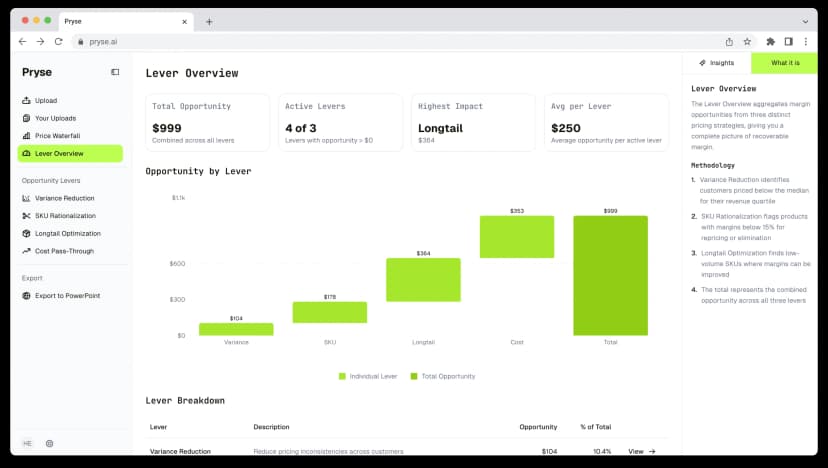
Tools like Pryse don't dynamically adjust prices. They analyze your existing pricing to find where margin leakage exists and quantify the dollar opportunity. They answer "should I invest in dynamic pricing software?" by showing you what better pricing is worth.
When Dynamic Pricing Makes Sense for B2B
Dynamic pricing isn't universally good or bad for B2B. It depends on your specific business characteristics.
Dynamic pricing works when:
-
You sell commodity products with volatile input costs. Chemical distributors, metal service centers, and building materials companies deal with costs that change weekly. Prices need to track costs or margins erode fast. Dynamic pricing tied to commodity indices solves this.
-
You have a high-velocity transactional business. If you process hundreds of small orders daily with minimal negotiation — think online B2B, MRO supplies, or fastener distribution — dynamic pricing can optimize each transaction without disrupting customer relationships.
-
Price transparency exists in your market. If customers can easily check competitor prices online, you need to respond quickly. Slow quarterly price updates mean you're either overpriced (losing volume) or underpriced (leaving margin) for months at a time.
Dynamic pricing fails when:
-
Relationships drive your business. When your top 20 customers represent 60% of revenue and expect stable pricing for budgeting, algorithm-driven price changes create friction and erode trust.
-
Sales reps control pricing. If your reps negotiate every deal and have broad discounting authority, dynamic pricing creates conflict. The system recommends one price; the rep quotes another. Nobody wins.
-
You have long-term contracts. If 70% of your revenue comes from annual contracts with fixed pricing, dynamic pricing only applies to the remaining 30%. The ROI math doesn't usually justify the investment.
Simon-Kucher research confirms that B2B industrial companies face unique obstacles: customers expect stable pricing, sales teams resist automation, and the complexity of B2B pricing structures makes algorithmic optimization harder than it looks.
The Build vs. Buy Decision
Some companies consider building dynamic pricing in-house rather than buying a platform. Here's the reality.
Building makes sense if:
- You have a strong data engineering team
- Your pricing logic is simple (rules-based, not ML)
- You only need to optimize online/transactional pricing
- You're willing to invest 6-12 months of development time
Buying makes sense if:
- You need ML-based optimization
- Integration with multiple selling systems is required
- You don't have dedicated data science resources
- You want to be operational in 3-6 months instead of 12-18
Most mid-market companies should buy, not build. The development cost of building a pricing engine that handles customer-specific pricing, discount structures, approval workflows, and ERP integration typically exceeds the first 3 years of a mid-market platform license.
What to Do Before Investing in Dynamic Pricing
Before signing a $50K-$200K annual contract, answer these questions with data.
How much margin leakage do you have today? If you haven't quantified your pricing inconsistencies, you don't know if dynamic pricing is worth the investment. Run a pricing diagnostic first. Upload 12 months of transaction data and see where the gaps are.
What's your price realization rate? If your target margin is 35% but realized margin is 28%, the 7-point gap isn't a dynamic pricing problem. It's a discount management problem. Fix that first — it's cheaper and faster.
How often do your costs actually change? If your costs are stable (updating quarterly or less), you don't need real-time pricing. Quarterly price reviews with better analytics will capture most of the opportunity at a fraction of the cost.
Can your organization execute price changes? If it takes your team 3 weeks to update prices in the ERP after a decision is made, dynamic pricing software that recommends daily changes won't help. Fix the execution bottleneck first.
A Realistic Path Forward
For most mid-market distributors and manufacturers, the right sequence isn't "buy dynamic pricing software." It's:
- Diagnose your current pricing — understand where margin leakage exists and how much opportunity you have ($999/year, done in 24 hours)
- Fix pricing inconsistencies — address outlier margins, unauthorized discounts, and outdated customer-specific pricing (internal effort, 2-3 months)
- Implement segment-based pricing — different strategies for commodity vs. specialty vs. tail SKUs (may require mid-market pricing tool, $30K-$80K/year)
- Add dynamic capabilities selectively — only for product categories where costs, demand, or competition change frequently enough to justify it
This sequence delivers margin improvement at each step. If you capture 2% margin improvement from diagnostics and pricing fixes (steps 1-2), that $1M+ payback on a $50M business funds the investment in more sophisticated tools.
Jumping straight to step 4 — which is what dynamic pricing software vendors encourage — means paying enterprise prices to solve problems that simpler tools fix better and faster.
Last updated: March 12, 2026
Frequently Asked Questions
Want to analyze your entire product catalog?
Pryse automatically identifies margin leakage across thousands of SKUs. Upload your data and find hidden profit in 24 hours.
$999/year. Cancel anytime.