 Pryse
PryseTop 7 PriceFx Alternatives for B2B Pricing (2026)
Evaluating PriceFx alternatives? We cover 7 options from enterprise platforms to self-serve diagnostics for B2B pricing teams.
If you are evaluating PriceFx alternatives, you are likely in one of a few situations: you have seen a demo and want to compare options, the implementation timeline or cost does not fit your current needs, or you are looking for something simpler that still solves your core pricing problem.
PriceFx is a strong platform. It is cloud-native, has invested heavily in AI (including its Copilot and 125+ AI Agents as of early 2026), and covers pricing management, optimization, and CPQ in a single suite. But not every company needs — or is ready for — a full enterprise pricing platform.
Here are seven alternatives worth evaluating, depending on your size, industry, and what you are actually trying to solve.
Why Companies Look for PriceFx Alternatives
PriceFx has built a solid position in the B2B pricing software market, holding a significant share of the price optimization category according to industry analysts. They entered 2026 with what they called "record momentum." So why look elsewhere?
Implementation effort. Enterprise pricing software requires data integration, configuration, user training, and organizational change management. Even cloud-native platforms take months to deploy fully. Some companies want faster time-to-value.
Cost structure. PriceFx uses subscription pricing based on users and modules. For companies with large sales teams or complex pricing needs across multiple modules, the annual cost can be substantial. Some organizations want to validate the pricing opportunity before committing to an ongoing platform investment.
Complexity mismatch. A full pricing platform with CPQ, optimization, rebate management, and AI agents may be more than you need — especially if your primary goal is to understand where you are losing margin and by how much.
Industry fit. While PriceFx serves many industries, companies in specialized sectors (like industrial distribution) sometimes prefer tools built specifically for their pricing dynamics.
1. PROS
PROS is one of the largest and most established players in B2B pricing software. Named a Leader in the IDC MarketScape for B2B Revenue and Profit Optimization Platforms (2025-2026), PROS was acquired by Thoma Bravo in a deal valuing the company at approximately $1.4 billion and is being combined with Conga.
What it is: An AI-powered SaaS platform covering pricing, CPQ, revenue management, and digital offer marketing. PROS Smart Price Optimization centralizes pricing into a single source of truth with real-time dynamic pricing capabilities.
Who it is for: Large enterprises with complex pricing needs spanning multiple business units, channels, and geographies. PROS is particularly strong in industries like airlines, manufacturing, and distribution.
Key strengths: Deep AI capabilities (including PROS Insights Agent, Price Quality Agent, and Sales Agent released in 2025), broad product suite, strong enterprise track record, and IDC MarketScape Leader recognition. The Thoma Bravo acquisition and Conga merger should strengthen their CPQ offering.
Key weaknesses: Enterprise-scale complexity and cost. Implementation timelines are typically long. The Thoma Bravo acquisition introduces some uncertainty about product direction and integration with Conga. May be overkill for mid-market companies.
Pricing model: Subscription-based, not publicly disclosed.
Best for: Large enterprises that need a full pricing and revenue optimization suite and have the resources to implement and maintain it.
2. Vendavo
Vendavo is a direct competitor to PriceFx in the B2B pricing and CPQ space, with particular strength in large enterprise deployments and SAP integration.
What it is: A cloud-based platform offering price optimization, CPQ, and rebate management solutions. Vendavo's Ensemble AI uses multiple algorithms to provide price guidance, and their price waterfall visualization shows how discounts affect net price.
Who it is for: Large manufacturers and distributors, particularly those in the SAP ecosystem. Vendavo's clients include companies in chemicals, distribution, high-tech, and manufacturing, with claimed annual margin improvement totaling more than $2.5 billion across their customer base.
Key strengths: Deep SAP integration, strong price waterfall and margin bridge analytics, proven track record with large B2B enterprises, and a solid profit analyzer with business risk alerts. Ranked #3 in SelectHub's Pricing Software directory with an 87% user satisfaction rating.
Key weaknesses: Can feel dated compared to cloud-native competitors like PriceFx. Implementation timelines for large enterprises can be extensive. Less flexible for companies that are not in the SAP ecosystem. Complexity can be a barrier for mid-market companies.
Pricing model: Subscription-based, not publicly disclosed.
Best for: Large manufacturers and distributors already using SAP that need deep price optimization and CPQ integration.
3. Zilliant
Zilliant focuses on AI-driven pricing and sales optimization for B2B companies, with strong roots in distribution and manufacturing. They have been expanding their product line, including the launch of Pricing Plus in late 2025 and Agentic AI capabilities in early 2026.
What it is: A cloud-native platform offering price optimization (Price IQ), deal management, sales intelligence, and the newer Pricing Plus for companies moving away from spreadsheet-based pricing. IDC has recognized Zilliant for "the highest ROI, shortest time to value and best customer experience" in B2B pricing.
Who it is for: Mid-market to enterprise B2B companies in distribution and manufacturing. Zilliant's Pricing Plus specifically targets companies replacing spreadsheet-based pricing processes — making it relevant for organizations that may not be ready for a full optimization suite.
Key strengths: Strong distribution and manufacturing focus, AI-driven price optimization with proven ROI claims, Pricing Plus as an entry point for spreadsheet-dependent companies, and new Agentic AI with an industry-first MCP server. Good breadth across 20+ vertical industries.
Key weaknesses: Pricing is not publicly available, which makes it hard to evaluate cost upfront. Less CPQ depth than PriceFx or Vendavo. Newer product launches (Pricing Plus, Agentic AI) are still maturing as of early 2026.
Pricing model: Not publicly disclosed. Contact for a custom quote.
Best for: B2B distributors and manufacturers that want AI-driven price optimization with strong industry focus, or companies specifically looking to move from spreadsheets to structured pricing.
4. Pryse
Pryse is a self-serve pricing diagnostic tool for mid-market distributors and manufacturers. Full disclosure: this is our product. It serves a fundamentally different purpose than PriceFx — it is a diagnostic, not an ongoing platform.
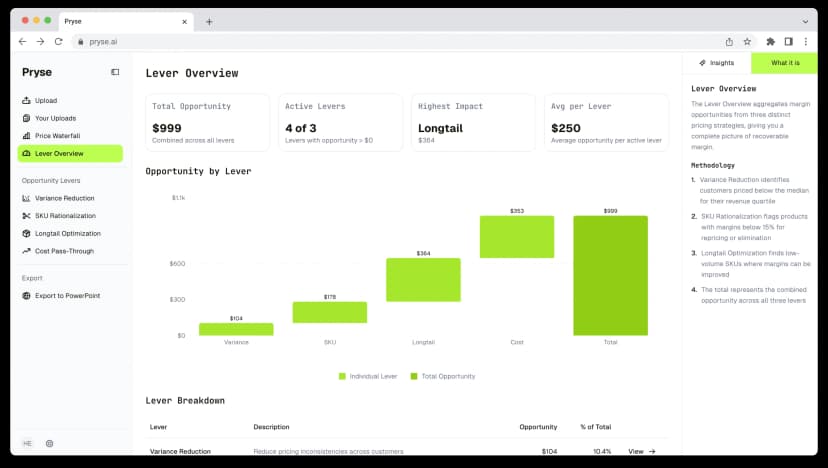
What it is: Upload your transaction data as a CSV, and Pryse generates a price waterfall analysis, identifies margin leakage patterns, and quantifies the dollar opportunity. Results delivered within 24 hours. No implementation, no integration.
Who it is for: Mid-market distribution and manufacturing companies ($20M-$200M revenue) that currently manage pricing in Excel or basic ERP systems and want to understand their pricing opportunity before investing in enterprise software.
Key strengths: Speed (24-hour turnaround), $999/year, zero implementation effort, and focused specifically on the margin leakage problems common in distribution and manufacturing — inconsistent discounting, cost-plus gaps, and pocket price erosion.
Key weaknesses: Not a pricing management platform. Does not provide ongoing price optimization, CPQ, or rebate management. No ERP integration. Limited to what can be analyzed from a CSV export. Not a substitute for PriceFx if you need a full pricing platform.
Pricing model: $999/year.
Best for: Companies that want to quantify their pricing opportunity quickly and affordably before deciding whether to invest in a platform like PriceFx, Vendavo, or Zilliant.
5. Competera
Competera is an AI-driven pricing platform that has been gaining attention, particularly in retail and e-commerce, but is expanding into B2B use cases.
What it is: A pricing platform that uses proprietary Contextual AI to analyze billions of price combinations across 20+ demand drivers. Competera processes competitive dynamics, customer behavior, and market conditions to recommend optimal prices. In 2025, they launched Store-Level Optimization and an AI Pricing Assistant.
Who it is for: Primarily retail and e-commerce companies, but increasingly relevant for B2B companies with large product catalogs and competitive pricing dynamics. Holds a 4.8 rating on Capterra based on 58 reviews.
Key strengths: Strong AI and machine learning capabilities, competitive intelligence integration, real-time pricing recommendations, and claimed performance of up to 8% revenue uplift and 6% margin growth. The 2025 AI Pricing Assistant adapts dynamically to market conditions.
Key weaknesses: Primarily built for retail — B2B features are less mature than dedicated B2B platforms like PriceFx. Less depth in B2B-specific needs like contract pricing, customer-specific pricing tiers, and quote management. Not the right fit for distribution or manufacturing companies with complex pricing structures.
Pricing model: Not publicly disclosed.
Best for: Retail-adjacent B2B companies or those with consumer-like pricing dynamics that want strong competitive intelligence and AI-driven recommendations.
6. Syncron Price
Syncron (formerly Syncron Price) offers pricing solutions particularly focused on aftermarket and service parts pricing — a niche where pricing dynamics differ significantly from standard product pricing.
What it is: A pricing optimization solution for service parts and aftermarket businesses. Syncron helps companies price spare parts, replacement components, and service items where demand patterns, competitive dynamics, and willingness-to-pay differ from original equipment pricing.
Who it is for: Manufacturers and OEMs with significant aftermarket or service parts businesses. If a meaningful portion of your revenue comes from spare parts and you are not optimizing those prices specifically, Syncron addresses that gap.
Key strengths: Deep specialization in aftermarket pricing (a niche most general pricing platforms handle poorly), strong demand forecasting for intermittent spare parts demand, and the ability to optimize across hundreds of thousands of parts SKUs.
Key weaknesses: Narrow focus — if aftermarket pricing is not your primary challenge, Syncron is not the right tool. Less relevant for companies selling finished goods or commodities. Limited CPQ and quote management capabilities compared to PriceFx.
Pricing model: Not publicly disclosed.
Best for: OEMs and manufacturers with large aftermarket or service parts catalogs that need specialized pricing optimization for that specific use case.
7. SAP CPQ + Pricing
For companies already deeply invested in the SAP ecosystem, SAP's own pricing and CPQ tools may be the most practical alternative — not because they are the best standalone pricing tools, but because they eliminate integration headaches.
What it is: SAP offers pricing functionality across its ERP and CRM products, along with SAP CPQ for quoting. The pricing capabilities are embedded within the broader SAP Commerce and S/4HANA ecosystem, providing condition-based pricing, tiered discounts, and contract pricing management.
Who it is for: Companies with heavy SAP investments that want pricing capabilities tightly coupled with their ERP, CRM, and commerce systems without managing a third-party integration.
Key strengths: Native integration with SAP ERP and S/4HANA, no third-party vendor to manage, condition-based pricing that can handle complex B2B pricing logic, and access to SAP's broader data and analytics ecosystem.
Key weaknesses: SAP's pricing capabilities are generally less sophisticated than dedicated pricing platforms when it comes to AI-driven optimization and margin analytics. CPQ is functional but less flexible than best-of-breed solutions. The SAP ecosystem can be expensive and slow to change.
Pricing model: Included within broader SAP licensing, or additional modules with separate licensing.
Best for: Companies already running SAP that want pricing and CPQ without adding another vendor, and whose pricing needs are more about execution consistency than AI-driven optimization.
How to Choose the Right Alternative
Start with your actual problem, not the software category.
If you need to replace or upgrade your current pricing platform, PROS, Vendavo, and Zilliant are the most direct PriceFx alternatives. PROS is the largest and broadest. Vendavo is strongest in the SAP world. Zilliant has the deepest distribution and manufacturing focus and is building an accessible entry point with Pricing Plus.
If you need to understand your pricing opportunity before buying software, Pryse gives you a quantified diagnostic in 24 hours for a fixed price. It is a fraction of the cost and effort of implementing any platform, and it helps you build the business case for whatever you do next.
If you have a specialized pricing challenge, Competera for competitive/retail pricing or Syncron for aftermarket parts pricing will outperform generalist tools in their respective niches.
If you are locked into SAP, evaluate SAP's native pricing capabilities first. They may be "good enough" and avoid the integration tax of a third-party tool.
The B2B pricing software market continues to evolve quickly — AI agents, copilots, and agentic capabilities are appearing across all the major platforms in 2025-2026. Whatever you choose, make sure you are solving a real pricing problem, not just buying technology for the sake of it.
Last updated: March 12, 2026
Frequently Asked Questions
Want to analyze your entire product catalog?
Pryse automatically identifies margin leakage across thousands of SKUs. Upload your data and find hidden profit in 24 hours.
$999/year. Cancel anytime.