 Pryse
PryseCompetitive Pricing Software: What It Does and Who Needs It
Competitive pricing software tracks competitor prices and adjusts yours. Learn what the tools do, the main categories, and whether your business actually needs one.
Competitive pricing software monitors what your competitors charge and helps you adjust your prices in response. The category spans everything from $50/month web scrapers to $500K/year enterprise platforms with AI-driven repricing engines.
The pricing software market was valued at roughly $1.03 billion in 2024 and is projected to reach $1.15 billion in 2025, growing at an 11.6% compound annual growth rate, according to The Business Research Company's 2025 market report. Competitive pricing tools represent one segment of that market, alongside optimization, CPQ, and analytics platforms.
But here's the thing most vendors won't tell you: the majority of mid-market distributors and manufacturers don't need competitive pricing software. Their pricing problems aren't caused by competitors. They're caused by internal margin leakage — discounts nobody tracks, costs that aren't passed through, and pricing that hasn't been updated in months.
This post explains what competitive pricing software actually does, the main categories of tools, and how to figure out whether your business needs one.
What Competitive Pricing Software Actually Does
At its core, competitive pricing software answers one question: what are my competitors charging, and how should I respond?
The technology works in layers:
Data collection. The software scrapes competitor websites, marketplaces, distributor portals, or other public sources to capture prices. Some platforms also ingest data from third-party market intelligence providers. The collection can be real-time, daily, or weekly depending on the tool and your market's velocity.
Product matching. Matching your SKUs to competitor products is harder than it sounds. The same product might have different part numbers, descriptions, and packaging across competitors. Good platforms use a combination of UPC/EAN codes, manufacturer part numbers, and machine learning to match products across sources.
Analysis and alerting. Once prices are collected and matched, the software compares your prices to competitors, tracks changes over time, and flags opportunities or threats. Basic tools send email alerts when a competitor drops below your price. Advanced platforms model price-volume relationships to predict what happens if you match, undercut, or hold.
Recommendation and execution. The most sophisticated platforms go beyond monitoring. They recommend optimal prices based on competitive position, margin targets, and demand elasticity. Some integrate directly with ecommerce platforms or ERPs to execute price changes automatically.
The Four Categories of Competitive Pricing Tools
Not all competitive pricing software does the same thing. The market breaks into four tiers.
Price Monitoring Tools
What they do: Track competitor prices on websites and marketplaces. Send alerts when prices change. Provide dashboards showing your position relative to competitors.
Examples: Prisync, Competera (basic tier), Price2Spy, Priceva.
Cost: $50-$500/month for small catalogs. $500-$2,000/month for larger SKU counts.
Best for: Ecommerce sellers, retailers with published prices, and anyone who needs to know what competitors are charging but can make pricing decisions manually.
Limitations: They tell you what competitors charge. They don't tell you what you should charge. The analysis and decision-making is still on you.
Competitive Intelligence Platforms
What they do: Everything monitoring tools do, plus market analysis, trend identification, and strategic insights. They contextualize competitor prices within broader market dynamics.
Examples: Crayon, Klue, Kompyte (now part of Semrush).
Cost: $20K-$80K annually.
Best for: Companies with dedicated competitive intelligence functions, product marketing teams, or strategic pricing teams who need market context beyond just price points.
Limitations: These are intelligence tools, not pricing execution tools. They help you understand the competitive environment but don't calculate or implement price changes.
AI-Driven Repricing Engines
What they do: Automatically adjust your prices based on competitor moves, demand signals, inventory levels, and margin targets. They operate on rules, machine learning, or both.
Examples: Feedvisor (Amazon), Omnia Retail, Competera (advanced tier), 7Learnings.
Cost: $20K-$150K annually, or a percentage of sales.
Best for: High-velocity retail and ecommerce businesses where prices change daily or hourly. Amazon sellers, online-only retailers, and businesses competing on published prices.
Limitations: These tools assume your primary pricing lever is competitive positioning. For businesses where customer relationships, contracts, and negotiated pricing drive most transactions, automated repricing misses the point.
Enterprise Pricing Optimization (with Competitive Features)
What they do: Full-suite pricing optimization that includes competitive intelligence as one input among many. They combine internal data (costs, margins, transactions) with external data (competitor prices, market trends) to recommend prices.
Examples: PROS, Pricefx, Vendavo, Zilliant.
Cost: $100K-$500K annually plus implementation.
Best for: Large enterprises with 20,000+ SKUs, dedicated pricing teams, and the organizational maturity to act on algorithmic recommendations.
Limitations: Cost and complexity. Implementation takes 6-18 months. The competitive pricing features are one module among many. You're not buying a competitive tool — you're buying a pricing platform.
Who Actually Needs Competitive Pricing Software
The honest answer: fewer companies than the vendors would like.
Competitive pricing software delivers clear value when three conditions are true:
Your customers compare prices before buying. In B2C ecommerce, this is almost always true. A shopper checks three sites before clicking "buy." In B2B distribution, it's often not true. Your customer calls their rep, orders from the catalog, and doesn't check what your competitor charges for the same widget.
Competitor prices are accessible. The software needs something to scrape. Published ecommerce prices, marketplace listings, and retail shelf prices are scrapable. Contract-based B2B pricing, negotiated distributor agreements, and bid-based pricing are not. If your competitors don't publish prices, there's nothing for the tool to monitor.
Price is the primary buying factor. If your customers choose based on price, competitive software helps you win. If they choose based on relationships, delivery speed, technical support, or product availability — which is true for most industrial distributors — then knowing a competitor's price matters less than knowing your own margin.
Who Doesn't Need It (But Thinks They Do)
Mid-market distributors with relationship-driven sales. Your 500 active customers don't shop around on every order. They buy from you because you have the inventory, you deliver on time, and their rep picks up the phone. Your pricing problem isn't that competitors are cheaper. It's that your own discounting, freight absorption, and stale pricing are leaking margin. Internal optimization outperforms competitive monitoring here.
Companies with fewer than 500 competitive SKUs. If you only need to track 100-500 products against a few competitors, a quarterly manual review costs nothing and takes a few hours. Software that automates this at $50K/year is hard to justify.
Manufacturers with custom or configured products. If every order is quoted based on specifications, materials, and quantities, there's no published competitor price to monitor. Your pricing intelligence comes from win/loss data and customer conversations, not scraped websites.
Businesses where most revenue comes from contracts. If 70%+ of your revenue is on contract pricing, competitive pricing software monitors the 30% where it matters least. Your margin improvement comes from better contract negotiations and cost pass-through clauses, not real-time competitive response.
What to Do Instead
For most mid-market distributors and manufacturers, the biggest pricing gains come from fixing internal margin problems, not monitoring external competitor prices.
Start with your own data. Export your transaction history and analyze margin by product, customer, and sales rep. The gaps you find — products below your margin floor, customers getting discounts they shouldn't, cost increases that never hit your price file — will almost certainly be larger than any competitive pricing adjustment.
McKinsey's 2019 research found that a 1% price increase yields a 22% EBITDA increase for distributors. That 1% improvement is far more likely to come from fixing your own pricing leaks than from matching a competitor's published prices.
Build a price waterfall. Before you worry about what competitors charge, understand what you actually pocket from each sale. The gap between your list price and your pocket price — after discounts, rebates, freight, and other off-invoice deductions — is where margin hides. See our price waterfall analysis guide for details.
Quantify before you invest. A pricing diagnostic that analyzes your transaction data costs a fraction of competitive pricing software and tells you whether your biggest opportunity is competitive, internal, or both. Most mid-market companies discover that 80% of their recoverable margin is internal.
When Competitive Software Becomes Worth It
There is a point where competitive pricing software pays for itself, even for B2B companies.
You sell commodity products where price is the tiebreaker. Fasteners, chemicals, electrical components, pipe fittings — categories where your product is identical to your competitor's product. Here, a 2% price difference actually drives purchase decisions.
You operate an ecommerce channel alongside traditional sales. If you're selling online, published prices are visible to buyers. Competitive monitoring on that channel prevents you from being dramatically out of market while your B2B team handles relationship accounts differently.
You've already fixed your internal leaks. Once you've plugged discount stacking, passed through cost increases, and aligned your pricing to cost-to-serve, the next increment of margin improvement may come from competitive positioning. This is usually a year-two or year-three priority, not where you start.
Your market is consolidating. When a large competitor cuts prices to gain share, you need to know fast. Competitive monitoring gives you early warning to decide whether to match, hold, or differentiate.
Building Your Own Competitive Intelligence (Without Software)
If you're not ready for dedicated software, a simple manual process captures 80% of the value.
Step 1: Identify your competitive products. Not everything you sell competes on price. Focus on the 100-500 SKUs where customers actually compare.
Step 2: Identify your competitors. Usually 3-5 primary competitors per product category.
Step 3: Set a monitoring cadence. Monthly is fine for most B2B markets. Weekly for volatile categories. Daily only if you're in ecommerce.
Step 4: Log prices in a spreadsheet. Date, competitor, product, price. Calculate your premium or discount versus each competitor.
Step 5: Review and act. Look at the trends quarterly. Are you consistently 15% above the market on commodity items? That's a risk. Are you 5% below on specialty items where you add value? That's money you're leaving on the table.
This manual approach breaks down around 500 SKUs or 10+ competitors. Below that threshold, the time investment is modest and the insight is real.
Key Takeaways
Competitive pricing software is a specialized tool for a specific problem: markets where published competitor prices drive purchasing decisions. It works well in retail, ecommerce, and commodity B2B. It delivers less value in relationship-driven distribution, contract-heavy manufacturing, and custom/configured products.
Before investing in competitive tools, fix your internal pricing first. The margin you're losing to your own discount practices, stale cost pass-throughs, and freight absorption is almost certainly larger than what you're losing to competitor pricing.
For a full comparison of pricing platforms including competitive tools, see our best pricing software buyer's guide. For competitive pricing strategy frameworks, see our competitive pricing guide.
Last updated: March 12, 2026
Frequently Asked Questions
Want to analyze your entire product catalog?
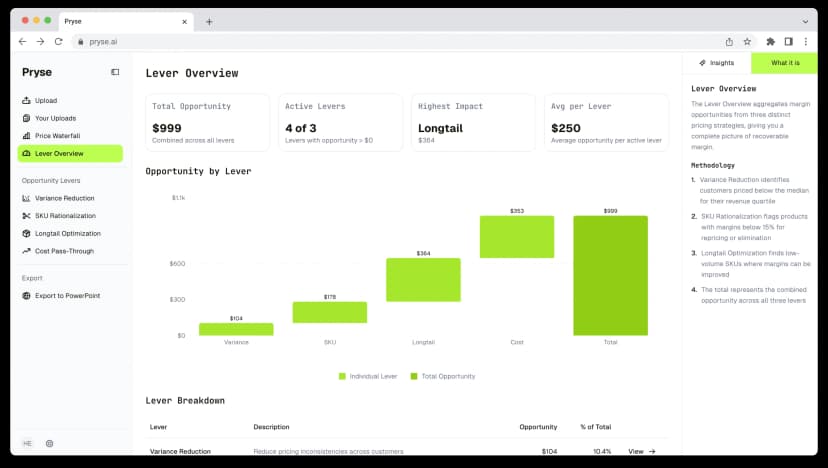
Pryse automatically identifies margin leakage across thousands of SKUs. Upload your data and find hidden profit in 24 hours.
$999/year. Cancel anytime.