 Pryse
Pryse7 Pricing Errors That Are Costing You Money (And How to Fix Them)
Seven specific pricing errors that drain profit in distribution and manufacturing. Each one includes dollar-impact examples and concrete fixes you can implement.
Pricing errors are different from pricing strategy problems. A strategy problem is charging the wrong price on purpose — your framework is broken. An error is charging the wrong price by accident — your execution is broken.
Errors are more expensive because they're invisible. A bad pricing strategy produces consistently low margins that show up in financial reporting. Pricing errors produce unpredictable margin leakage that hides in the noise of thousands of transactions.
Here are seven specific errors we see repeatedly in distribution and manufacturing data, with the dollar impact and the fix for each one.
1. Cost Increases That Never Hit Your Price File
This is the single most expensive pricing error in distribution. It's also the most common.
Your suppliers raise prices. The notification arrives by email or EDI. Someone in purchasing acknowledges it. The new cost gets updated in the ERP. But the corresponding price increase to your customers? That waits. For weeks. Sometimes months.
The cost of this lag is straightforward to calculate:
Lag Cost = Revenue During Lag x Supplier Cost Increase %
A $60M distributor with 20 suppliers who raise prices averaging 4% each year. If the average lag between cost increase and price increase is 45 days:
$60,000,000 x 0.04 x (45 / 365) = $295,890 per year
Nearly $300K in margin vanishes because of a process gap. Nobody made a bad decision. Nobody gave an unauthorized discount. The cost went up, the price didn't follow fast enough, and thousands of orders shipped at the old price on the new cost.
The fix: Create a standing process for cost pass-through. When a supplier cost increase hits, the pricing update goes into the queue immediately, not "when we get to it." Set a target lag of 15 days or less. For your highest-volume suppliers, aim for same-week.
Some companies automate this by linking ERP cost updates to price file updates with a pre-set markup formula. The price increase hits the system the same week the cost increase does. No human delay.
2. Discount Stacking Beyond Policy Limits
Your discount policy says customers can get up to 20% off list. In practice, they're getting 28%. Here's how.
A customer qualifies for a 10% volume discount (standard). Their sales rep gives an additional 8% relationship discount (within the rep's authority). The customer is also on a 5% promotional program from Q3 that nobody deactivated. And they take the 2% early-pay discount from AR.
10% + 8% + 5% + 2% = 25% total discount.
Each discount was individually authorized. Nobody looked at the cumulative effect. The customer's effective discount exceeds the 20% policy cap by 5 points, and the system doesn't flag it because each discount type lives in a different workflow.
On a $75M distributor, if 15% of revenue goes through transactions with stacked discounts averaging 3 points above the cap:
$75,000,000 x 0.15 x 0.03 = $337,500 per year
The fix: Track cumulative discount per transaction, not individual discount components. Set system alerts when the total discount on any invoice exceeds your cap. Require approval for any transaction where combined discounts exceed a threshold — say, 22%.
The harder fix is cultural. Reps stack discounts because they can. Requiring visibility into the total discount for every deal changes the conversation from "can I give 5% more?" to "the customer is already at 23% total — here's what that costs us."
3. Zombie Pricing: Promotions That Never Die
Promotional pricing is supposed to be temporary. In practice, it's often permanent.
A manufacturer runs a Q2 promotional discount on a product line. Sales reps push it hard. Customers buy at the promotional price. Q2 ends. The promotion is supposed to revert. But nobody updates the price file, or the customer-specific pricing override stays active, or the promotional price became the "new normal" that reps keep quoting because "that's what the customer paid last time."
The danger is that zombie pricing compounds. This quarter's promotion becomes next quarter's baseline, and the next promotion stacks on top of it.
A $40M distributor with 8,000 SKUs that runs 4-6 promotional campaigns per year. If just 3% of SKUs retain promotional pricing after the promotion ends, and the average promotional discount is 8%:
8,000 SKUs x 0.03 = 240 SKUs at zombie prices
If those 240 SKUs represent $2M in annual revenue:
$2,000,000 x 0.08 = $160,000 per year in margin erosion
The fix: Every promotion gets an end date in the system. On that date, pricing automatically reverts. No manual step required. For customer-specific overrides, implement automatic expiration — the system should force a review, not assume the override is permanent.
Run a monthly audit of active promotional codes. Any promotion past its end date is either deactivated or explicitly renewed with margin impact acknowledged.
4. New Products Priced on Bad Comparables
When you add a new product to the catalog, someone needs to set the initial price. The most common approach: "price it like the similar product we already sell."
The problem is that the comparable product might already be underpriced. If Product A has been slowly losing margin through years of unchecked discounts and missed cost increases, and you price Product B by reference to Product A, you've just imported all of Product A's margin problems into Product B on day one.
This is how margin erosion propagates through a catalog. One product gets underpriced. Similar products get priced by comparison. The entire category drifts below target margin, and nobody notices because each individual pricing decision seemed reasonable in isolation.
The fix: Price new products from cost-up, not from comparable-down. Calculate your COGS, apply your target margin for the category, and set the list price. Then check whether the result is competitive. If your cost-up price is dramatically higher than what similar products sell for, that's a signal that similar products are underpriced — not that your new product should be, too.
For specialty or low-competition items, price even more aggressively from cost-up. Customers buying a product that only two distributors stock aren't comparison shopping.
5. Customer-Specific Pricing That Nobody Reviews
Customer-specific pricing is normal in B2B distribution. A customer negotiates a price, it goes into the ERP as an override, and every subsequent order for that product ships at the negotiated price.
The problem: nobody reviews these overrides. The price was set in 2022 when COGS was lower. Costs have increased 12% since then. The customer's volume declined 20%. But the price override is still there, unchanged, applied to every order.
NAW research indicates that pricing overrides affect more than 50% of transactions at many distributors. That means more than half of your orders are priced not by your current price list, but by a historical negotiation that may no longer reflect current economics.
For a $50M distributor with 3,000 active customer-specific overrides, if 30% are outdated by an average of 4% margin:
Total Override Revenue = $50,000,000 x 0.50 = $25,000,000
Outdated Override Revenue = $25,000,000 x 0.30 = $7,500,000
Annual Margin Impact = $7,500,000 x 0.04 = $300,000
The fix: Implement override expiration. Every customer-specific price gets a review date — 6 months for high-volume customers, 12 months for others. When the date arrives, the override either gets renewed at the current price or reverts to the standard price file.
The review process should check: Has COGS changed since the override was set? Has the customer's volume justified the discount? Is the override still below your margin floor?
6. Freight-Blind Pricing
This isn't a data error — it's a structural error. Your prices don't account for the cost of getting the product to the customer.
Two customers buy the same product at the same price. Customer A is 30 miles away; freight costs $4/hundredweight. Customer B is 500 miles away; freight costs $14/hundredweight. Same revenue, dramatically different profit.
The error is treating freight as a general overhead cost rather than a customer-specific variable cost. When freight is buried in the logistics budget, nobody sees that specific customers or shipment profiles are destroying margin.
For a $50M distributor where freight runs 5% of revenue ($2.5M) and half of that freight is absorbed rather than billed:
Absorbed Freight = $2,500,000 x 0.50 = $1,250,000
Not all of that is recoverable. But the distribution is heavily skewed — 20% of customers typically account for 50%+ of absorbed freight. Addressing just the top quartile of freight-subsidized customers can recover $200K-$400K.
The fix: Calculate freight cost as a percentage of revenue for every customer. Identify customers where freight exceeds 5% of their revenue. For those customers, implement minimum order values, freight surcharges, or adjusted base pricing that reflects delivery cost.
7. Margin Floors That Exist in Policy but Not in Systems
Many distributors have a stated minimum margin. "We don't sell anything below 15% gross margin." It's written in the discount policy. Sales managers cite it in meetings.
Then you look at the data and find that 12% of transactions are below 15%. And 3% are below 10%. And a handful are at negative margin.
The error isn't the policy. It's the enforcement. If your ERP and quoting system allow transactions below the margin floor without flagging them, the floor doesn't exist. It's a suggestion.
For a $60M distributor where 10% of revenue ships below a 15% margin floor, with actual margin on those transactions averaging 9%:
Below-Floor Revenue = $60,000,000 x 0.10 = $6,000,000
Margin Gap = 0.15 - 0.09 = 0.06
Annual Impact = $6,000,000 x 0.06 = $360,000
The fix: Build the margin floor into the system, not just the policy. Configure your ERP or quoting tool to flag any order where calculated margin falls below the floor. Require management approval for below-floor transactions. Track the approval rate — if managers approve 90% of exceptions, the floor is still meaningless.
Some companies implement a two-tier system: a soft floor (15%) that triggers a flag and requires documentation, and a hard floor (10%) that blocks the transaction entirely without VP-level override.
How These Errors Compound
A single customer can be affected by multiple errors simultaneously. They have an outdated customer-specific price (Error 5) on a product whose cost increased 6 months ago (Error 1), with a promotional discount still active (Error 3), shipped to a remote location at no freight charge (Error 6), and the whole transaction is below the margin floor that nobody enforces (Error 7).
Each error might represent 2-3 points of margin. Combined, they're 10-15 points. On a product line with 22% gross margin, that customer's effective margin is 7-12%. After cost-to-serve, they might be breakeven or worse.
The compounding is why aggregate margin analysis misses these problems. Your overall margin might be 24%. The average masks the 15% of transactions where margin is under 10%.
McKinsey's research on distributor pricing found that a 1% price increase yields a 22% EBITDA increase. The flip side: a 1% erosion from accumulated pricing errors cuts EBITDA by a comparable amount. When you're operating on 3-5% net margins, these errors aren't rounding errors. They're the difference between an average business and a profitable one.
Finding Your Pricing Errors
Every error on this list is identifiable from your transaction data. You don't need specialized software for the first pass.
Export 12 months of invoice data. Calculate margin for every line. Flag anomalies: transactions below your margin floor, prices that don't match the current price file, discounts above your policy cap, and products where the price hasn't changed in 12+ months despite cost changes.
For a structured approach to this analysis, see our how to audit your pricing in 5 steps guide. For the root causes behind these errors, see our 9 causes of margin leakage post.
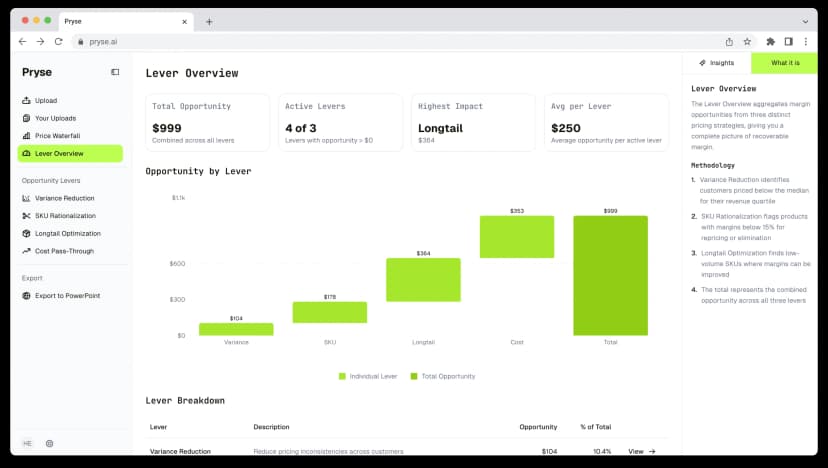
For companies that want the analysis done professionally, Pryse identifies all seven of these error categories from your transaction data. Upload your CSV, and within 24 hours you'll have every below-floor transaction, every stale price, and every margin anomaly quantified in dollars.
Last updated: March 12, 2026
Frequently Asked Questions
Want to analyze your entire product catalog?
Pryse automatically identifies margin leakage across thousands of SKUs. Upload your data and find hidden profit in 24 hours.
$999/year. Cancel anytime.