 Pryse
PryseTop 7 Zilliant Alternatives for B2B Pricing (2026)
Considering Zilliant alternatives? We review 7 B2B pricing options from AI platforms to self-serve diagnostics for distribution and manufacturing.
If you are researching Zilliant alternatives, you likely fall into one of two groups: you have evaluated Zilliant and want to compare it against other options, or you are looking for B2B pricing software in the distribution and manufacturing space and Zilliant keeps appearing on your shortlist.
Zilliant has real strengths — particularly in AI-driven price optimization for B2B distributors and manufacturers. IDC recognized their Price IQ product for the highest ROI, shortest time to value, and best customer experience in B2B pricing. Their Pricing Plus launch in late 2025 and Agentic AI capabilities in early 2026 show they are pushing to make pricing intelligence more accessible.
But Zilliant is not the only option, and depending on what you need, a different tool may be a better fit. Here are seven alternatives across different categories.
Why Companies Look for Zilliant Alternatives
Zilliant occupies an interesting position: they are more focused than the broadest enterprise platforms (PROS, Vendavo) but more sophisticated than basic pricing tools. That positioning creates gaps on both sides that drive companies to look elsewhere.
CPQ needs. Zilliant's Deal Manager handles contract and agreement pricing, but it is not a full CPQ platform. If your sales team needs configure-price-quote capabilities alongside pricing optimization, you may need to pair Zilliant with a separate CPQ tool — or choose a platform that combines both.
Rebate management. Unlike PriceFx and Vendavo, Zilliant does not offer a dedicated rebate management module. For companies where rebate programs are a major part of their pricing architecture, this is a gap.
Platform maturity of newer products. Pricing Plus and Agentic AI are promising but launched in late 2025 and early 2026 respectively. Some companies prefer tools with longer production track records.
Budget and scope. Even with Pricing Plus as an entry point, Zilliant is still enterprise pricing software. Companies that just want to understand where they are losing margin may not need a platform at all.
1. PriceFx
PriceFx is the most frequently mentioned competitor to Zilliant and, in our view, the most direct alternative for companies that want a broad B2B pricing platform.
What it is: A cloud-native platform covering pricing analytics, management, optimization, CPQ, and rebate management. PriceFx entered 2026 with significant AI momentum, including their Pricefx Copilot and a growing catalog of 125+ AI Agents. They hold a substantial share of the price optimization market.
Who it is for: Mid-market to enterprise B2B companies that want a single platform covering pricing management, optimization, CPQ, and rebates. PriceFx appeals to organizations that want all of these capabilities from one vendor.
Key strengths: Broadest product coverage in a single platform (pricing, CPQ, rebates), cloud-native architecture, heavy AI investment (Copilot + 125+ Agents), faster deployment than legacy platforms, and strong market share. Fills the CPQ and rebate gaps that Zilliant has.
Key weaknesses: The breadth means complexity — more to configure and more to maintain. Subscription costs based on users and modules can add up. Less deep distribution and manufacturing expertise than Zilliant's 20+ vertical focus.
Pricing model: Subscription-based by users and modules. Not publicly disclosed.
Best for: Companies that need pricing optimization plus CPQ and rebate management in a single modern platform.
2. Vendavo
Vendavo is the incumbent enterprise pricing platform, particularly strong in the largest B2B companies running SAP.
What it is: Price optimization, CPQ, and rebate management for large B2B enterprises. Vendavo's Ensemble AI provides multi-algorithm price guidance, and their price waterfall visualization is well-regarded. They claim more than $2.5 billion in annual margin improvement across their customer base.
Who it is for: Large manufacturers and distributors ($500M+ revenue), particularly those in the SAP ecosystem. Vendavo's sweet spot is companies in chemicals, distribution, high-tech, and manufacturing with complex pricing structures.
Key strengths: Deep SAP integration, proven track record with the largest enterprises, strong price waterfall and margin bridge analytics, CPQ with guided selling capabilities, and rebate management. An 87% user satisfaction rating based on 101 reviews across major review sites.
Key weaknesses: Can feel less modern than cloud-native competitors. Implementation timelines can be extensive for large deployments. Less accessible for mid-market companies. Outside the SAP ecosystem, integration is less of a differentiator.
Pricing model: Subscription-based. Not publicly disclosed.
Best for: Large enterprises already in the SAP ecosystem that need an all-in-one pricing, CPQ, and rebate platform.
3. PROS
PROS is the largest independent pricing software vendor (now owned by Thoma Bravo as of 2025-2026) and a direct competitor to both Zilliant and Vendavo at the enterprise level.
What it is: An AI-powered platform for pricing, CPQ, revenue management, and digital offer marketing. PROS Smart Price Optimization creates a centralized pricing source of truth with real-time capabilities. Being merged with Conga to strengthen CPQ. Named a Leader in the IDC MarketScape (2025-2026).
Who it is for: Large enterprises with complex, multi-business-unit pricing needs. PROS is strong in manufacturing, distribution, chemicals, and has notable presence in travel and logistics.
Key strengths: IDC MarketScape Leader, deep AI capabilities (Insights Agent, Price Quality Agent, Sales Agent), the broadest product suite in the market, decades of enterprise experience, and post-acquisition resources from Thoma Bravo.
Key weaknesses: The most enterprise-oriented option — complexity and cost reflect that. The Thoma Bravo acquisition and Conga merger introduce transition risk. Implementation is a significant undertaking.
Pricing model: Subscription-based. Not publicly disclosed.
Best for: The largest enterprises that need the broadest and deepest pricing and revenue optimization capabilities.
4. SPARXiQ
SPARXiQ is the most distribution-focused alternative on this list. While Zilliant serves distribution among many industries, SPARXiQ works exclusively with distributors and manufacturers.
What it is: PriceGPS (pricing analytics integrated directly into major ERPs), ContractGPS (contract pricing management), consulting services, and sales training. SPARXiQ has been doing pricing for distributors and manufacturers for over 30 years.
Who it is for: Industrial distributors and manufacturers that want pricing guidance embedded in their daily ERP workflow rather than in a separate platform. SPARXiQ integrates with Epicor Prophet 21, Eclipse, Infor, SAP, and Oracle.
Key strengths: The deepest distribution-specific expertise available (30+ years), ERP-native pricing that lives where sales reps already work, Profit Diamond profitability framework, contract management, and sales training. Claims 2-4% gross margin improvement. Understands the realities of distribution pricing — overrides, branch inconsistencies, and cost-plus habits.
Key weaknesses: Technology is more guidance-within-ERP than a standalone platform. Less sophisticated AI optimization than Zilliant's Price IQ. No CPQ or rebate management. Will not work for companies outside distribution and manufacturing.
Pricing model: Software licensing plus consulting. Not publicly disclosed.
Best for: Distributors and manufacturers that want pricing guidance integrated into their ERP workflow from the company with the most sector experience.
5. Pryse
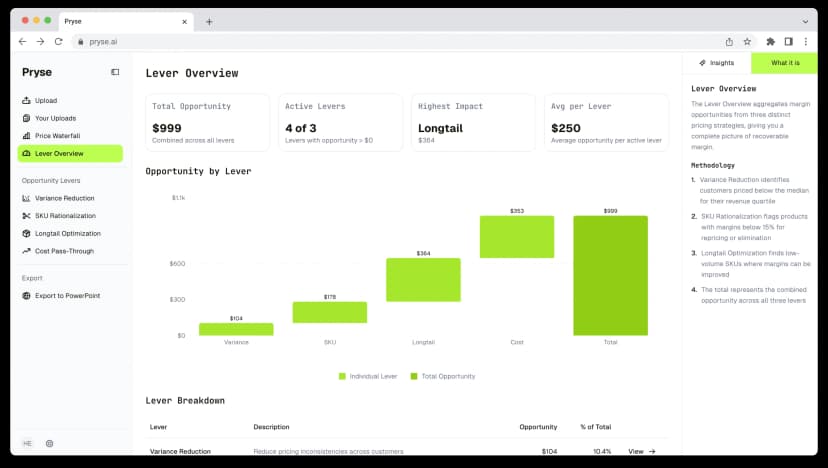
Pryse is a self-serve pricing diagnostic for mid-market distributors and manufacturers. Full disclosure: this is our product. It occupies a different position than Zilliant — it is a diagnostic tool, not a pricing platform.
What it is: CSV upload, price waterfall analysis, margin leakage detection, and dollar opportunity quantification. Results within 24 hours. No implementation, no integration, no subscription.
Who it is for: Mid-market companies ($20M-$200M revenue) that know pricing is an issue but have not quantified the opportunity yet. Companies that are still in spreadsheets and want data to support the decision of whether to invest in a platform like Zilliant.
Key strengths: 24-hour turnaround, $999/year, zero implementation, and built specifically for the margin leakage patterns common in mid-market distribution and manufacturing.
Key weaknesses: Not a pricing platform. No ongoing optimization, no sales tools, no ERP integration. A diagnostic, not a system you run your pricing through.
Pricing model: $999/year.
Best for: Companies that want to quantify their pricing opportunity before deciding whether to invest in Zilliant, PriceFx, SPARXiQ, or another solution.
6. Competera
Competera approaches pricing from a different angle — competitive intelligence and demand-driven optimization rather than B2B transaction data analysis.
What it is: An AI-driven pricing platform using proprietary Contextual AI to analyze billions of price combinations across 20+ demand drivers. Launched Store-Level Optimization and AI Pricing Assistant in 2025. Claims up to 8% revenue uplift and 6% margin growth.
Who it is for: Primarily retail and e-commerce companies. Relevant for B2B companies with retail-like pricing dynamics — large catalogs, competitive markets, and price-sensitive customers where competitive positioning matters as much as margin optimization.
Key strengths: Powerful competitive intelligence capabilities, real-time AI pricing recommendations, strong in high-SKU environments with competitive pressure, and a 4.8 rating on Capterra. Good at the "what should my market price be" question.
Key weaknesses: Built primarily for retail, not B2B distribution or manufacturing. Lacks B2B-specific features like contract pricing, customer-specific agreements, and complex discount structures. Not appropriate for companies where willingness-to-pay varies dramatically by customer segment.
Pricing model: Not publicly disclosed.
Best for: Companies with retail-adjacent pricing dynamics that need competitive intelligence-driven price recommendations at scale.
7. Bubo.AI
Bubo.AI is a smaller, newer entrant in the B2B pricing optimization space that positions itself as more accessible than the established enterprise platforms.
What it is: An AI-powered pricing platform that helps B2B companies optimize pricing using machine learning. Bubo.AI focuses on making price optimization accessible to companies that may not have dedicated pricing teams or data science resources.
Who it is for: Mid-market B2B companies that want AI-driven pricing recommendations without the complexity and cost of the large enterprise platforms. Bubo.AI tends to appeal to companies looking for a faster, lighter approach to price optimization.
Key strengths: More accessible than enterprise platforms, focused on usability for non-technical pricing teams, AI-driven recommendations, and a faster path to deployment than the major platforms.
Key weaknesses: Smaller company with a smaller installed base — less proven at scale. Fewer features than established platforms like PriceFx or PROS. Less distribution and manufacturing-specific depth than Zilliant. Newer in the market, so the track record is shorter.
Pricing model: Not publicly disclosed.
Best for: Mid-market B2B companies that want AI-powered pricing in a more accessible package without committing to a full enterprise platform.
How to Choose the Right Alternative
Your decision should start with what Zilliant does well and whether the gap you are trying to fill is about getting more, getting something different, or getting something simpler.
If you need more than Zilliant offers — specifically CPQ and rebate management alongside pricing — PriceFx is the most direct answer. It covers the broadest set of capabilities in a single platform. Vendavo is the alternative if you are in the SAP ecosystem.
If you need the deepest enterprise pricing platform, PROS is the largest and most established. It is the most capable option but also the most complex and expensive.
If you want more distribution-specific focus than Zilliant already provides, SPARXiQ has spent 30 years exclusively in distribution and manufacturing. Their ERP-integrated approach means pricing guidance lives in the system your reps already use, not in a separate application.
If you are not ready for a platform, Pryse gives you a quantified diagnostic in 24 hours. It tells you where margin leakage is happening and how much it is costing you — the data you need to justify a platform investment.
If your pricing is more competitive/retail in nature, Competera brings competitive intelligence capabilities that the B2B-focused platforms lack.
The B2B pricing software space is moving quickly as of early 2026. AI agents, copilots, and MCP servers are showing up across the major platforms. The technology gap between vendors is narrowing. The real differentiator is increasingly about industry depth, implementation speed, and how well the tool fits your actual pricing workflow — not just feature lists.
Last updated: March 12, 2026
Frequently Asked Questions
Want to analyze your entire product catalog?
Pryse automatically identifies margin leakage across thousands of SKUs. Upload your data and find hidden profit in 24 hours.
$999/year. Cancel anytime.