 Pryse
PryseTop 7 Vendavo Alternatives for B2B Pricing (2026)
Exploring Vendavo alternatives? We review 7 B2B pricing options from enterprise platforms to self-serve tools for distributors and manufacturers.
If you are looking at Vendavo alternatives, you are probably running into one of the friction points that come with a large enterprise pricing platform: long implementation timelines, high costs, a user interface that feels like it was built in a different era, or the realization that you might not need a full-suite solution for what you are trying to accomplish.
Vendavo is a serious platform with genuine strengths — particularly for large enterprises in the SAP ecosystem. They have helped their customers drive what they report as more than $2.5 billion in annual margin improvements, and their price waterfall and Ensemble AI capabilities are well-regarded. But it is not the only option, and for some companies, it is not the right one.
Here are seven alternatives across different categories: enterprise platforms, distribution-focused tools, and more accessible options for companies that are not ready for a full platform deployment.
Why Companies Look for Vendavo Alternatives
Vendavo has been in the B2B pricing market for a long time. They serve some of the largest companies in chemicals, distribution, high-tech, and manufacturing. But several factors push companies to evaluate alternatives.
Implementation burden. Getting a full Vendavo deployment running means data integration, workflow configuration, user training, and change management. For companies that need answers fast, this timeline can feel too long.
SAP dependency. Vendavo's deep SAP integration is a strength for SAP shops but can be a limitation for companies on other ERP systems. If you run Oracle, Epicor, or Infor, you may find integration less seamless.
Modernization. Some users feel the platform's interface and architecture have not kept pace with newer cloud-native competitors. The pricing software market has moved quickly in recent years, with AI copilots and agentic capabilities becoming table stakes.
Scope mismatch. If your goal is to understand where you are losing margin — not to deploy an enterprise-wide pricing system — the full Vendavo platform may be more than you need.
1. PriceFx
PriceFx is the most frequently cited alternative to Vendavo in the B2B pricing software market. Cloud-native from the start, PriceFx has been gaining market share and entered 2026 with what they described as record momentum.
What it is: A cloud-native platform covering pricing analytics, price management, optimization, CPQ, and rebate management. PriceFx has invested heavily in AI, launching Pricefx Copilot (conversational pricing insights) and a catalog of 125+ AI Agents designed to surface margin-impacting outliers and deal anomalies.
Who it is for: Mid-market to enterprise B2B companies that want a modern, cloud-native alternative to legacy pricing platforms. PriceFx appeals to companies that want faster implementation and a more flexible platform architecture.
Key strengths: Cloud-native architecture (no on-premise baggage), strong AI investment including Copilot and Agents, faster deployment timelines than traditional enterprise platforms, broad pricing coverage (management, optimization, CPQ, rebates), and significant market share in the price optimization category.
Key weaknesses: Subscription pricing based on users and modules can still be expensive for large organizations. The platform's breadth means complexity — you still need time and resources to configure and deploy it properly. Less deep SAP integration than Vendavo.
Pricing model: Subscription-based by users and modules. Not publicly disclosed.
Best for: Companies that want Vendavo-level capabilities in a more modern, cloud-native architecture with stronger AI features.
2. PROS
PROS is one of the oldest and largest players in the pricing software space, recently acquired by Thoma Bravo in a deal valuing the company at approximately $1.4 billion and being merged with Conga.
What it is: An AI-powered platform spanning pricing, CPQ, revenue management, and digital offer marketing. PROS Smart Price Optimization creates a centralized source of truth for pricing with real-time dynamic pricing capabilities. Named a Leader in the IDC MarketScape for B2B Revenue and Profit Optimization (2025-2026).
Who it is for: Large enterprises with complex pricing needs across multiple business units and geographies. PROS has particularly strong positions in manufacturing, distribution, chemicals, and travel/logistics.
Key strengths: Deep AI capabilities (PROS Insights Agent, Price Quality Agent, Sales Agent), IDC MarketScape Leader recognition, broad product suite, and decades of enterprise pricing experience. The Conga merger should add CPQ strength.
Key weaknesses: Enterprise-scale pricing and complexity. The Thoma Bravo acquisition and Conga merger create some uncertainty about product direction during integration. Implementation timelines are similar to Vendavo's. May be too much platform for mid-market companies.
Pricing model: Subscription-based. Not publicly disclosed.
Best for: Large enterprises that want a mature, AI-powered pricing platform with broad capabilities across pricing, CPQ, and revenue management.
3. Zilliant
Zilliant is a pricing and sales optimization platform with particularly strong roots in B2B distribution and manufacturing. They have been making interesting moves, including launching Pricing Plus and Agentic AI capabilities.
What it is: A cloud-native platform offering Price IQ (optimization), Deal Manager (agreement management), Sales IQ (sales intelligence), and the newer Pricing Plus — specifically designed to help companies replace spreadsheet-based pricing. Recognized by IDC for highest ROI and shortest time to value in B2B pricing.
Who it is for: B2B distributors and manufacturers, from mid-market to enterprise. Zilliant's Pricing Plus specifically targets companies that are moving from spreadsheets to structured pricing — a different entry point than a full optimization suite.
Key strengths: Deep distribution and manufacturing expertise across 20+ industries, AI-driven optimization with strong ROI claims, Pricing Plus as an accessible entry point, Deal Manager for contract and agreement pricing, and new Agentic AI with an MCP server launching in early 2026.
Key weaknesses: Less CPQ depth than Vendavo or PriceFx. Pricing is not publicly available. Newer products (Pricing Plus, Agentic AI) are still maturing. Smaller company than PROS or Vendavo's parent organization.
Pricing model: Not publicly disclosed. Custom quotes.
Best for: B2B distributors and manufacturers that want strong AI optimization with deep industry knowledge, or companies specifically moving from spreadsheets to structured pricing.
4. Pryse
Pryse is a self-serve pricing diagnostic for mid-market distributors and manufacturers. Full disclosure: this is our product. It does not compete with Vendavo directly — it serves a different purpose for a different stage of pricing maturity.
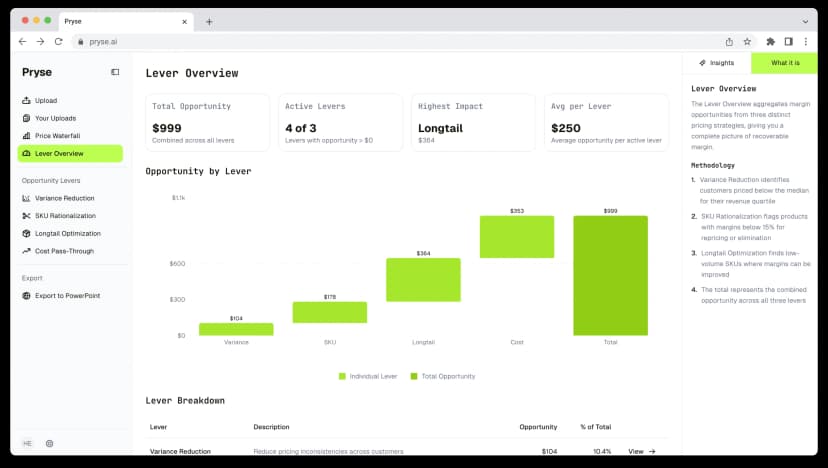
What it is: Upload transaction data as a CSV, and Pryse delivers a price waterfall analysis, margin leakage detection, and dollar opportunity quantification within 24 hours. No implementation, no integration.
Who it is for: Mid-market companies ($20M-$200M revenue) that are managing pricing in Excel or basic ERP systems and want to understand where they are losing margin before committing to an enterprise platform or consulting engagement.
Key strengths: 24-hour turnaround, $999/year, zero implementation effort, and focused specifically on the margin leakage problems that plague distribution and manufacturing — inconsistent discounting, cost-plus erosion, and pocket price leakage.
Key weaknesses: Not a pricing platform. No ongoing optimization, no CPQ, no rebate management, no ERP integration. It is a diagnostic, not a replacement for Vendavo. Limited to CSV-based analysis.
Pricing model: $999/year.
Best for: Companies that want to quantify their pricing opportunity before investing in an enterprise platform. Use it to build the business case for Vendavo, PriceFx, Zilliant, or internal pricing improvements.
5. SPARXiQ
SPARXiQ has been working with distributors and manufacturers on pricing for over 30 years, combining analytics software with consulting and sales training.
What it is: PriceGPS (pricing analytics that integrates directly with major ERPs), consulting services, and sales training — all focused on the distribution and manufacturing sectors. SPARXiQ's Profit Diamond framework analyzes profitability across customers, products, and channels.
Who it is for: Industrial distributors and manufacturers that want pricing guidance embedded in their ERP workflow. SPARXiQ integrates with Epicor Prophet 21, Eclipse, Infor, SAP, Oracle, and other distribution ERPs.
Key strengths: 30 years of distribution-specific expertise, ERP-native pricing guidance (not a separate system to manage), the Profit Diamond profitability framework, ContractGPS for contract pricing management, and sales training to help reps hold pricing. Claims 2-4% gross margin improvement.
Key weaknesses: Narrow industry focus — exclusively distribution and manufacturing. Less sophisticated AI and optimization than enterprise platforms like Vendavo. Not suitable if you need CPQ or rebate management. The technology is more "guidance within ERP" than "standalone pricing platform."
Pricing model: Software licensing plus consulting fees. Not publicly disclosed.
Best for: Distributors and manufacturers that want pricing analytics integrated directly into their ERP and prefer a sector specialist over a generalist platform.
6. Oracle CPQ + Pricing
For companies in the Oracle ecosystem, Oracle's own pricing and CPQ capabilities may be the path of least resistance.
What it is: Oracle CPQ Cloud provides configure-price-quote capabilities, with pricing functionality available across Oracle E-Business Suite, Oracle Cloud ERP, and Oracle Commerce. Oracle's pricing covers list pricing, tiered discounts, contract pricing, and promotional pricing within the broader ERP ecosystem.
Key strengths: Native integration with Oracle ERP and Cloud, strong CPQ capabilities, no third-party vendor to manage, and access to Oracle's broader data and analytics platform.
Key weaknesses: Oracle's pricing optimization capabilities are less sophisticated than dedicated pricing platforms. The ecosystem can be rigid and expensive to customize. AI-driven price optimization and margin analytics are not at the level of dedicated pricing vendors.
Pricing model: Included in Oracle licensing or as additional modules.
Best for: Companies heavily invested in Oracle that want to avoid third-party pricing tools and whose needs are more about consistent price execution than AI-driven optimization.
7. DealHub
DealHub takes a different approach — it is a revenue platform focused on the quoting and deal management side of pricing, rather than back-end price optimization.
What it is: A CPQ, CLM (contract lifecycle management), and billing platform that helps sales teams create accurate quotes, manage deals, and handle subscriptions. DealHub focuses on the front-end sales experience rather than back-end price optimization.
Who it is for: Companies whose primary pricing pain is in the quoting and deal management process rather than in setting and optimizing base prices. Particularly relevant for B2B companies with complex quoting workflows.
Key strengths: Strong user experience for sales reps, good CRM integration (particularly Salesforce and HubSpot), contract management capabilities, and subscription billing support. Less complex to deploy than a full pricing optimization platform.
Key weaknesses: Not a price optimization tool. Does not provide margin analytics, price waterfall analysis, or AI-driven pricing recommendations. If your problem is that you do not know the right price, DealHub does not solve that — it helps you quote and manage deals once you know the price.
Pricing model: Subscription-based. Not publicly disclosed.
Best for: Companies whose pricing challenge is primarily about quoting efficiency, deal management, and contract handling rather than price setting and optimization.
How to Choose the Right Alternative
The alternatives on this list serve fundamentally different needs. Choosing the right one starts with understanding what you are actually trying to solve.
If you want a direct Vendavo replacement, PriceFx and PROS are the closest competitors. PriceFx for a more modern, cloud-native experience. PROS for the broadest enterprise capability and AI depth.
If you are a distributor or manufacturer, Zilliant and SPARXiQ both focus on your industry. Zilliant is the platform play with AI optimization. SPARXiQ is the ERP-integrated guidance play with 30 years of sector expertise.
If you are not sure you need a platform yet, Pryse gives you a diagnostic in 24 hours that quantifies your margin leakage. It costs less than a single month of most enterprise pricing subscriptions and tells you whether the opportunity justifies a bigger investment.
If your problem is quoting, not pricing, DealHub or a CPQ-focused solution may be what you actually need, even though it is a different category than Vendavo.
If you are locked into an ERP ecosystem, check what your ERP vendor already offers before adding another platform. Oracle and SAP both have pricing capabilities that, while less sophisticated than dedicated tools, avoid the integration tax of a third-party solution.
Last updated: March 12, 2026
Frequently Asked Questions
Want to analyze your entire product catalog?
Pryse automatically identifies margin leakage across thousands of SKUs. Upload your data and find hidden profit in 24 hours.
$999/year. Cancel anytime.